
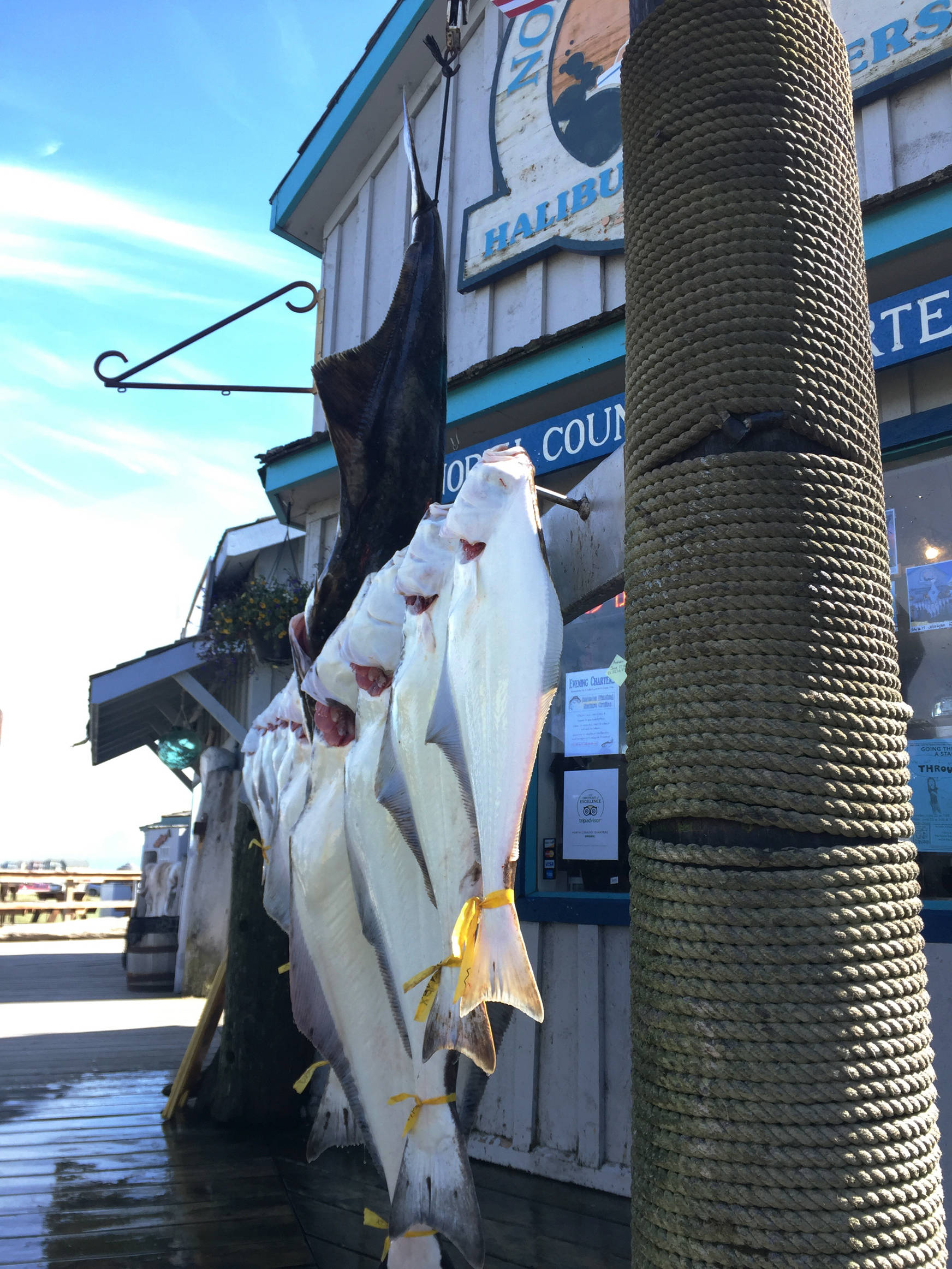
A pair of University of Alaska researchers want to know more about how halibut charter fishermen in the state carry out their trips.
Halibut have long been a popular sportfish all along the coasts of Alaska, as well as supporting a valuable commercial fishery. While the commercial fishery is well-surveyed and documented annually by the National Marine Fisheries Service, with supplementary research from the Alaska Department of Fish and Game and other academic and nonprofit science researchers, the recreational fishery is less well-documented.
Maggie Chan, a doctoral candidate at University of Alaska Fairbanks, wants to provide more context about how charter businesses have operated over the past few decades.
“It seems like recreational charters get left out of a lot of research,” she said.
Focusing on charter operations Sitka and Homer, two of the largest communities for halibut fishing, Chan and professor Anne Beaudreau interviewed 53 charter captains in 2014 and 2015, ultimately focusing on 46. They asked the fishermen to indicate their regular fishing grounds over time, beginning in the 1990s, to see how they changed.
In Homer, it turns out fishermen started staying closer to port as fuel prices increased in the 2010s, expanding southward in the early 2000s and retracting again in the late 2000s. The highest concentration of fishing trips between 2010 and 2015 concentrated in the areas along the coast between Bluff Point and around the outer coast to Elizabeth and Perl islands south of Port Graham, according to Chan and Beaudreau’s study, published in the scientific journal PLOS One.
In Sitka, it was the opposite — as regulations changed and halibut abundance changed, the area covered by charter operators expanded as they were spurred to go further from port.
“Homer and Sitka showed opposite trends in core fishing location area over time, with an overall decrease in Homer and an overall increase in Sitka,” the study states.
Homer operators were also impacted by business owners’ choice to include package trips as an option, with a variety of species targets and varying lengths of trips. In Homer, it’s common to see half-day charters offered alongside full-day or multi-day trips, with the option to fish for halibut, lingcod, rockfish, king salmon or multiple types of fish.
Chan said the researchers heard about Homer businesses’ variety of offerings and said it helps buffer them from fluctuations in the regulations or availability of halibut.
“The charter industry is incredibly adaptable and resilient … it’s this creativity to be successful businesses,” she said.
Over time, though, things have changed for both locations. In Sitka, the charter operators are heavily dependent on out-of-state clients landing in cruise ships, where the cruise industry has grown dramatically since the 1990s. Homer does not see the cruise ships Sitka does, but more clients are tourists than locals there as well, Chan said. The regulations have tightened over time as halibut stocks have declined, allowing recreational fishermen to retain fewer fish, which may deter more Alaska residents from taking an expensive charter trip if they can keep less fish, she said.
The paper, published June 20, is planned to be the first of several looking at the charter industry, she said. She related it to “laying down a picture frame” for looking at the charter industry as a whole and providing information about the potential impacts of regulations on other fish species. For instance, if halibut are more restricted and more Homer charter fishermen target rockfish and lingcod, it could affect those stocks, on which there is less information available.
Marine recreational fishing is a major pressure on fisheries — in 2015, anglers took about 61 million saltwater fishing trips, landing 351 million fish, according to the National Marine Fisheries Service. In Homer, halibut in particular are highly targeted, especially with the high-value Homer halibut derby that runs between May 15 and September 15 every year.
The goal is just to better understand charter fisheries, Chan said.
“We don’t always talk about how individuals can affect fisheries,” Chan said. “…We’re really trying to focus on the human aspect and their ability to help affect the environment as well.”
Reach Elizabeth Earl at elizabeth.earl@peninsulaclarion.com.
