
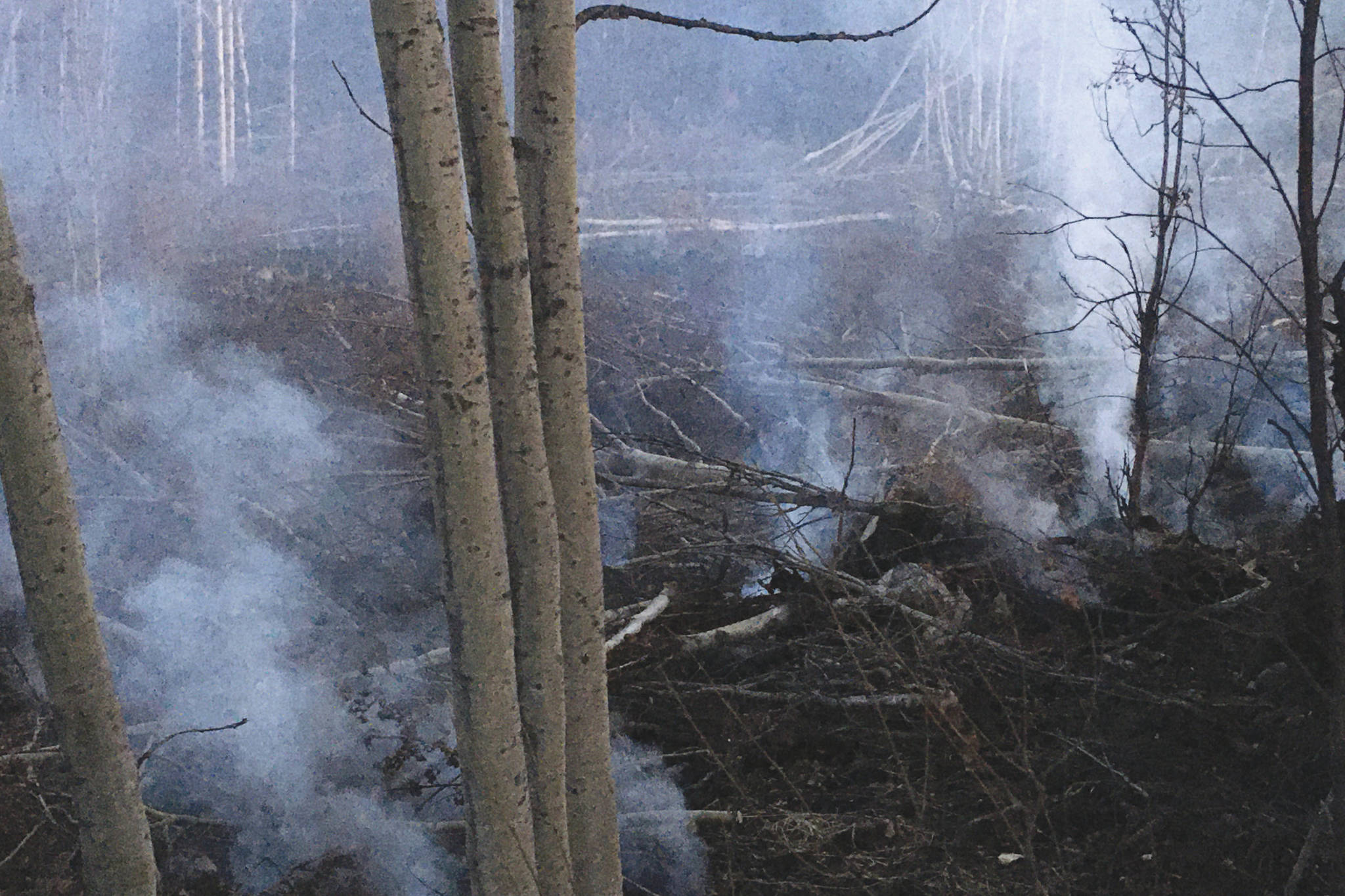
Smoke can be seen rising from areas scarred by the Swan Lake Fire on Sunday, Oct. 6, 2019 at Mile 10 of Skilak Loop Road, on Alaska’s Kenai Peninsula. (Photo by Jeff Helminiak/Peninsula Clarion)

Smoke can be seen rising from areas scarred by the Swan Lake Fire on Sunday, Oct. 6, 2019 at Mile 10 of Skilak Loop Road, on Alaska’s Kenai Peninsula. (Photo by Jeff Helminiak/Peninsula Clarion)

Study finds scientific evidence of “zombie fires” in Alaska, Arctic

Zombie fires in boreal forests are associated with hot summers and deep burning into organic soil.

Climate change puts boreal forests at risk for “zombie” or holdover fires, which smolder after fire season and flare up the following spring. That’s according to a study published last month in the peer-reviewed journal Nature. The study was led by researchers at Vrije Universiteit Amsterdam in the Netherlands and co-authored by researchers at the University of Alaska Fairbanks and the U.S. Bureau of Land Management’s Alaska Fire Service.

Researchers studied boreal forests in Alaska and Canada, which are categorized by deep and organic soil, which is favorable for smoldering. Those conditions, exacerbated by climate change, may create “unusually favourable conditions for overwintering,” the abstract says.

Generally, researchers found that overwintering or zombie fires in boreal forests are associated with hot summers and deep burning into organic soil, which is becoming more common in recent decades in the geographies studied.

“Our results are based on an algorithm with which we detect overwintering fires in Alaska, USA, and the Northwest Territories, Canada, using field and remote sensing datasets,” the study abstract says. “Between 2002 and 2018, overwintering fires were responsible for 0.8 per cent of the total burned area; however, in one year this amounted to 38 per cent.”

Being able to predict overwintering fires, it says, could reduce carbon emissions and costs to firefighting costs if used by fire management agencies.

According to the study abstract, forest fires are generally viewed in the context of one fire season, however, some fires show “overwintering” behavior, meaning they continue to smolder beyond fire season and flare the next spring.

At least two zombie fires, or holdover fires, have been reported as the result of the 2019 Swan Lake Fire. That fire, which burned for almost four months on both sides of the Sterling Highway, burned more than 167,000 acres.

According to the Alaska Division of Forestry, the first holdover fire from the Swan Lake Fire was reported on June 15, 2020 near Milepost 66.5 of the Sterling Highway. That fire was a 10-by-10-foot hot spot that took firefighters about 10 minutes to extinguish.

The second holdover fire was reported a few weeks later near Milepost 68, in the Kenai National Wildlife Refuge. As of June 26, 2020, firefighters estimated that it was about 7.2 acres and not expected to grow in size. At least 20 firefighters responded to the fire, which rose from the Swan Lake Fire burn scar.

According to a UAF release, overwintering fires are still relatively rare and account for about 1% Alaska and Canada’s total burn area. However, temperatures in the Arctic are expected to increase more quickly than in other parts of the world, with early snowpack melts already being reported in Alaska.

The Alaska Division of Forestry encourages residents to adopt Firewise principles and to adhere to burn permits, which can be accessed on their website.

More information about the study can be found in Nature or on UAF’s website at news.uaf.edu.

Reach reporter Ashlyn O’Hara at ashlyn.ohara@peninsulaclarion.com.

More in News

David Ross is sworn in as Kenai Police Chief on Tuesday, May 31, 2016 at Kenai City Hall. The Alaska Association of Chiefs of Police named Ross the 2025 Police Chief of the Year, recognizing over two decades of service. Photo by Megan Pacer/Peninsula Clarion
Kenai police chief named 2025 Police Chief of the Year

The Alaska Association of Chiefs of Police recognized David Ross for his more than two decades of leadership.

The cast of Nikiski Middle School’s upcoming performance of “Alice in Wonderland” is pictured on Dec. 2, 2025. The upperclassmen-directed play opens on Friday, with additional showtimes Saturday and next weekend. Photo courtesy of Carla Jenness
Nikiski Middle School debuts student-led “Alice in Wonderland”

The show opens on Friday, with additional showtimes this weekend and next.

On Tuesday, the Kenaitze Indian Tribe unveiled Kahtnu Area Transit, a public transportation service open to the entire Peninsula Borough community. Photo courtesy of Kahtnu Area Transit
Kenaitze Indian Tribe unveils Kahtnu Area Transit

The fixed bus route offers 13 stops between Nikiski and Sterling.

The Kenai Chamber of Commerce and Visitor Center hosts the annual Christmas Comes to Kenai on Nov. 28<ins>, 2025</ins>. The beloved event began over 40 years ago, and this year over 1,000 attendees enjoyed hot chocolate, fireworks, pictures with Santa and shopping. Photo courtesy of the Kenai Chamber of Commerce
 Photo courtesy of the Kenai Chamber of Commerce
The Kenai Chamber of Commerce and Visitor Center hosted the annual Christmas Comes to Kenai on Nov. 28. The beloved event began over 40 years ago, and this year over 1,000 attendees enjoyed hot chocolate, fireworks, pictures with Santa and shopping.
Kicking off a month of holiday festivities

Last weekend’s holiday events, including the annual Christmas Comes to Kenai and the Soldotna Turkey Trot, drew folks from all over the Kenai Peninsula.

Starting Dec. 2, Aleutian Airways will offer roundtrip flights between Anchorage and Unalakleet every Tuesday, Friday and Sunday.
Aleutian Airways to offer roundtrip flights between Anchorage and Unalakleet

Starting Dec. 2, Aleutian Airways will offer three roundtrip flights per week.

The Trump administration’s “Big Beautiful Bill” act requires the Bureau of Ocean Energy management to hold at least six offshore oil and gas lease sales in Alaska between 2026-2028 and 2030-2032. The first of these sales — known as “Big Beautiful Cook Inlet 1,” or BBC1— is scheduled for March 2026. Photo courtesy of the Bureau of Ocean Energy Management
Cook Inletkeeper launches petition against federal government

The organization is calling for transparency in Cook Inlet offshore oil and gas sales.

Winter dining has always carried more weight than the menu might suggest. In the off-season, eating out isn’t just about comfort food or convenience; it’s a way of supporting local businesses as they hold steady through the slower months. Photo credit: Canva.
The ripple effect: How local spending builds stronger communities on the Kenai Peninsula

From cozy cafés to fine-dining bistros, purchases made close to home sustain local jobs and services

Courtesy Harvest
On the Kenai Peninsula, a dormant liquefied natural gas export plant could be repurposed to receive cargoes of imported LNG under a plan being studied by Harvest, an affiliate of oil and gas company Hilcorp. The fuel would be transferred from ships to the tanks on the left, still in liquid form, before being converted back into gas and sent into a pipeline.
Utilities say Alaska needs an LNG import terminal. Consumers could end up paying for two.

Planning for two separate projects is currently moving ahead.

A map shows the locations of the 21 Alaska federal offshore oil and gas lease sales proposed by the Trump administration. (Map provided by the U.S. Bureau of Ocean Energy Management)
Trump administration proposes offshore leasing in almost all Alaska waters

A new five-year offshore oil and gas leasing plan proposes 21 sales in Alaska, from the Gulf of Alaska to the High Arctic, and 13 more off the U.S. West Coast and in the Gulf of Mexico.

Most Read