
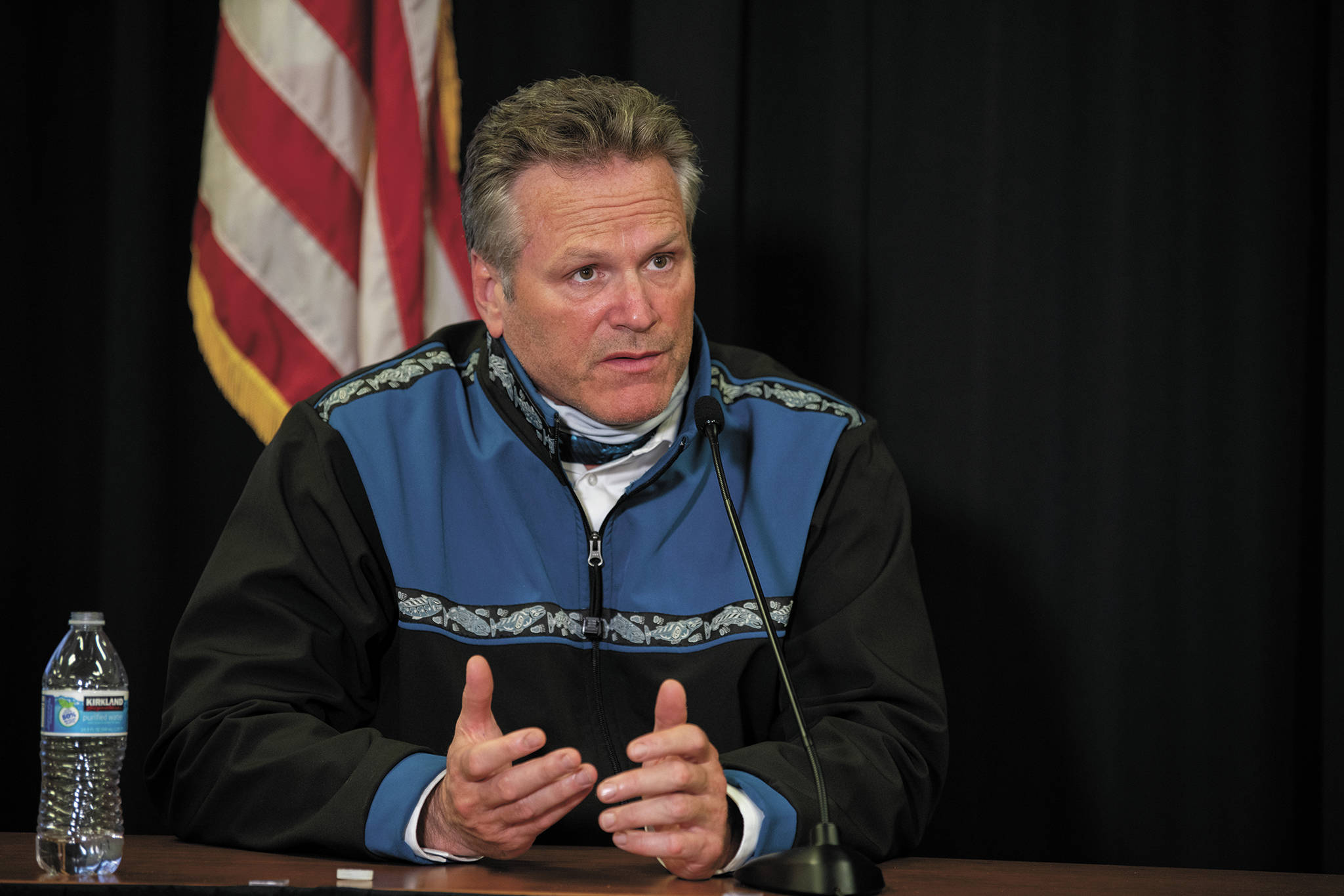
Gov. Mike Dunleavy’s administration announced a host of new equipment purchases on Wednesday that are meant to help slow the rate of COVID-19’s spread around the state, as hospital capacity becomes a concern.
Dunleavy held a press conference Wednesday evening with state officials, including Chief Medical Officer Dr. Anne Zink and Alaska Department of Health and Social Services Commissioner Adam Crum. Earlier in the day, Dunleavy’s office announced several new purchases of testing and personal protective equipment, as well as plans to bolster state health care and pandemic response infrastructure.
The state reported 353 new cases of COVID-19 on Wednesday, as well as one new death — a woman from the northern Kenai Peninsula in her 80s. Hospitalizations are the highest they’ve been in Alaska since the start of the pandemic, but Dunleavy said during the press conference that the rate of hospitalizations is not rising at the same rate as new cases.
On Wednesday, 100 out of 130 adult ICU beds statewide were taken, as were over half of adult non-ICU inpatient beds. To help provide relief to the state’s health care sector, and to tackle emerging clusters of the virus in rural Alaska, the state is planning to open a new commercial testing lab, prepare more alternate care sites around the state and expand contact-tracing staff. The state is also purchasing 3.5 million pairs of gloves for hospitals and clinics and 50 new rapid test machines to be used on cluster response.
Dunleavy said an order Alaska had made from Abbott Laboratories has been moved up, and the state will soon be getting 189 additional rapid test machines that it had ordered along with 186,000 tests.
The state also plans to set up a new testing site in Nome, expand testing in schools and has launched a website to help connect workers qualified in the health care field with licenses facilities and service providers. This is a partnership between DHSS’ Senior and Disabilities Services Division and the nonprofit organization ADvancing States.
Crum said this program can help long-term service providers stay staffed in the event that their employees have to take time off to quarantine.
“We still need to provide care to some of these patients,” Crum said. “So this is connecting to make sure that health care professionals in Alaska can go to work, can continue that process, this level of care is provided.”
No other mitigation measures were announced Wednesday beyond the equipment purchases and plans for increased infrastructure. Dunleavy encouraged Alaskans to continue doing their part to reduce the spread of COVID-19, but again reiterated that he feels health mandates, such as a requirement to wear masks, should be done at the local level. Some municipalities in the state have the legal ability to enact those health powers, while others don’t.
Asked at what point the administration would consider reinstating previous social restrictions, such as limits on gathering size or movement around the state, if health care capacity gets too stressed, Dunleavy said “nothing’s been taken off the table.”
Dunleavy said his administration will continue to watch metrics such as hospitalization rates, length of hospital stays, and inpatient and ICU bed capacity.
“It’s math,” he said. “(If) the numbers keep increasing, that math can translate into more beds being occupied, and that’s what we’re going to keep an eye on,” he said. “And if it looks like it’s getting ahead of us, this virus, then we’ll have a discussion as to what mitigating events, procedures, etc. that we have to take to slow this down. So nothing’s off the table.”
The state’s disaster emergency declaration is set to expire on Nov. 15. The governor’s declaration can only stay in effect for 30 days unless extended by the Legislature, as happened in March.
During the press conference, Dunleavy reiterated the sentiment shared by his office earlier this week that it has not yet been decided whether the declaration will be allowed to expire. He said discussions are currently taking place about what exactly Alaska needs to combat the virus moving forward, and whether that includes the provisions provided by the emergency declaration.
“For the most part, we believe that the tools we have available to us, and we still have available to us, are going to help up manage the virus,” Dunleavy said.
He said more announcements regarding the fate of the emergency declaration with happen next week.
Reach Megan Pacer at mpacer@homernews.com.
