
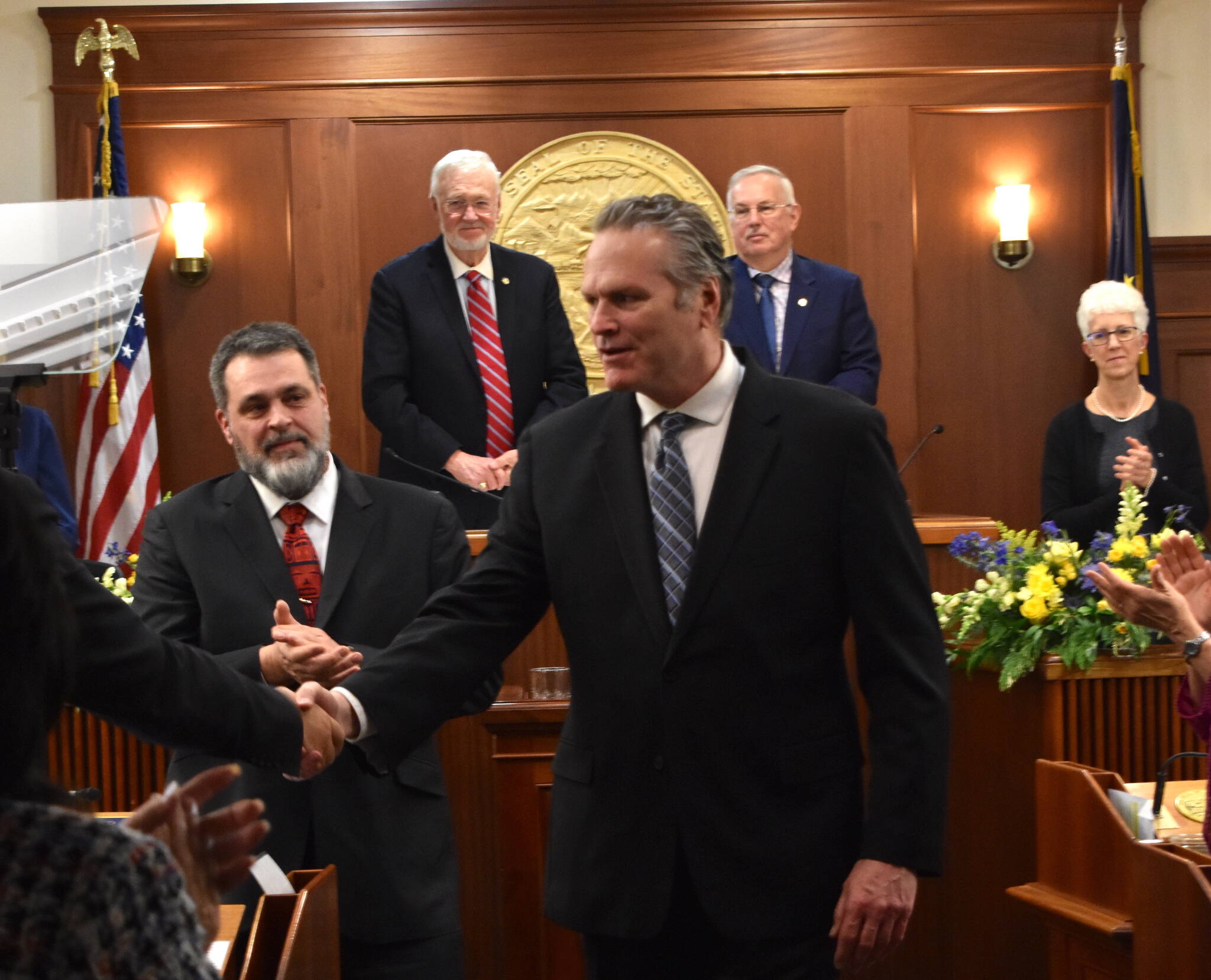
Gov. Mike Dunleavy delivered his eighth and final State of the State address last Thursday evening, closing out his tenure in the term-limited office. The speech highlighted past accomplishments and offered only broad outlines of his long-promised fiscal plan.
Much of the 80-minute address focused on what Dunleavy described as successes of his administration, alongside renewed emphasis on a proposed liquefied natural gas pipeline as a long-term solution to Alaska’s budget woes.
“This is my 26th governor’s address, and I’ve got to say this is probably one of the longer ones,” said Senate President Gary Stevens, a Kodiak Republican. “But it was very good. I really appreciate all the things governor had to say.”
Still, lawmakers said they were left wanting more specifics when it came to how the governor plans to close the budget gap.
A fiscal plan
The budget is the biggest issue of the session, Dunleavy said throughout his speech.
Alaska’s government has, for the past decade, struggled to keep its operating costs below revenue. Alaska’s primary source of general-purpose revenue is the Permanent Fund, measuring at about 60%, followed by 30% coming from oil.
Dunleavy released his proposed budget for fiscal year 2027 in December, calling for a full Permanent Fund Dividend of $3,650 per Alaskan while projecting a deficit of $1.5 billion.
Since then, the governor has promised a more detailed fiscal plan to address the gap. Dunleavy did not outline a concrete plan during Thursday’s speech, but said his fiscal plan for the near future is meant to bridge the gap until the state taps into more fuel revenue from the North Slope.
“This fiscal plan recognizes that in the next five years, current revenues may not be enough to fund the government, especially with low oil prices,” Dunleavy said.
He also promised that “the Permanent Fund and the Dividend will be protected.”
At a televised cabinet meeting Wednesday, he said his administration was considering a temporary, seasonal sales tax and planned to put that concept forward for discussion with the Legislature. He made no mention of the sales tax during the State of the State.
Following the address, Stevens said he was hoping that the governor would have mentioned more specifics of the fiscal plan.
“We’re anxious to hear more from the governor,” Stevens said. “We need to have a lot of answers, and we need to know specifically what the bills are he’s introducing, what the ramifications are, how it affects us, and we really will get into the details then. But there’s a lot to do, a lot to do in one session.”
House leadership said the chamber received two bills on Thursday pertaining to the governor’s fiscal approach that were expected to be will read at the House Finance committee Friday afternoon.
One of the bills would establish a statutory spending limit, and another proposes combining the Permanent Fund into a single endowment and protect it in the state constitution, said Speaker of the House Bryce Edgmon, I-Dillingham.
Edgmon said he is not optimistic about passing a comprehensive budget bill this session.
“This is the eighth year that the governor has put a budget in front of the legislature with an over billion dollar deficit yet to be contrasted this session with a fiscal plan that is going to be very controversial that none of us have seen yet,” Edgmon said. “It’s complicated. It’s a huge lift.”
LNG pipeline
Dunleavy framed the potential Alaska LNG pipeline as central to the state’s financial future.
“Our long-sought goal to transport stranded natural gas off the North Slope is closer to reality than ever,” Dunleavy said.
Dunleavy said the energy company Glenfarne has moved into the execution phase of the project. The company announced new agreements totaling $10 billion with Alaska-based companies ASRC, Doyon, and Cruz Construction for pipeline construction and project management.
They also and announced agreements with Hilcorp and ExxonMobil to supply gas to the pipeline, Dunleavy said.
The governor argued that new fuel production, anticipated gas pipeline exports and growth of the Permanent Fund could eventually provide revenue to fund state government starting in 2032.
The Senate Resources Committee was scheduled to begin hearings on the gasline Friday afternoon, with additional meetings planned over the next three weeks.
“If a bill shows up and it’s assigned to us, we will begin dissecting it,” said Senate Majority Leader Cathy Giessel, R-Anchorage.
Reflections on past and future
Dunleavy spent much of his address reflecting on his eight years in office, stating that he has served the will of the people.
“It’s because of you, the people, that I have never lost an election, and it hasn’t really been close,” Dunleavy said. “Despite what the media says, despite what the political pundits say, despite what my detractors say, the ideals I stand for, and campaigned on, are what the majority of the Alaskans chose.”
Dunleavy is the first governor since 1998 to win two back-to-back elections.
Crime reduction was a major point of pride for Dunleavy. Since 2018, Dunleavy cited that Alaska’s overall crime rate has declined by over 40%. He acknowledged that Anchorage has a violent crime rate three times the national average. He said he has made it a priority to clear the backlog of DNA samples from sexual assault cases.
Among other strengths in the past decade, he also pointed to the Alaska Housing Finance Corporation housing nearly 4,000 residents, cooperation with the Trump administration on resource development efforts for the state, and increased reading literacy following passage of the READS Act in 2022.
“I think he took a lot of credit for things that are occurring around the state, which most governors do,” Edgmon said. “And in the end, it was definitely a mix of aspirational and … looking into the future.”
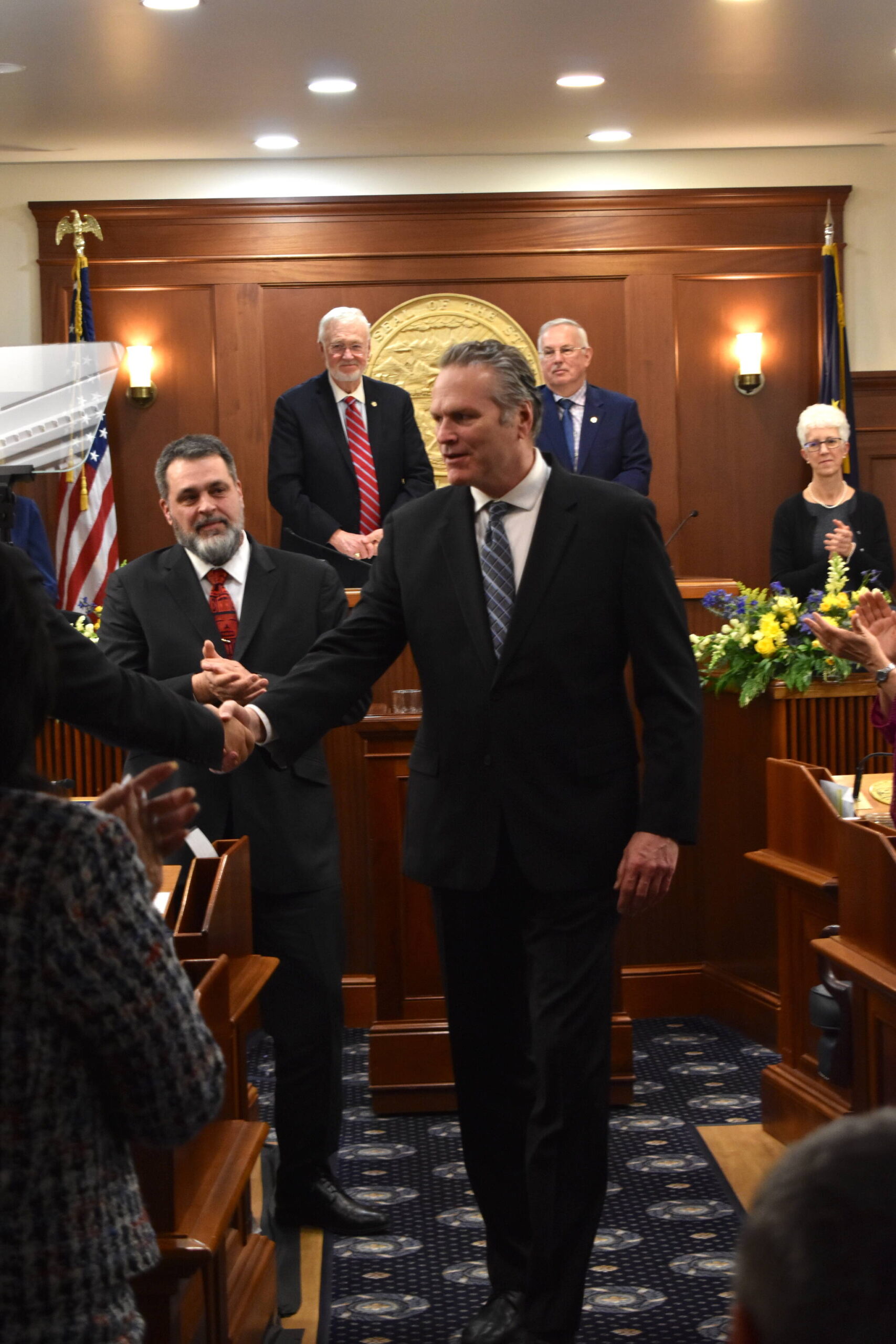
Photos by Mari Kanagy/Juneau Empire Governor Dunleavy shakes hands with a representative as he exits from his final State of the State address on Thurday, Jan. 22.
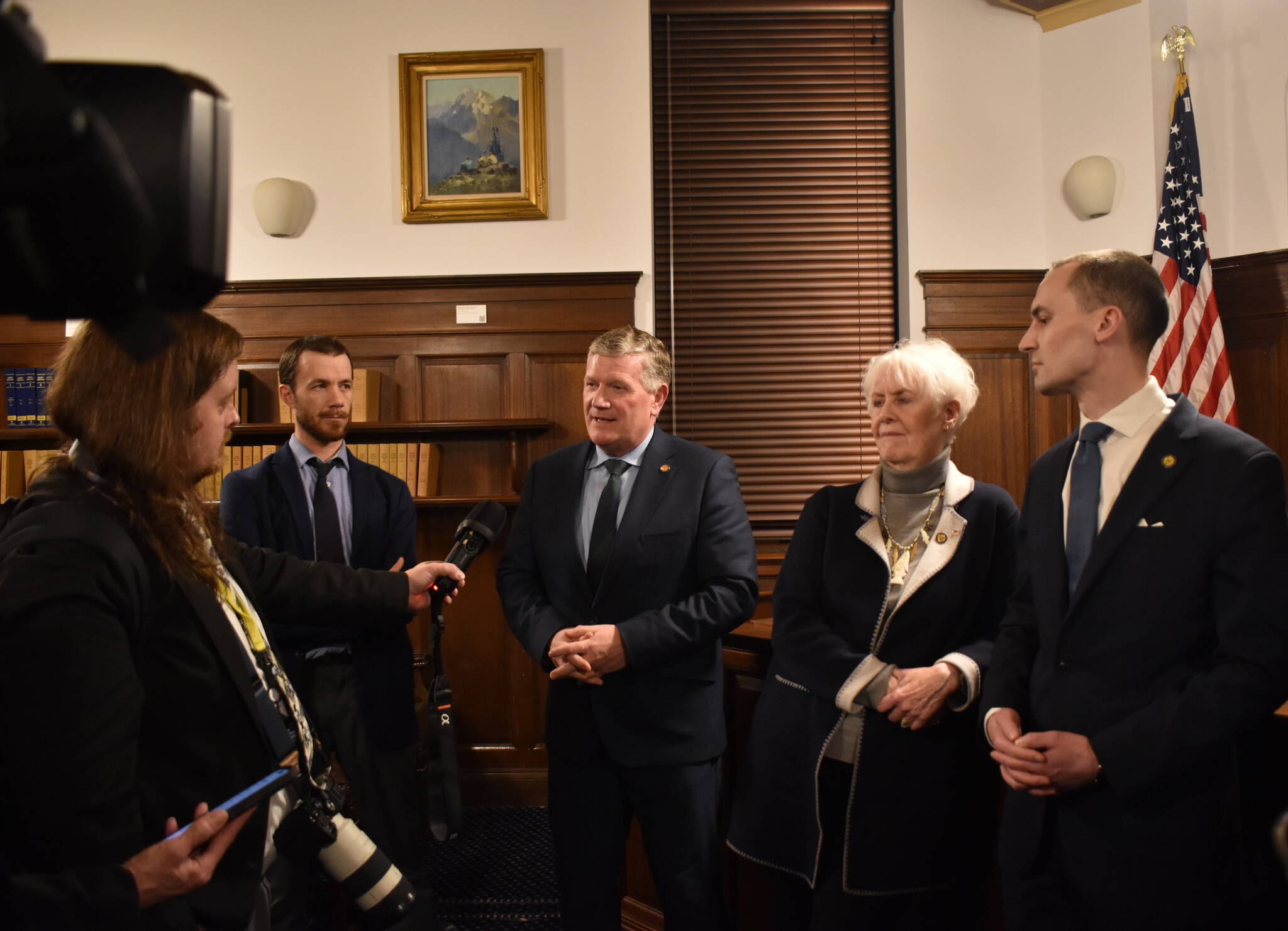
Mari Kanagy/Juneau Empire Representative Zack Fields, House Majority Leader Chuck Kopp, Representative Louise Stutes and Speaker of the House Bryce Edgmon answer question from the press following Governor Mike Dunleavy’s State of the State address on Thurday, Jan. 22.
