
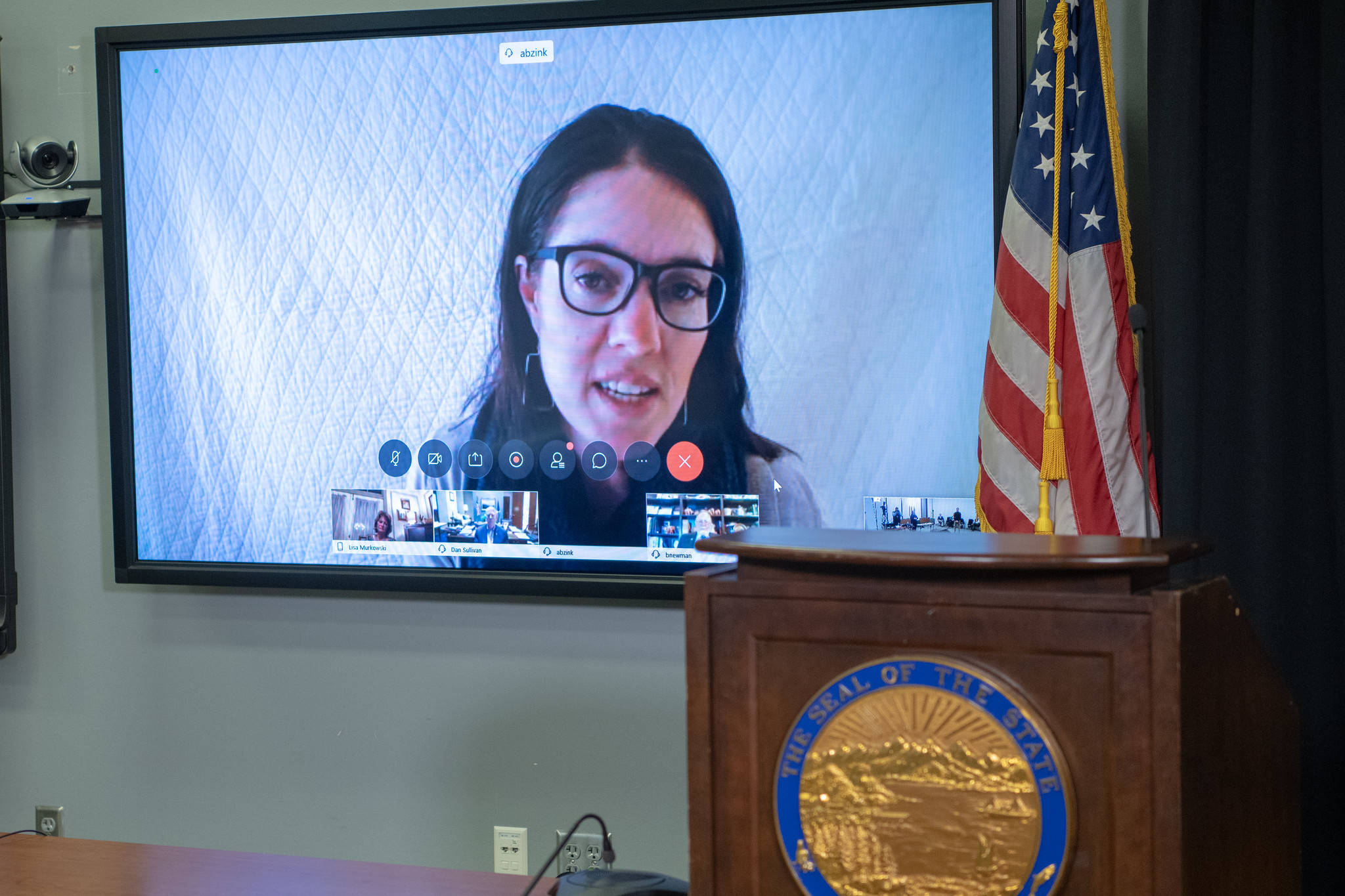
Chief Medical Officer Dr. Anne Zink participates via teleconference in the state’s daily press briefing on the new coronavirus on Monday, March 30, 2020. (Courtesy photo)

Chief Medical Officer Dr. Anne Zink participates via teleconference in the state’s daily press briefing on the new coronavirus on Monday, March 30, 2020. (Courtesy photo)

State changes website, COVID-19 reporting

The state’s case daily count will be based on the numbers reported as of 11:59 p.m. the previous day.

The State of Alaska has changed the way it is reporting the COVID-19 outbreak within the state and has rolled out a new website to reflect those changes.

During a Thursday night press conference, Chief Medical Officer Dr. Anne Zink went into detail about the changes in the state’s COVID-19 reporting while also providing information on the scientific models being used for case count projections. Zink also discussed the state’s supply of personal protective equipment.

Before Zink’s presentation on the state’s new website, Gov. Mike Dunleavy gave an update on the current case count for Alaska. Dunleavy initially reported that the total case count was at 151 confirmed positive, but Zink clarified later in the press conference that the total as of 11:59 p.m. Wednesday was 147. The discrepancy in the numbers, Zink explained, was because of the changes in how they are being reported, which went into effect Wednesday night.

The state’s case count moving forward, Zink said, would be based on the numbers reported by the Division of Health and Social Services as of 11:59 p.m. the previous day. Previously, the numbers announced at the governor’s nightly press conference were based on DHSS reports as of 3 p.m. that day.

Three new cases were identified between Wednesday night’s press conference and the new deadline of 11:59 p.m., which brought the total to 147. In addition, Kenai Peninsula Borough Incident Commander Dan Nelson told the Clarion on Thursday that a second Seward resident had been confirmed positive for the disease. This case was not included in the state’s latest numbers because it had been reported after the 11:59 p.m. deadline.

Nine peninsula residents in total have been confirmed positive for the disease as of Thursday night — two in Seward, two in Homer, two in Soldotna, two in Sterling and one in Kenai.

Thirteen people have been hospitalized by the illness, which includes the two patients who have died within the state. Three Alaskans in total have died from the disease, including one Alaska resident who was out of state when they died.

As of Thursday, 5,330 Alaskans have been tested, Dunleavy said. Zink said that the state is working on increasing the testing capabilities within the state, including by giving rural health centers the capacity to process tests, not just collect samples.

“A huge focus for us has been to get testing available to all Alaskans as close as possible to home,” Zink said.

The state also modified the decision that was announced Wednesday restricting bear hunting in the spring. Dunleavy said Alaskans would still be allowed to go bear hunting, but the season is still closed to nonresidents. All hunting activities, other than subsistence, must still conform with the intrastate travel health mandate, which limits in-state travel between communities, according to an April 2 press release from the Alaska Department of Fish and Game. General hunting, including bear hunting, has not been identified as a critical personal need in the context of the travel mandate.

Zink said during Thursday night’s press conference that new information is constantly coming out about COVID-19, and some new data shows additional symptoms beyond what were previously reported. Zink said that patients have reported losing the inability to smell or taste and older patients have reported nausea, vomiting and diarrhea. Reports have shown that the virus can remain on stainless steel and plastic surfaces for several hours and linger in the air after someone sneezes. Zink noted that experts initially thought the virus did not linger on surfaces.

“This is something that’s been very humbling as we continue to learn more about the disease,” Zink said.

In Alaska, about 2% of the tests being collected are coming back positive for the disease, Zink said. Alaska also has the fewest total cases of any other state and is in the top 10 for tests completed per capita.

“The work that Alaskans are doing to flatten the curve is tremendous,” Zink said.

The tests currently being conducted by the state look for the presence of the specific strain of the coronavirus that causes COVID-19, but Zink said that methods of serology testing are currently being developed on a national level that will better assess the spread of the disease within communities. Serology tests, Zink said, look for the presence of antibodies made in response to infections, so those tests would be able to determine if someone has been in contact with the virus even if they didn’t contract the disease.

Visit the State’s new COVID-19 Dashboard here.

More in News

David Ross is sworn in as Kenai Police Chief on Tuesday, May 31, 2016 at Kenai City Hall. The Alaska Association of Chiefs of Police named Ross the 2025 Police Chief of the Year, recognizing over two decades of service. Photo by Megan Pacer/Peninsula Clarion
Kenai police chief named 2025 Police Chief of the Year

The Alaska Association of Chiefs of Police recognized David Ross for his more than two decades of leadership.

The cast of Nikiski Middle School’s upcoming performance of “Alice in Wonderland” is pictured on Dec. 2, 2025. The upperclassmen-directed play opens on Friday, with additional showtimes Saturday and next weekend. Photo courtesy of Carla Jenness
Nikiski Middle School debuts student-led “Alice in Wonderland”

The show opens on Friday, with additional showtimes this weekend and next.

On Tuesday, the Kenaitze Indian Tribe unveiled Kahtnu Area Transit, a public transportation service open to the entire Peninsula Borough community. Photo courtesy of Kahtnu Area Transit
Kenaitze Indian Tribe unveils Kahtnu Area Transit

The fixed bus route offers 13 stops between Nikiski and Sterling.

The Kenai Chamber of Commerce and Visitor Center hosts the annual Christmas Comes to Kenai on Nov. 28<ins>, 2025</ins>. The beloved event began over 40 years ago, and this year over 1,000 attendees enjoyed hot chocolate, fireworks, pictures with Santa and shopping. Photo courtesy of the Kenai Chamber of Commerce
 Photo courtesy of the Kenai Chamber of Commerce
The Kenai Chamber of Commerce and Visitor Center hosted the annual Christmas Comes to Kenai on Nov. 28. The beloved event began over 40 years ago, and this year over 1,000 attendees enjoyed hot chocolate, fireworks, pictures with Santa and shopping.
Kicking off a month of holiday festivities

Last weekend’s holiday events, including the annual Christmas Comes to Kenai and the Soldotna Turkey Trot, drew folks from all over the Kenai Peninsula.

Starting Dec. 2, Aleutian Airways will offer roundtrip flights between Anchorage and Unalakleet every Tuesday, Friday and Sunday.
Aleutian Airways to offer roundtrip flights between Anchorage and Unalakleet

Starting Dec. 2, Aleutian Airways will offer three roundtrip flights per week.

The Trump administration’s “Big Beautiful Bill” act requires the Bureau of Ocean Energy management to hold at least six offshore oil and gas lease sales in Alaska between 2026-2028 and 2030-2032. The first of these sales — known as “Big Beautiful Cook Inlet 1,” or BBC1— is scheduled for March 2026. Photo courtesy of the Bureau of Ocean Energy Management
Cook Inletkeeper launches petition against federal government

The organization is calling for transparency in Cook Inlet offshore oil and gas sales.

Winter dining has always carried more weight than the menu might suggest. In the off-season, eating out isn’t just about comfort food or convenience; it’s a way of supporting local businesses as they hold steady through the slower months. Photo credit: Canva.
The ripple effect: How local spending builds stronger communities on the Kenai Peninsula

From cozy cafés to fine-dining bistros, purchases made close to home sustain local jobs and services

Courtesy Harvest
On the Kenai Peninsula, a dormant liquefied natural gas export plant could be repurposed to receive cargoes of imported LNG under a plan being studied by Harvest, an affiliate of oil and gas company Hilcorp. The fuel would be transferred from ships to the tanks on the left, still in liquid form, before being converted back into gas and sent into a pipeline.
Utilities say Alaska needs an LNG import terminal. Consumers could end up paying for two.

Planning for two separate projects is currently moving ahead.

A map shows the locations of the 21 Alaska federal offshore oil and gas lease sales proposed by the Trump administration. (Map provided by the U.S. Bureau of Ocean Energy Management)
Trump administration proposes offshore leasing in almost all Alaska waters

A new five-year offshore oil and gas leasing plan proposes 21 sales in Alaska, from the Gulf of Alaska to the High Arctic, and 13 more off the U.S. West Coast and in the Gulf of Mexico.

Most Read