
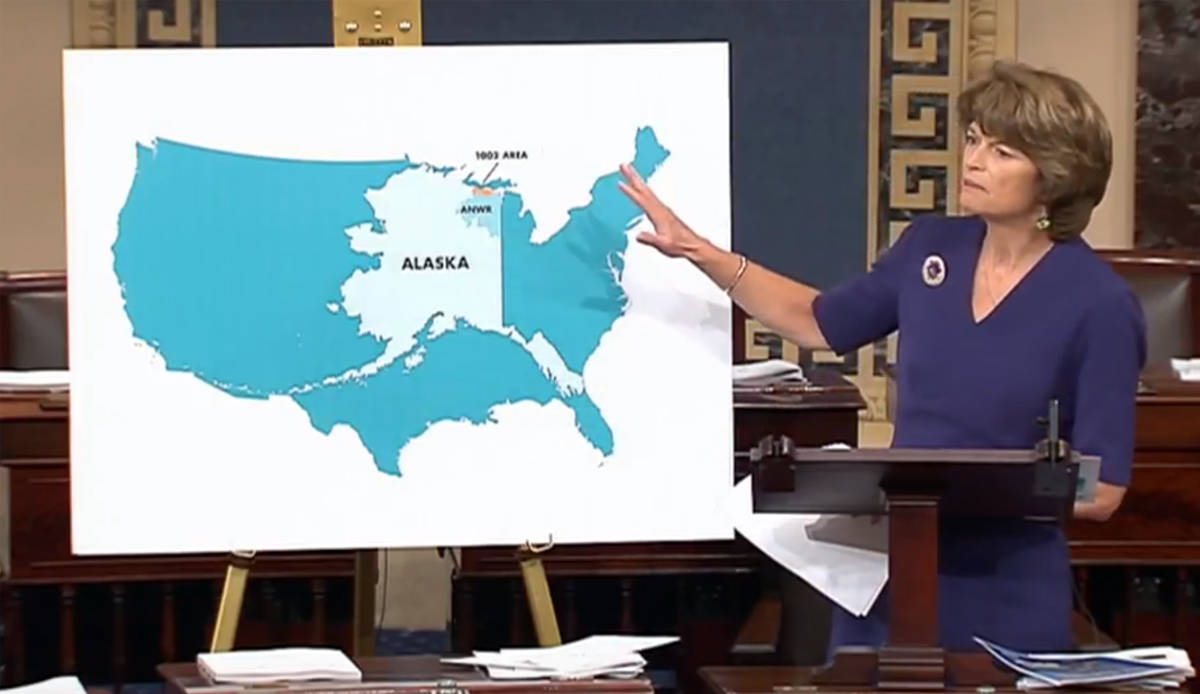
In this Dec. 19, 2017 photo, Sen. Lisa Murkowski, R-Alaska, speaks about oil drilling in the Arctic National Wildlife Refuge during debates about the GOP tax cut on the floor of the U.S. Senate. (C-SPAN)

In this Dec. 19, 2017 photo, Sen. Lisa Murkowski, R-Alaska, speaks about oil drilling in the Arctic National Wildlife Refuge during debates about the GOP tax cut on the floor of the U.S. Senate. (C-SPAN)

State asks Legislature for $10 million to survey ANWR for oil

The administration of Gov. Bill Walker is asking the Alaska Legislature for permission to spend $10 million on seismic surveying in the coastal plain of the Arctic National Wildlife Refuge.

The seismic survey funding was included as part of a supplemental spending request delivered by the state to the Legislature last week. The request, which totals $26 million in additional costs, is to be folded into ongoing work on the state’s operating and capital budgets for fiscal year 2019.

The Senate Finance Committee heard a presentation Monday on the supplemental request, including the funding. State officials said the money would be used to provide better information about the oil and gas below the surface of the little-surveyed coastal plain. The request comes at a critical time for ANWR, the federal government, and for the state, which is grappling with a $2.5 billion annual deficit.

In December, Congress approved a federal budget that calls for oil and gas lease sales in the coastal plain. Estimates by the Department of Interior to Congress indicate as much as $2.2 billion could be earned from the sales of oil and gas leases there. Half of that money would go to the state.

That amount could be increased if the surveys turned up good results.

“Even a small uptick in participation, we would recapture any of the costs we would put in at this point,” Department of Natural Resources Commissioner Andy Mack said.

Sen. Click Bishop, R-Fairbanks, said that if that’s the case, “I’m looking at $10 million and wondering if that’s enough. … I don’t know if we’re ever going to get back there again.”

“I agree, it’s a one-shot deal here,” Mack responded, saying that the first lease sale in ANWR is likely to be the biggest.

Sen. Peter Micciche, R-Soldotna, pointed out that the state’s plan isn’t a zero-risk scenario. If surveys turn up no oil, or oil in smaller amounts than expected, it could actually decrease demand for leases.

“If you were to lease without that knowledge, sometimes folks will take that risk believing that entire area may have the potential,” he said.

This isn’t the first time Alaska has tried to encourage ANWR drilling with seismic surveys. In 2013, then-Gov. Sean Parnell (with help from then-DNR Commissioner Dan Sullivan) proposed spending $50 million of state money on seismic surveying in ANWR — if the federal government participated as a partner.

The Department of the Interior, then controlled by an appointee of President Barack Obama, declined to do so, and the idea died.

John Hendrix is the former general manager of Apache, an independent oil company, and now works as an oil and gas adviser to Walker.

By phone on Monday, he said seismic surveying isn’t cheap. “In the Arctic, where there’s no roads, it could cost anywhere from $40,000 to $100,000 per square mile.”

At those rates, $10 million isn’t a lot of money. For that reason, the state would likely to buy into a partnership with other groups or smaller oil companies to complete a larger survey.

Pitney, speaking to the Empire after Monday’s hearing, said that larger survey would cost much more than the $10 million the administration is prepared to spend right now.

“My understanding a seismic shoot could be as much as $100 million but maybe as little as $60 (million),” she said.

Pitney said the state has been talking with potential partners but does not yet have any agreements.

Hendrix said the cost is high, but he said it makes sense for the state to take a look, then made an analogy to Southeast Alaska.

“It’s just like a fisherman: Would you find a fisherman out there without a sonar?” he asked. “This is just to get the conversation going.”


• Contact reporter James Brooks at james.k.brooks@juneauempire.com or call 523-2258.


More in News

Low clouds hang over Cook Inlet north of Anchor Point on Oct. 23, 2025. (Photo by Yereth Rosen/Alaska Beacon)
Inletkeeper condemns federal management of Cook Inlet oil lease sale

The agency alleges an environmental study by the Bureau of Ocean Energy Management was conducted with a “serious” lack of transparency.

The Kenai Chamber of Commerce announced the winners of the 13th annual gingerbread house competition on Dec. 20, 2025. This creation by Sierra won the 2-5 year old age category. Photo courtesy of the Kenai Chamber of Commerce
Wrapping up the holiday season

The Kenai Chamber of Commerce’s Angel Tree program and gingerbread house competition spread Christmas cheer to hundreds locally.

The Challenger Learning Center is seen here in Kenai<ins>, Alaska,</ins> on Sept. 10, 2020. (Photo by Brian Mazurek/Peninsula Clarion)
Kenai City Council considers possible uses for Challenger Center

One option would assess the facility’s potential as the new public safety building.

A snowmachine rider takes advantage of 2 feet of fresh snow on a field down Murwood Avenue in Soldotna, Alaska, on Monday, Dec. 12, 2022. (Jake Dye/Peninsula Clarion)
Ice fishing opens on some Kenai National Wildlife Refuge lakes

Snowmachines are permitted for ice fishing access on Hidden, Kelly, Petersen, Engineer and Watson lakes.

The waters of Cook Inlet lap against Nikishka Beach in Nikiski, Alaska, where several local fish sites are located, on Friday, March 24, 2023. (Jake Dye/Peninsula Clarion)
Kenai asks for fishery economic disaster declaration

The Kenai City Council requested that Gov. Dunleavy declare a disaster and support a recovery plan for the Upper Cook Inlet East Side Set Net fishery.

The Kenai Peninsula Borough School District logo. (Photo courtesy of Kenai Peninsula Borough School District)
District superintendent dispels rumors about student construction

Superintendent Clayton Holland said student involvement in Seward High School construction is “based on rumor, not fact.”

Anchorage-based singer and songwriter Keeley Boyle is pictured in Anchorage<ins>, Alaska,</ins> on Sept. 26, 2023. Boyle, who was raised on the Kenai Peninsula, will use a $10,000 grant she received from the Rasmuson Foundation to create an album of songs about her grandparents’ home in Nikiski. Photo courtesy of Jovell Rennie
Musician hailing from Kenai receives Rasmuson grant

Keeley Boyle will record an album of songs about her grandparents’ Nikiski home.

Commercial fishing and recreational vessels are docked in the Homer harbor on Oct. 23, 2025. The commercial fishing industry endured a series of challenges over the year, some of them imposed by the new Trump administration. (Photo by Yereth Rosen/Alaska Beacon)
Alaska fisheries in 2025: turmoil, economic and environmental challenges and some bright spots

NOAA cuts, economic headwinds and invasive species pose problems, but there was some recovery in crab stocks and salmon harvests.

Cook Inlet near Clam Gulch is seen on Oct. 23, 2025. (Photo by Yereth Rosen/Alaska Beacon)
Disputed oil lease sale in Alaska’s Cook Inlet upheld in new Trump administration decision

After completing a court-ordered environmental study, the Bureau of Ocean Energy Management said no changes are needed for the 2022 sale that drew just one bid.

Most Read