
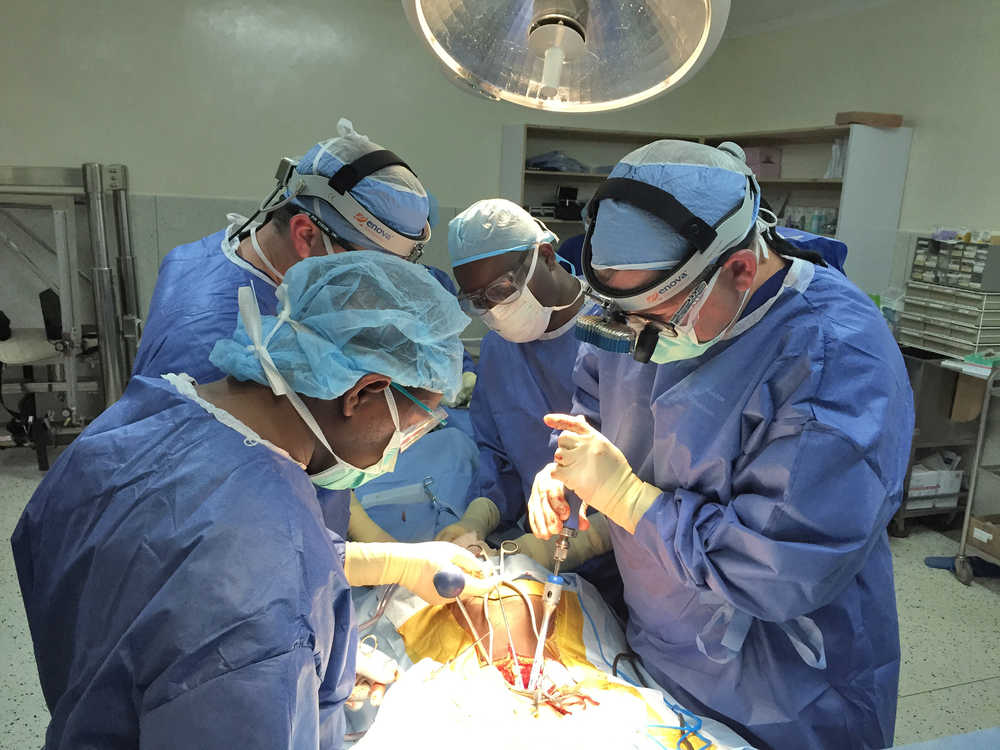
In the course of his medical career, spine surgeon Dr. Craig Humphreys of Kenai Spine Center performed aid work in India, Lithuania, and St. Lucia, but after making three visits to the Kenyan town of Kijabe, he decided to become more deeply involved.
Humphreys plans to found a non-profit to create spine treatment clinics, starting in Kenya. Humphreys has made three trips to Kenya funded through his private practice, the first in 2012 with the Christian aid group Samaritan’s Purse.
Visiting the town of Kijabe, Humphreys stopped at a hospital run by Cure International, another Christian aid group, to see how his spine medicine was managed there.
“It was — I’d almost say “unorganized” but that’s a bad word,” Humphreys said. “It kind of came in and was emergent. And the spine stuff they showed me was either real bad scoliotic curves, or really bad tumors. They just didn’t have the stuff… to give blood back or have monitoring.”
After a second trip to Kenya in January 2014, Humphreys discovered that spinal procedures, which require specialized equipment, are particularly difficult to accomplish in developing countries.
“The first two trips, I wouldn’t say I didn’t accomplish anything, but I was very frustrated. I wouldn’t have gone back. I just didn’t feel like for taking three weeks off, it was accomplishing very much. But what I did realize is that… the logistics of doing spine (medicine) are hard. Doing the surgery’s hard, but the logistics of getting everything and doing it safely is the issue.”
Two pieces of equipment that Humphreys thought spine surgeons in Kenya required were Jackson tables — a specialized table to allow access to the spine — and a cell-saver, which collects and preserves blood removed from the patient’s body during surgery so it can be returned afterward, eliminating the need for transfusions of donated blood, which in HIV-troubled Africa present additional danger.
At the end of his second trip, Humphreys made a connection that he thought would help him solve the logistical problems of safe spine surgery.
As he was preparing to leave Kenya, Humphreys and his team had a meeting with the CEO and head doctor of Cure International, whose hospital he had visited on his previous trip.
“We spent an hour and a half with them, and after talking with them I felt they had a much more organized approach and they could help us from the US side,” said Humphreys.
“Trying to get big machinery into Africa, if you don’t know the tax structure, they will try to rip you off. We just didn’t know how to do any of that. I felt like when we left, there was a reasonable chance of having a partner to help us get things in and help us set up, and we’d hopefully have the technical skills to provide things they didn’t have.”
After the meeting, Humphreys decided to make a third trip. Gathering a team of 13 people, including Kenai Spine employees, other doctors, and their family members, he returned to Kijabe in January 2015. In addition to more personnel, the third trip brought supplies including paper gowns, general surgical equipment, and spinal implants donated by Central Peninsula Hospital, as well as a cell-saver machine. Humphreys and his doctors operated on five patients and conducted classes for Kenyan doctors in residence at the Kijabe Care Hospital.
Humphreys and his team have planned three more trips to Kenya this year, the next in August.
With that trip, he hopes to bring a Jackson table to the clinic. Longer term plans include bringing Kenyan doctors for residencies with Kenai Spine Center after it moves into its new location in Central Peninsula Hospital’s special clinics building.
The special clinics building is currently under construction and is expected to be finished next year. Craig Wilcox, a practice manager at Central Peninsula Hospital who works with Humphreys’ spine center, is working to organize the team’s efforts under a 501c3 non-profit, with the tentative title of Kenai Spine Gives Back.
Wilcox said that the non-profit will fill a need for continuous spinal care that other medical aid groups have been unable to provide.
“There are doctors that go do spine, but it seems more sporadic,” Wilcox said.
“They’re not comprehensive charitable programs focused on the spine. There are lots of spine doctors, in Kenya they call them “parachute doctors.” The doctors come in, they do lots of great surgeries… but then they go away, and the local surgeons don’t have the knowledge, skills and expertise to be able to provide adequate post-op care in some instances. So while those services are helpful in short-term mission trips, it’s really the program that’s needed.”
Reach Ben Boettger at ben.boettger@peninsulaclarion.com
