
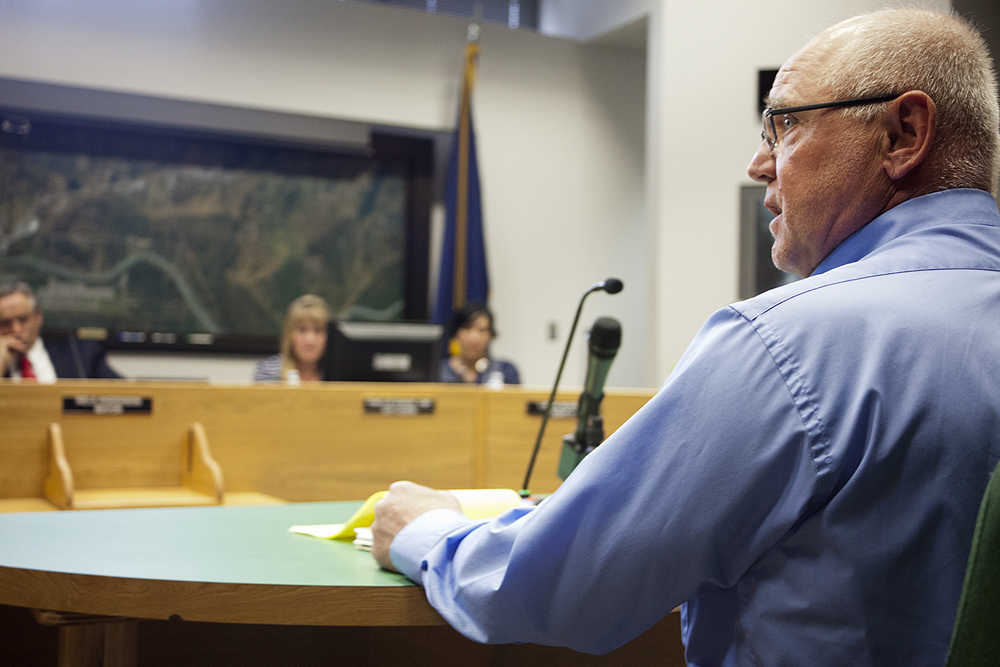
Despite the on-record protestations of nearly 30 people, cheered on by an audience of more than 70, the Soldotna City Council voted to move forward with a plan to spend money researching the feasibility of annexing neighboring territory — albeit with a newly narrowed focus on the economic benefits of such a maneuver.
For more than two hours, council members heard from people — primarily those who live outside of city limits — who said they did not want to be annexed into the city. Their public comments were recorded during discussion on an ordinance to spend $150,000 for an economic analysis and public outreach process to explore annexation. The council ultimately approved $50,000 for an economic analysis after member Pete Sprague amended the ordinance to narrow the scope of the work. Member Meaggan Bos was the lone dissenting vote.
Mayor Nels Anderson prefaced the public comment period by criticizing the way the study had been proposed and that it was “not good public policy.”
City administration referenced fears from residents that an annexation decision or vote could happen without the input or vote of the people whose land was being considered by the city. Anderson said everyone would be given an opportunity to voice their concerns and potentially a vote.
“This issue is that this is just a study, you will not be annexed without your permission and approval. Period,” Anderson said.
Despite his assurances, residents and business owners from Ridgeway, a census designated place north of Soldotna, Kalifornsky Beach Road, and other areas in the borough testified that if they had wanted to live or work in the city, they would have.
Lucky Raven Tobacco owner Patricia Patterson, whose business is located along the Kenai Spur Highway in Ridgeway, said she was afraid her business was being targeted for annexation to help the city make up for a lack of sales tax revenue.
“I don’t feel like I’m looked at as a home owner or a person, I feel like I’m looked at as a business,” she said.
Patterson said she polled 23 business owners in the Ridgeway area near Knight Drive. Of those, 19 voted no and three were undecided.
“There were no yes (votes). None. Everybody feels that all you want is our money,” she said.
Patterson wasn’t the only person who polled her neighbors.
Brian Olson, a borough resident and president of Borough Residents Against Annexation, said his group contacted 86 businesses on or near Kalifornsky Beach Road and found just one that was in favor of being annexed.
It is the second time in less than a month, that the city’s council chambers have been filled with people who oppose annexation. Many cited the last go-round of annexation discussions that ended in 2008 with a mayoral veto of a council-approved plan to annex four areas into the city. At that time, the city had been considering annexation of properties along Funny River Road, east of the intersection with the Sterling Highway; an area south of Kalifornsky Beach Road at Skyline Drive; a portion of land in the census-designated place Ridgeway, which borders the city’s northernmost boundary at Knight Drive; and an area southwest of the city near Skyview Middle School and the Tsalteshi Trails.
During a February meeting in 2008 the council voted to petition the state Local Boundary Commission to annex the four areas using a type of method that did not automatically include a vote of the people in the affected areas.
Several people said they didn’t want the city to “start a war” by reigniting discussion of annexation.
Martin Hall, who lives on Lonesome Street south of Kalifornsky Beach Road, said he had lived outside of Soldotna for 35 years and wanted to stay outside of the city.
“We do not want to be annexed. We do not want you moving into our area. You talk about an open policy where you notify people … well that isn’t always the way annexation happens and I know that,” he said. “I just do not trust politicians to say one thing one year and follow through the next year. I have been here too long, I’m too old, and I’ve seen it.”
Maria Dammeyer, who lives on Lincoln Avenue south of Kalifornsky Beach Road, said she understood that the council was just voting on an ordinance to study the issue, but that their methodology was flawed. Rather, she said, the city should consider annexing just the areas that wanted to be annexed.
City Planner Stephanie Queen said after the meeting that she heard from a lot of people during the meeting who lived north of the city or south of Kalifornsky Beach Road.
“It was really loud and clear that they don’t want to be annexed,” she said. “We agree.”
However, as long as the city continues to explore its options for annexation, the discussion could continue to be contentious.
“I think that it’s still going to be a challenge because, right now, we’re asking them to trust us,” she said. “I think that, reasonably so, they’ll be concerned and paying attention until it gets to the point that there’s an actual document.
Reach Rashah McChesney at rashah.mcchesney@peninsulaclarion.com.
