Sockeye runs on Kenai and Kasilof predicted to be less than 20-year average

The sockeye fishery opens the third Monday in June or June 19, whichever comes last.

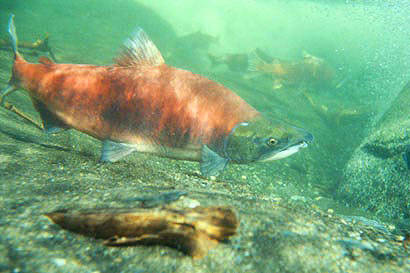
Sockeye salmon. (Photo via Alaska Department of Fish and Game)

Sockeye salmon. (Photo via Alaska Department of Fish and Game)

The Alaska Department of Fish and Game announced Thursday that the forecast for sockeye runs will be less than average in the Kenai and Kasilof Rivers.

According to the ADFG’s analysis, about 2.3 million sockeye are predicted to make their way through the Kenai River. This is 36% less than the 20-year average run of about 3.6 million. Opening day is the third Monday in June or June 19, whichever comes last.

Still, the ADFG reports it would “be approximately 50% greater than the 2020 preliminary total run estimate of 12,216 large fish.”

Optimum escapement goals are set by the Board of Fisheries, according to the ADFG. They calculate the amount of salmon to preserve each season based on the biological needs of the particular stock of salmon.

Biological escapement goals describe the number of salmon in a stock that the ADFG deems is necessary to escape and repopulate for the following fishing season.

Sustainable escapement goals are based on historical data in order to conserve salmon runs for future years. They are set by the ADFG.

The OEG for late-run king salmon in the Kenai River this summer is 15,000 to 30,000 large fish.

Forrest Bowers, the deputy director of the ADFG Division of Commercial Fisheries, said meeting the majority of the state’s escapement goals is important so as to “consistently produce large yields over the long term.”

But if a goal isn’t met, Bowers said it likely isn’t dire. “Department goals are management targets, not necessarily conservation benchmarks,” he said.

According to Bowers, about 80% of escapement goals over around 250 different stocks were met across the state last year.

In the Kasilof River, 881,000 sockeye are expected to run, which is 12% less than the 20-year average of 986,000 salmon. The OEG is 140,000 to 370,000 sockeye salmon.

The ADFG can make adjustments depending on the stock levels of sockeye, Bowers said. If there is an abundance of salmon, the department may increase the time allotment for commercial and sport fishing. If there are fewer sockeye in the run, ADFG may impose restrictions such as prohibiting the use of bait, only allowing catch and release, regulating by fish size, or closing the river altogether.

More announcements from the ADFG will come as the season nears.

Reach reporter Camille Botello at camille.botello@peninsulaclarion.com.

More in News

Jake Dye / Peninsula Clarion
Kenai Peninsula Borough Mayor Peter Micciche speaks during a meeting of the Borough Assembly in Soldotna, Alaska, on Tuesday, May 21, 2024.
Assembly will ask state legislature for authority to enact caps on real property tax assessments

Mayor Peter Micciche said a 34% increase over three years has created “real financial hardships” for many in the borough.

Ryan Tunseth speaks during a meeting of the Kenai Peninsula Borough Assembly in Soldotna, Alaska, on Tuesday, April 1, 2025. (Jake Dye/Peninsula Clarion)
Assembly accepts state funding for community assistance program

The funding will be disbursed to unincorporated communities in the Kenai Peninsula Borough for projects under the state Community Assistance Program.

tease
Soldotna artist awarded Rasmuson Foundation grant

Lester Nelson-Gacal will use the funds to create a handmade, illustrated book about his father’s final year.

State of Alaska Department of Law logo. Photo courtesy of the State of Alaska Department of Law
Kenai man sentenced for sexual abuse of minor, possession of child pornography

Joshua Aseltine was sentenced on Dec. 4 to serve 28 years in prison.

Alaska Department of Natural Resources logo (graphic)
State proposes changes to material sales regulations

The Department of Natural Resources is proposing changes to regulations related to material sales and conveyances to state agencies.

A map depicts the Cook Inlet Area state waters closed to retention of big skates through Dec. 31, 2025. Photo courtesy of the Alaska Department of Fish and Game
Cook Inlet area closed to big skate bycatch retention

The closure is effective in Cook Inlet Area state waters through Dec. 31.

A diagram presented by Seward City Manager Kat Sorenson during a Kenai Peninsula Borough Assembly meeting on Dec. 2, 2025, shows the expected timeline for the Port of Seward Vessel Shore Power Implementation Project. Screenshot
Seward shore power project moves into preliminary design phase

The project will create jobs, reduce cruise ship emissions and provide a backup power grid.

The U.S. Forest Service Porcupine Campground offers gorgeous views of the Kenai Mountains and Turnagain Arm, as seen here on July 20, 2020, near Hope, Alaska. (Photo by Michael Armstrong/Homer News)
Department of Natural Resources seeks public input on proposed Kenai Peninsula State Forest

DNR is gathering community perspectives during several meetings this week.

David Ross is sworn in as Kenai Police Chief on Tuesday, May 31, 2016 at Kenai City Hall. The Alaska Association of Chiefs of Police named Ross the 2025 Police Chief of the Year, recognizing over two decades of service. Photo by Megan Pacer/Peninsula Clarion
Kenai police chief named 2025 Police Chief of the Year

The Alaska Association of Chiefs of Police recognized David Ross for his more than two decades of leadership.

Most Read