
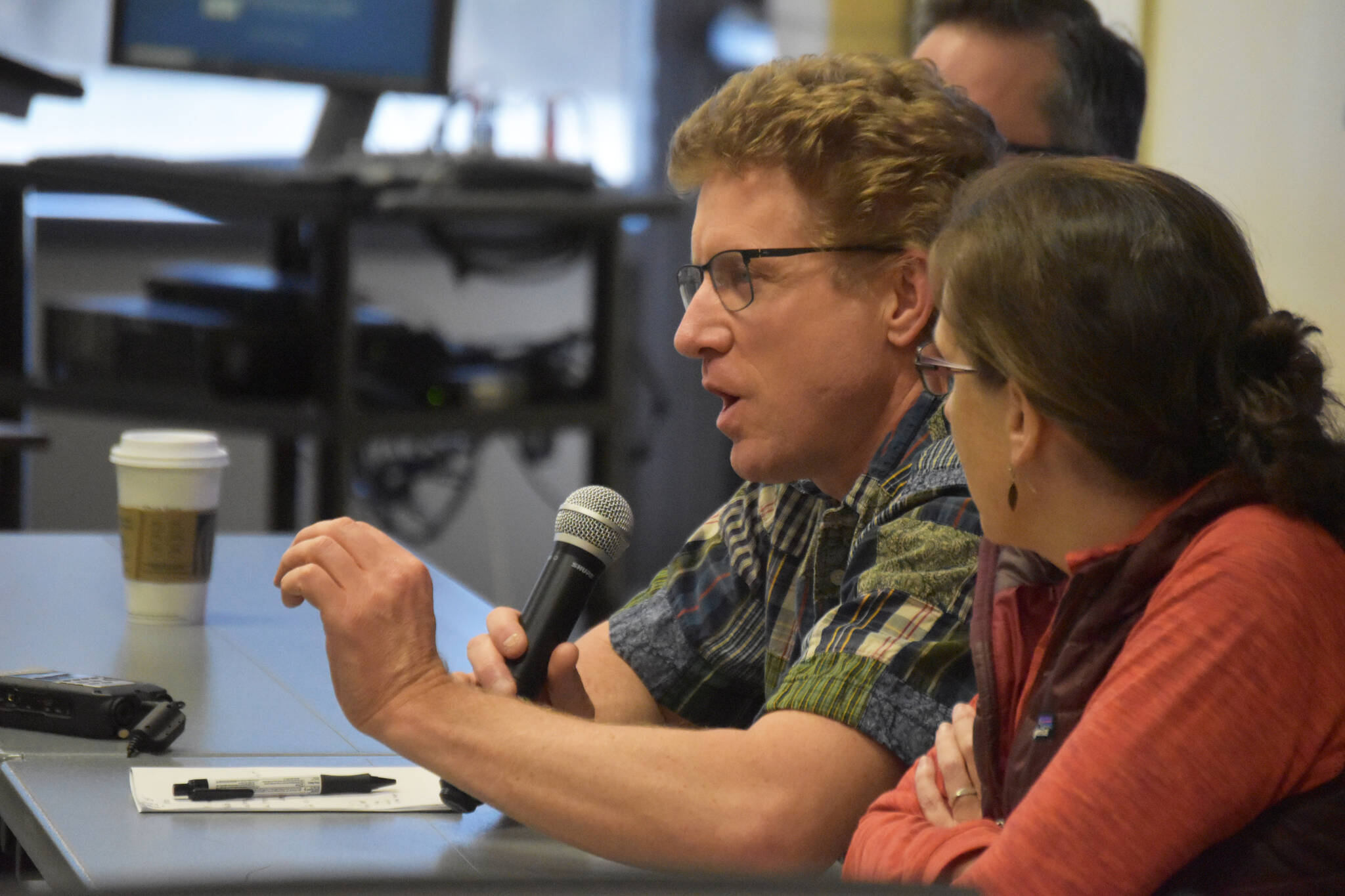
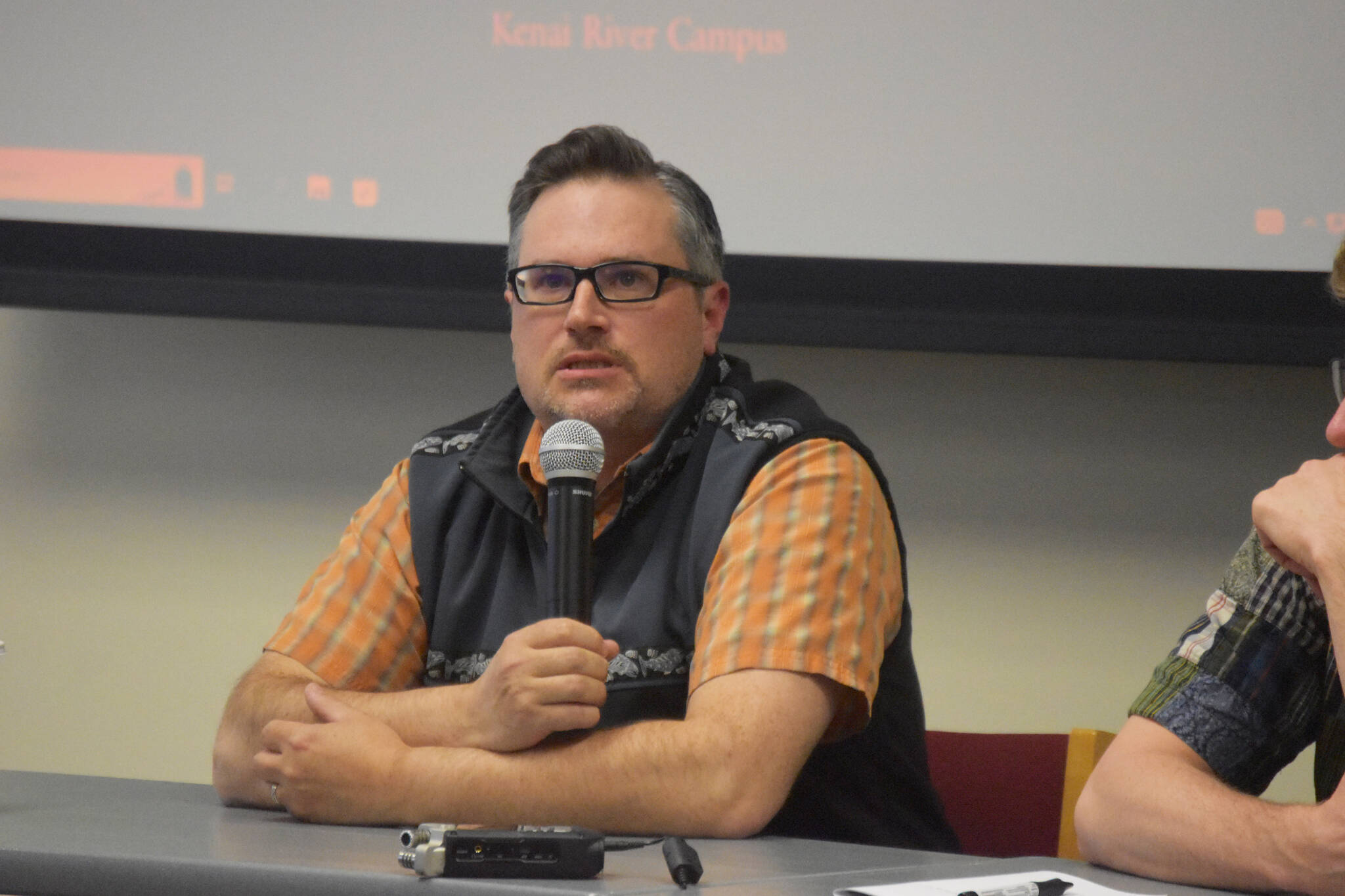
At the latest Kenai Peninsula College Showcase, hosted by Trout Unlimited and titled “State of the Salmon,” University of Alaska Fairbanks Associate Professor Dr. Peter Westley gave a presentation on current research about salmon populations in Alaska, then participated in a panel discussion with Cook Inletkeeper Science Director Sue Mauger and Department of Fish and Game Biologist Adam Reimer.
The reports and data shared by Westley painted a grim picture, especially for king salmon. His research centered on the Yukon River, but he said the story was largely the same around the state, including for Kenai River kings and Nushugak kings.
Warming waters, more numerous predators, bycatch, parasites and increased competition all point to tremendous difficulty in seeing a resurgence of the species.
The first question posed to the three during the panel discussion was “Are there any bright spots for chinook salmon?” All three responded with a cold “No.”
The “State of the Salmon,” Westley said, isn’t an apt description. It’s the “States of the Salmon” — varied by species, by region, by metric. That’s where you see the “manager’s dilemma” of abundant sockeye and declining chinook in areas like the Nushugak and the Kasilof River.
Westley said that around 2012 and 2013, the Department of Fish and Game identified that chinook were really struggling. In the years since, he said, we’ve learned a lot about the species, but that hasn’t yet translated into an improvement for the species.
“Things are not better and continue to get worse,” he said.
Chinook and other salmon species in Alaska are less abundant, and statewide are also shrinking in size, he said. He shared graphs of the average recorded length of chinook, sockeye, chum and coho, all of which have seen a significant decline since 2000.
“There’s been a lot of work to try to understand. What are these drivers? How do we explain this and ultimately is there anything that we can do about it?” Westley said. “There’s a series of papers from across the North Pacific and some that are closer to home that are increasingly pointing to the fact that the ocean is an increasingly risky place.”
Westley said the Marine Mammal Protection Act, established in 1972, has successfully led to rebounds and increasing populations of harbor seals, sea lions and killer whales. Similarly, there is less harvest from Indigenous cultures who once relied on seals for subsistence.
“The point is, there are likely more predators in the ocean now than there has been likely in thousands of years.”
He said that doesn’t mean folks should go after those predators, but that they are one of many factors that could be impacting salmon. If the ocean is more dangerous for salmon, it becomes harder for salmon to survive to grow older and larger.
A study cited by Westley indicates that older, larger salmon are more likely to be targeted by predators like salmon sharks.
Similarly, Westley pointed to salmon hatcheries, which nationwide add 5 billion salmon into the Pacific Ocean each year. Alaska accounts for around 1.5 billion of those. Further hatchery salmon come from the other side of the ocean in Asia.
Previously, Westley said, scientists, including himself, were taught that the ocean is a black box with infinite capacity for species development.
“There’s increasing evidence that there is competition and limited amount of capacity for feed and growth in the ocean,” he said.
Studies are piling up, Westley said, that build a “weight of evidence” that this competition may be leading to the decline in fish size.
Declining size is a large part of the conversation, Westley said, because larger fish, “particularly larger females,” produce more eggs and larger eggs. He showed two graphs indicating the fecundity — or number of eggs — and the mass of the eggs in larger and smaller salmon.
“The point is that you have disproportionate declines of reproductive potential if you have declines in body size,” he said. “Really what that’s suggesting is the importance of big, fat, old female fish.”
Another issue facing salmon is rising temperature, Westley said. The Yukon River is “historically warm” right now, and was especially in the exceptionally warm summer of 2019. That summer, he said, there were “widespread die-offs, pre-spawning mortality” and “missing fish that we expected were gonna make it to Canada that didn’t really show up.”
A study performed by Dr. Vanessa von Biela of the U.S. Geological Survey, Westley said, found that the populations in that river were “absolutely showing signs of heat stress.”
“What that means, what the consequences are, those are great questions. We don’t totally know,” Westley said. “But we absolutely do know if 2019 is anything like what our future might look like it suggests that salmon in the Yukon are going to have a hard time.”
The final issue Westley discussed is historic incidence of infection rates for Icthyophonus, a naturally occurring pathogenic parasite found in harvested salmon. He said it isn’t clear where exactly the fish are encountering the parasite, but in 2020, 44%, or approaching half of Yukon salmon surveyed showed signs of the infection.
Westley said the parasite attacks cardiac tissue in the heart, impacting their ability to move oxygen through their bodies. He compared them to athletes, their migration like a race — now being undertaken while another organism attacks their heart.
In warmer water, the metabolism is higher, and they require even more oxygen. He said studies are actively being undertaken to understand what this means for mortality.
Alaska is unique, Westley said, in that the habitat is in better condition than would be found in the Lower 48. But he said at this point, habitat preservation may not be sufficient.
“People have burdened the conservation cross for a long time — have not been fishing — and it still continues to get worse,” Westley said. “It makes me worry and makes me question about whether we as Alaskans are truly willing to accept what might be coming for us.”
During the panel, Mauger said the number of people in attendance heartened her in what looks like a dire situation.
“It’s a good sign that you’re all here; it means we still care,” she said. “It’s going to take a lot of compromise and collaboration to have salmon into the future.”
Reimer said that Westley’s presentation was sobering, telling him he should have provided tissues.
“It’s tough to sit through Peter’s talk, and it’s like, ‘what are we going to do about this?’” he asked.
A question was asked of the panel what impact commercial bycatch from industrial pollock harvest.
“I’m surprised it was only the second question, that it wasn’t the first,” Westley said.
Westley said he doesn’t ignore the bycatch conversation, but that it’s just part of the way the ocean has changed. He said he’s “looked hard” at the numbers and they “do not explain the stark decline in and of itself.”
“Is it doing anyone any favors and helping the fish? No,” he said. “But it’s not the sole driver.”
As part of the presentation, Westley shared sources of information valuable to looking at historical trends and current status of salmon in Alaska. He said information from the State Department of Fish and Game is his first stop, which can be found at adfg.alaska.gov, but he also shared a database that he helped to compile called State of Alaska’s Salmon and People. That database can be accessed for free at alaskasalmonandpeople.org, and features regional breakdowns of salmon populations, as well as the raw data used to assemble its analyses.
Reach reporter Jake Dye at jacob.dye@peninsulaclarion.com.
University of Alaska Fairbanks Associate Professor Dr. Peter Westley responds to a question during a panel discussion for the Kenai Peninsula College Showcase “State of the Salmon” on Wednesday, April 20, 2023, at KPC in Soldotna, Alaska. (Jake Dye/Peninsula Clarion)
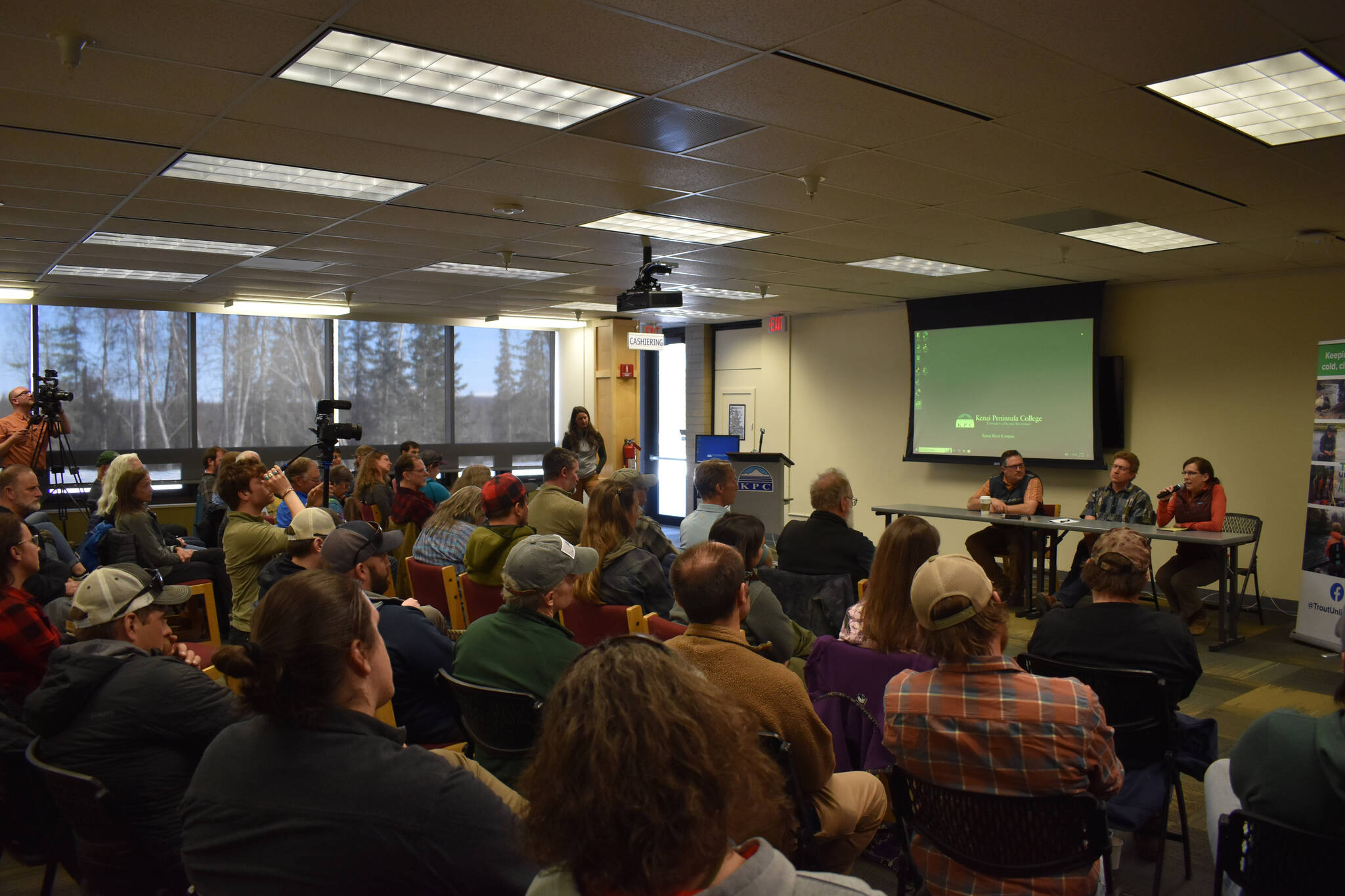
Cook Inletkeeper Science Director Sue Mauger speaks in front of a packed crowd during a panel discussion for the Kenai Peninsula College Showcase “State of the Salmon” on Wednesday, April 20, 2023, at KPC in Soldotna, Alaska. (Jake Dye/Peninsula Clarion)
