
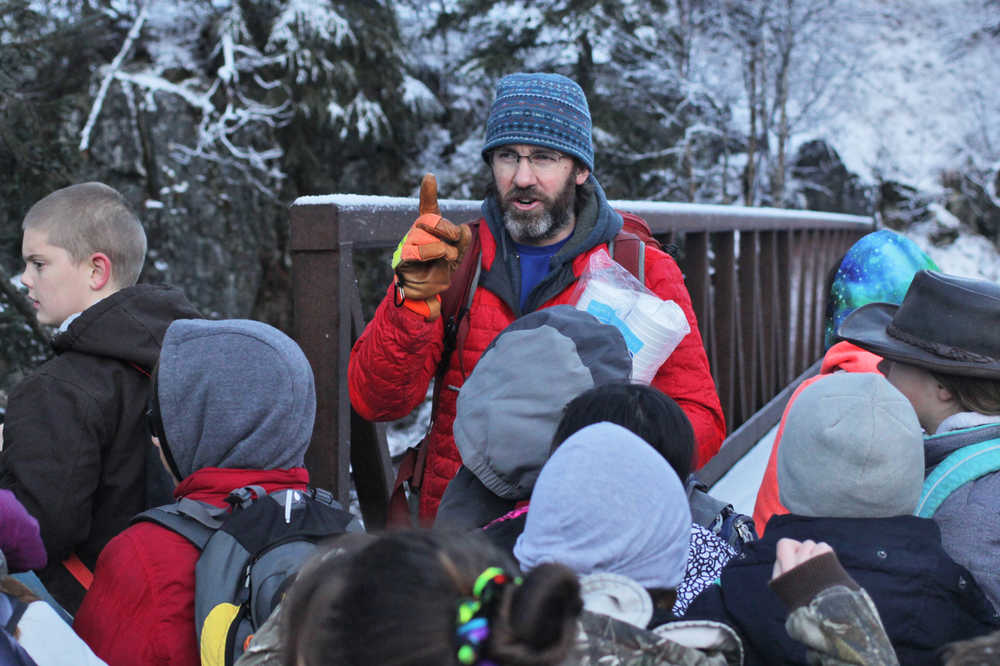
Manitoba cabin sits on a wooded hill overlooking a creek about three quarters of a mile from the Seward Highway. For much of the winter it’s occupied with skiers and snowshoers taking advantage of the nearby trail system. For a few hours on Nov. 15, it hosted a group of Seward Elementary School fourth and fifth graders, brought by their teacher Jason Leslie.
Leslie is a board member of the Alaska Huts Association, a nonprofit seeking to restore and open for public use some of the cabins scattered through the eastern Kenai Peninsula woods. Manitoba Cabin, the only one the group has opened thus far, was built as a prospector’s cabin in 1936, according to the Alaska Huts Association website. The U.S Forest Service condemned it after it fell into disrepair, but instead the association took charge of it and restored it, and since 2012 has rented it out through the summer and winter. Though Leslie said the cabin is popular in ski season, most tenants come during the weekend. Leslie’s been trying to fill the mid-week gap by encouraging school groups to use the cabin. Though he himself has been bringing student groups — usually an outdoor club on overnight trips — there since 2013, this month’s field trip was a first for him.
“Every other school group I’ve brought here, even in January and February, it has been just pouring rain,” Leslie said. “The kids have had a wonderful time anyway — they don’t care that it’s raining.”
For the fourth and fifth graders he brought this month, the trip was in part a science lesson. The day before, Leslie said, they had begun an Earth science unit by talking about four spheres of terrestrial activity: the geosphere, the atmosphere, the biosphere, and the hydrosphere.
“Really what we’re studying is how they interconnect, how everything doesn’t exist in its own little bubble in the world,” Leslie said. “We’re kind of getting (the students) to have hands-on experiences with all these things, and then push their brains to ask, ‘How do these things connect to each other?’”
The geosphere is the realm of gold prospector Steve Morris, whom Leslie met when Morris came to help stack firewood at an Alaska Huts Association volunteer event. Leslie said he’d been considering a gold panning lesson for his students for a long time and it finally worked out when he met Morris.
At a table in front of the cabin, Morris scooped out concentrated material he had dredged from the riverbed of his nearby claim into green plastic pans he gave to each student. Normally he would haul the concentrate to his home in Anchorage, where he’d spend the winter filtering it for gold using a panning technique similar to what he demonstrated for the students. He also uses panning to discover likely dredging areas.
“Basically, with any type of prospecting, panning is your most important tool,” Morris said. “You start with that and you finish with that.”
Morris guided the students through the patient art of shaking out a pan full of sediment and water, then sloshing it with gentle, precise movements until gold flakes show on the edges. Among the tricks he showed them were the “blueberry bump” method of tapping the side of the pan and how to use a magnet to pull magnetite out of the mix. Once the students managed to isolate a collection of golden flecks, Morris brought them inside the cabin for the even more delicate job of pulling the flakes out with a suction bottle. Most, if not all, the students went home with small vials of gold.
“Man, I’m giving you guys some good dirt,” Morris said to the students.
Representing the biosphere was Nick Jordan, a Seward-based local education coordinator with the Chugachmuit Native Association’s heritage program. Inside one of the heated yurts near the cabin, he spoke to students not only about the region’s wildlife, but also about how that wildlife benefited humanity. Passing around the skulls of porcupines, the horns of mountain goats, and the fur of martins, he told his audience how Sugpiaq Native people used porcupine quills as sewing needles, mountain goat horns as spoons and utensils, and furs as clothing.
The program Jordan presented was adapted from one of Chugachmiut’s heritage kits, themed packages of educational material designed with the advice of cultural elders to teach how the region’s Native people traditionally lived. Jordan used material from the hunting kit for his presentation at Manitoba cabin. Though Jordan specializes in Sugpiaq traditions — a culture found along the eastern coastal regions of the Kenai peninsula, according to the University of Alaska’s Native Language center website — and said the inland area of Manitoba cabin would have more likely hosted Ahtna or Athabascan groups instead, he thought the material would be “interesting to bring into a sort of wilderness area,” he said. Other heritage kits — which Chugachmiut distributes on request to area schools — examine subjects such as seals, trading, symbols, and Native games. In addition to 17 kits already compiled, Jordan said Chugachmiut is working on 10 more.
“It’s important that they understand the region they’re a part of,” Jordan said of the students. “So when they look out into the bay from Seward they know that this was a traditional area where there were groups of Sugpiaq traveling around and hunting and gathering, and the importance of those animals in their lifestyle.”
Leslie led a third group of students on walk through the woods for a lesson on “how not to get lost,” he said.
“Doing things like telling other people where you’re going, when you plan to be back, being alert and noticing your surroundings, always having your head up and realizing where you’re going and having a turn-around time,” Leslie said of his instructional goals. “And then what to do when you do get lost. With kids we just focus on staying put. Pick a project, find a tree and start building yourself a shelter or something. And if people know you’re missing — because you’ve told someone — people will come looking.”
Meanwhile in the cabin, groups of gold-panners coming in from the cold were learning another practical lesson that Morris summarized in a simple exclamation.
“Gold’s great, but hot cocoa’s better!” he said.
Reach Ben Boettger at ben.boettger@peninsulaclarion.com.
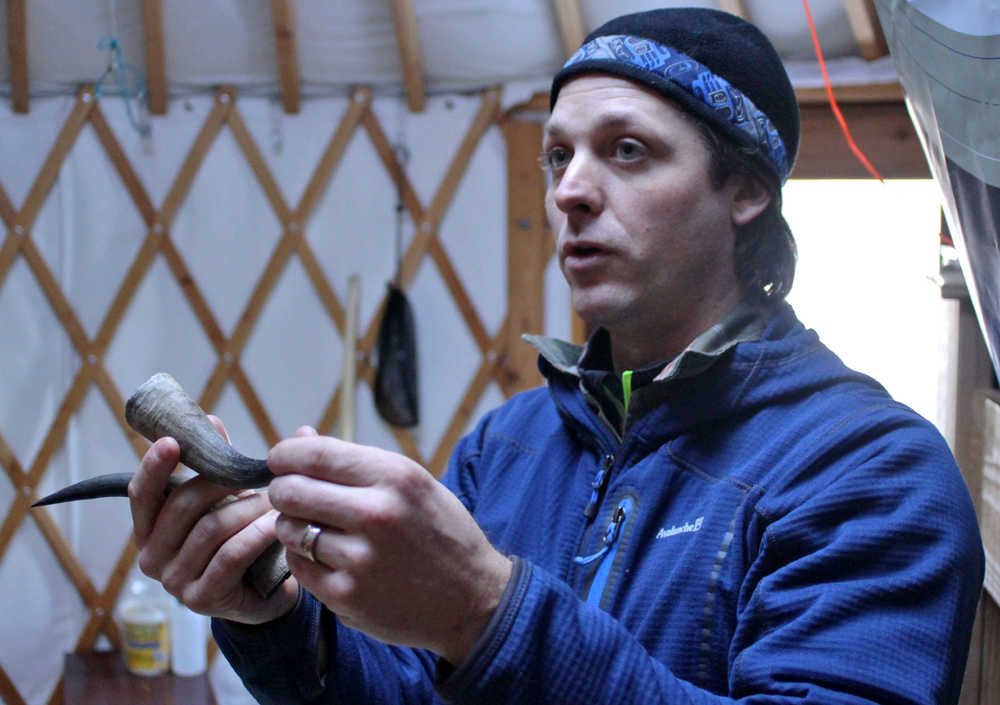
Ben Boettger/Peninsula Clarion Speaking to Seward Elementary students in a yurt near the cabin, Chugachmuit Native organization Local Education Coordinator Nick Jordan holds up a mountain goat horn – traditionally used by local Supiak Natives to made spoons and other utensils – during a field trip to Manitoba cabin on Tuesday, Nov. 15 near the Seward Highway.d
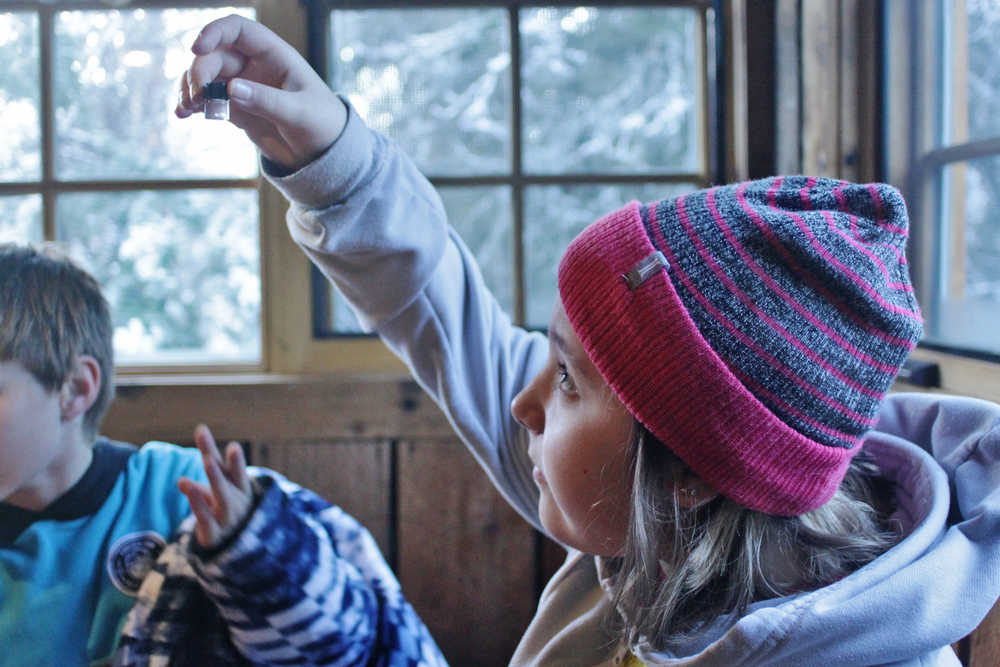
Ben Boettger/Peninsula Clarion Seward Elementary student Ayden Lapinskas holds a water-filled vial to the light to inspect the gold flakes she panned during a field trip to Manitoba cabin on Tuesday, Nov. 15 near the Seward Highway.
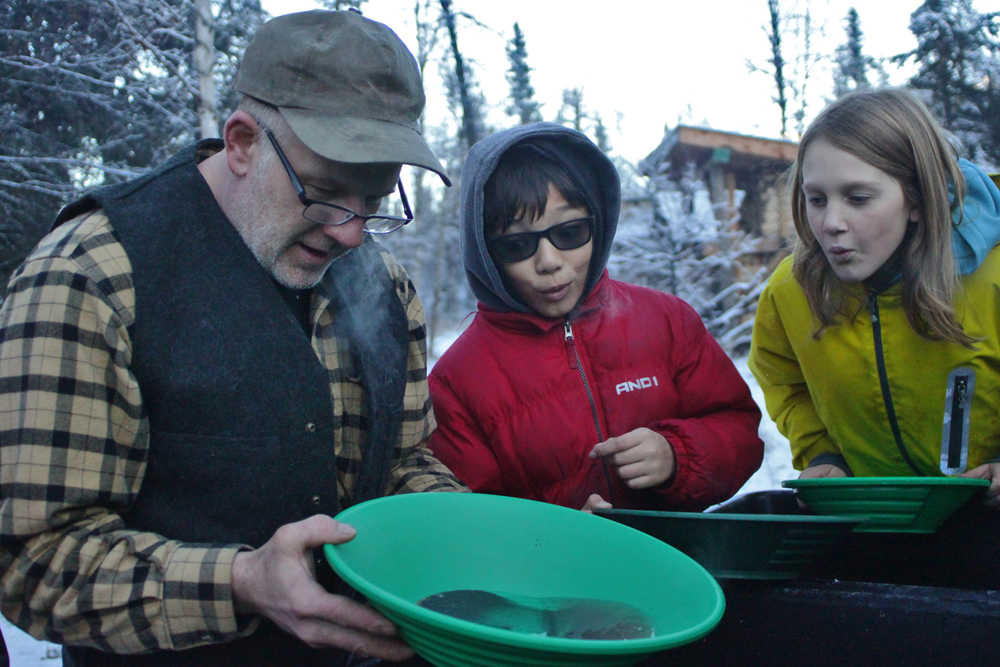
Ben Boettger/Peninsula Clarion Prospector Steve Morris (left) taps a pan of water and concentrated sediment, which he dredged from a nearby river, to reveal gold flakes to onlooking Seward Elementary students Bengimiin Ambrosiani and Aloshia Cross during a fieldtrip to Manitoba Cabin on Tuesday, Nov. 15, near the Seward Highway.
