
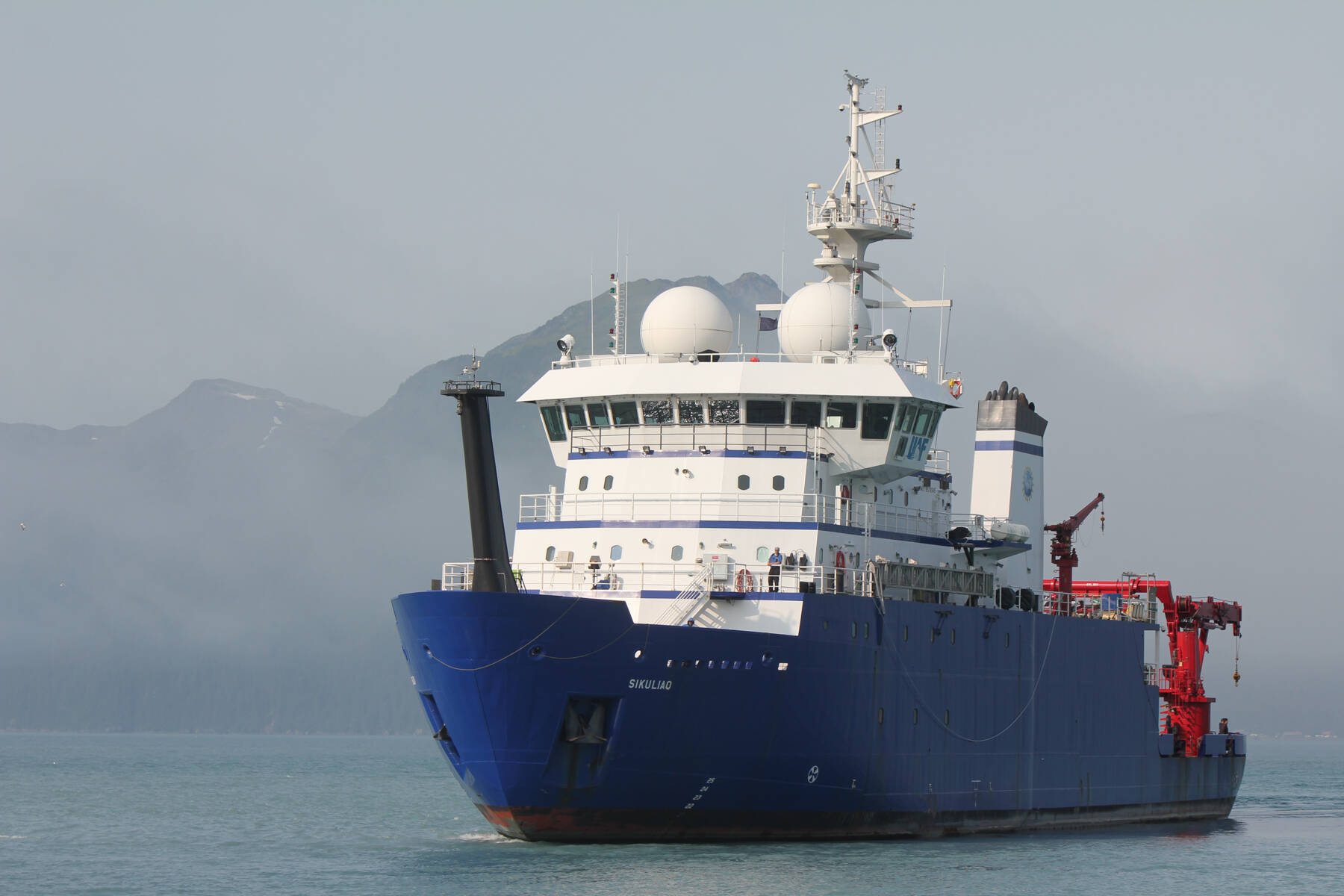
The Seward-based research vessel, Sikuliaq, began its first journey to Antarctica last week, where it will support three research projects starting in early January. The ice-capable ship, which has been owned by the National Science Foundation and operated by the University of Alaska Fairbanks College of Fisheries and Ocean Sciences since 2014, has until now primarily operated in Alaskan and Pacific Northwestern waters.
“We’re not just burning diesel and stirring water with our propellers,” said Doug Baird, the marine superintendent at the UAF College of Fisheries and Ocean Sciences. “We’re actually doing something for people to understand what’s going on in the world.”
The projects that Sikuliaq will support were previously assigned to the research vessels Laurence M. Gould and Nathaniel B. Palmer. Both vessels concluded their contracts with NSF in 2024 and earlier this year, respectively. The Sikuliaq was assigned to these projects because it’s the only vessel in the U.S. Academic Research Fleet rated to navigate ice up to 2.5 feet thick.
Despite some rough seas out of Dutch Harbor, the Sikuliaq landed in Honolulu to restock and refuel on Nov. 24 after a 10-day journey. The ship mobilized again on Wednesday for a three-week-long NSF-funded research project in the South Pacific to study influences on “shifting levels of ocean heat” between Honolulu and Tahiti.
While traveling from Tahiti to their next stop in Chile, Baird said researchers will come aboard to perform “ad-hoc” science.
“The ship’s not going to dedicate time to it, but basically they’re able to take advantage of the ship being in the Southern Pacific and do some of their experiments while the ship’s transiting,” he said.
The Sikuliaq will arrive in Punta Arenas, Chile during the first week of January. It will remain there until a series of research projects are completed in March.
In Antarctica, researchers will study summer sea ice in the Weddell Sea and begin a coring project on Seymour Island to evaluate the effects of an extinction event during the Cretaceous period, which began approximately 145 million years ago and ended around 66 million years ago. The Sikuliaq’s final cruise will deploy divers to collect invertebrate samples from the ocean floor to evaluate the ecology of the west side of the Antarctic Peninsula.
According to a Nov. 20 press release, Katrin Iken is one of the divers who will collect the samples. A professor of marine biology at UAF who has done similar work in Antarctica as a Ph.D. student and postdoctoral researcher, she will join 25 other scientists and 20 crew members aboard the 261-foot-long ship.
“Aside from being an exciting project, it’s going to be a fun opportunity for me to, in a way, go back to my roots,” Iken said in the press release. “This was just everything coming together to close a loop.”
The crew is also eager for the opportunity to travel to the “deep south,” Baird said.
“Crew are very excited — they like the idea of winter in the tropics and getting to go to Antarctica,” he said in the press release. “We’ve had temporary relief crew members tell us they want to go if we need them.”
Follow the Sikuliaq through the ship’s Facebook page.
