
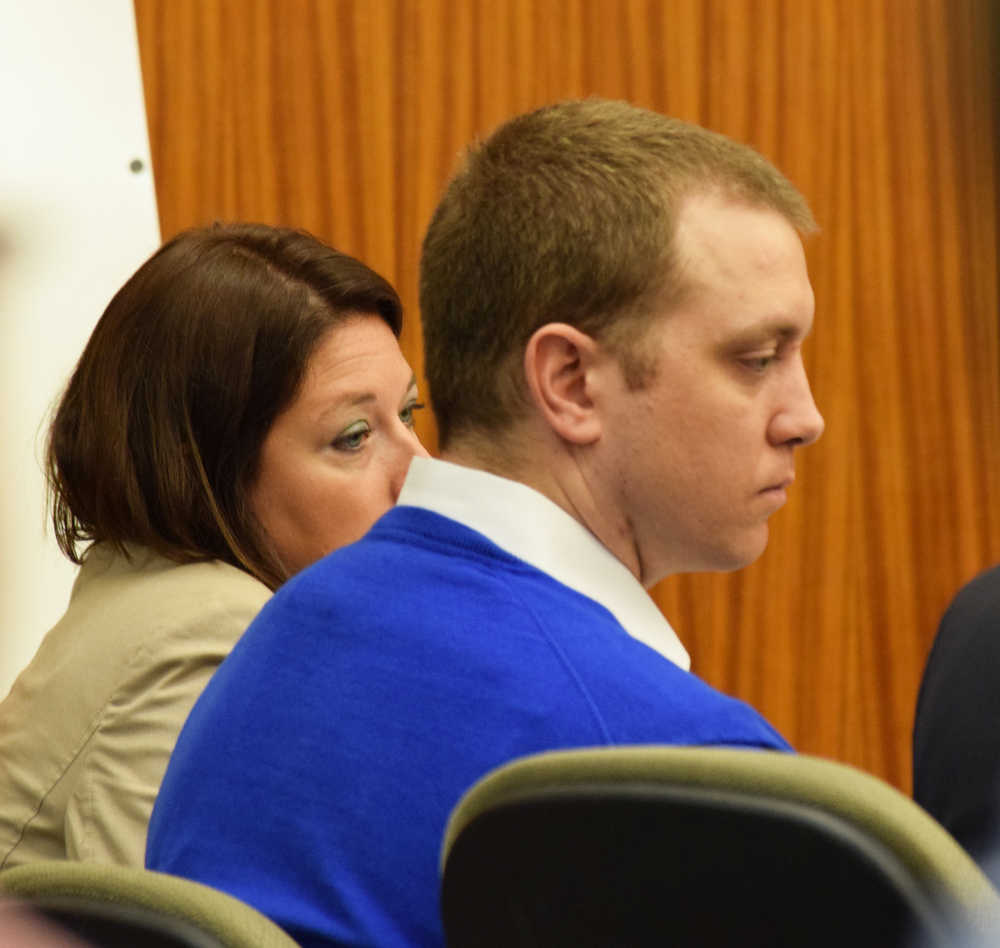
More than 30 people packed a Kenai courtroom Tuesday for a sentencing that will end a manslaughter case more than 2 1/2 years old.
Paul Vermillion, an Iraq War veteran from Anchorage, was originally charged with one count of murder in the first degree, two counts of second-degree murder and a count of manslaughter for the December 2013 death of Genghis Muskox in Cooper Landing. The two were said to be friends who got into a physical fight that night after drinking that ended with Muskox first being hit in the head with an ice axe and then shot twice in the head with two different guns.
In the more than two years since Muskox’s death, some details of the case have been argued in court, but the agreement in which Vermillion pleaded guilty to manslaughter took place one day before his trial was scheduled to start in April. Throughout the sentencing, defense attorney Andrew Lambert plans to call witnesses and present evidence which he said at the April hearing were a factor in the plea agreement being reached and support the theory that Vermillion acted in self-defense.
The issue of the sentence itself was tackled at the onset of Tuesday’s hearing, with Lambert and District Attorney Scot Leaders clarifying the length of time to which Vermillion can be sentenced since the passage of Senate Bill 91, a crime reform bill aimed at reducing the state’s prison population signed into law on June 11. The attorneys had originally reached a deal that called for a sentencing range of 7-11 years. They said that under new statute Vermillion will face a range of 5-9 years, though they said the state can still ask for a sentence of up to 11 years per their agreement.
“The statute made sentencing in pending cases retroactive,” Lambert told the court. “So, initially because there was a weapon involved he was 7-11 (years), but when SB 91 went into effect … it changed it to 5-9 (years) if weapons (were) involved.”
Kenai Superior Court Judge Charles Huguelet can sentence Vermillion to up to 20 years in prison including suspended jail time, but he is only subject to a maximum of 11 years of active jail time, with credit for time already served or spent outside of jail on an ankle monitor.
Lambert has argued that Vermillion acted in self-defense when he killed Muskox. He began Tuesday by playing two 911 calls and a conversation Vermillion had with an Alaska State Trooper the night Muskox died in order to clear up some details in the pre-sentence report he and Leaders disagreed on, such as whether Vermillion told troopers he was sure if Muskox had a gun that night or not.
Vermillion can be heard in the recordings telling the 911 dispatcher “I just reacted” and “he was trying to kill me,” and told the trooper who later spoke to him that he “eliminated the target,” describing the incident as a fight to the death.
Lambert first called to witness Tara Henry, an expert in strangulation. She said there is evidence Vermillion had suffered from strangulation based on case material she reviewed, like his 911 calls in which he mentioned Muskox was holding his throat, and a later interview with him. She said the physical and other evidence she reviewed was “consistent with a history of being strangled.”
The second witness called Tuesday was Timothy Charpenter, a former member of the U.S. Military for 23 years who helped develop and teach the Modern Army Combative Program. Charpenter explained telephonically that, based on his review of case materials and an interview with the defendant, he believes Vermillion defended himself the way he was trained to do in the military. When Lambert asked, Charpenter said the military teaches that strangulation is a lethal force.
“We’re taught that that’s an imminent threat, a life threat,” Charpenter said of strangulation.
Soldiers are not trained to extricate themselves from a situation in which deadly force is being used against them, he said, but rather to create enough space between themselves and the other person to get hold of a weapon. Members of the military are taught to continue using force until the other person is dead and they are sure the threat is no longer there, he said.
“Once the situation crosses that threshold, that imminent threat, by the rules of engagement that we were given, there isn’t really a de-escalation point there,” Charpenter said.
Lambert also plans to call a crime scene reconstructionist who analyzed the scene in the Cooper Landing home where Vermillion was staying for the defense and reported findings that greatly differed from what was reported by the state’s analysis. During an evidentiary hearing last October, Investigator Austin MacDonald with the Alaska Bureau of Investigations testified that, based on his analysis of the crime scene, Vermillion had hit Muskox in the head with an ice axe. He testified there was evidence that suggested Muskox had dragged himself from the living room to the bedroom, where Vermillion shot him once in the head with a firearm, and again in the head with a different gun after the first firearm jammed.
Lambert, who said he originally thought the days set for the sentencing would be longer, told the court he is not sure there will be time to get to all of his witnesses and evidence before the sentencing’s end.
Reach Megan Pacer at megan.pacer@peninsulaclarion.com.
