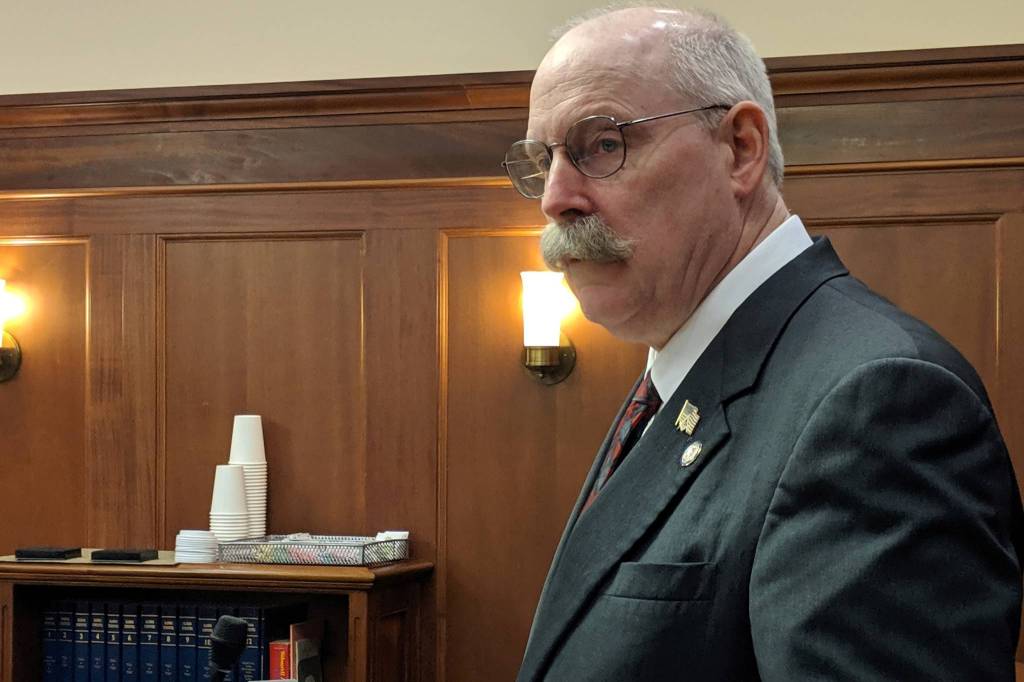
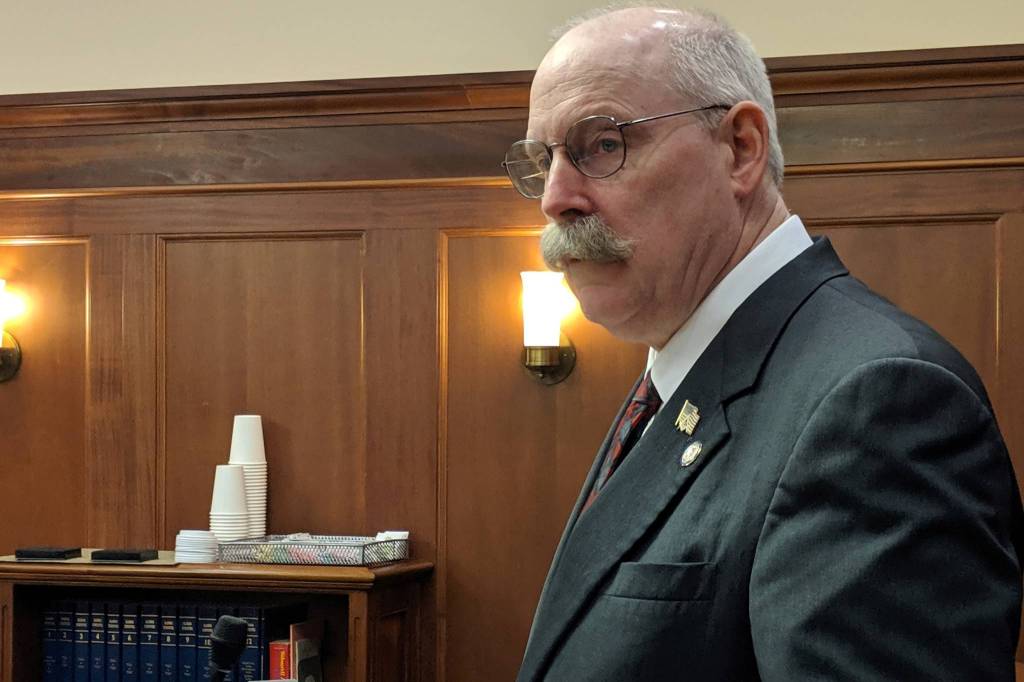
Sen. Bert Stedman, R-Sitka, speaks in favor of a senate bill that would reverse “the sweep” during a Senate floor session Saturday, July 20, 2019. (Ben Hohenstatt | Juneau Empire)

Sen. Bert Stedman, R-Sitka, speaks in favor of a senate bill that would reverse “the sweep” during a Senate floor session Saturday, July 20, 2019. (Ben Hohenstatt | Juneau Empire)

Senate approves ‘reverse sweep’ and capital budget bill

House may do the same tomorrow

A 19-0 Senate vote Saturday could mean big things for the state’s financial picture depending on what the House and Gov. Mike Dunleavy do next.

The Senate approved Senate Bill 2002, which funds the capital budget and includes “reverse sweep” language. The sweep is an annual bookkeeping oddity in which hundreds of millions of dollars in various state accounts are “swept” into the Constitutional Budget Reserve.

Typically, a “reverse sweep” moves the money back into the original accounts, but the Legislature did not approve a reverse sweep when it sent a bill to the governor.

“This bill is a do-over, it’s a reset if you will,” said Sen. Natasha von Imhof, R-Anchorage. “I urge a ‘yes’ vote on this bill.”

Her fellow senators did exactly that.

The House Finance Committee voted Saturday to move the bill out of committee, which sets up Sunday as a likely date of a vote. The House is set to adjourn at 1 p.m., and the Senate at 2 p.m.

Every meeting and session held Saturday primarily focused on the reverse sweep aspect of the bill.

Sen. Bill Wielechowski, D-Anchorage, said on the Senate floor Saturday the impacts of that weren’t fully understood at the time.

Historically, funds that provide college scholarships and subsidize electricity have not been swept, but the Dunleavy administration is examining more wide ranging sweeps.

“The consequences of not reversing that sweep are pretty stunning and not what many anticipated,” Wielechowski said.

Sen. Lora Reinbold, R-Eagle River, was an ardent voice against voting for the bill, but she did ultimately vote for it.

“I just got a copy of this bill hours ago, and I do not understand the implications,” Reinbold. “This is a big, important bill for me to understand. I am asking for a recess until my amendments are read.”

She said the bill was put together through backdoor meetings, which led to Sen. John Coghill calling for a point of order, and saying the meetings were public and transparent.

[Live coverage from the Capitol]

Reinbold said that’s debatable.

Other senators agreed the bill’s contents were created in the public eye and noted it was similar to a bill passed by the Legislature months ago.

“There is no subversive or secretive issues in this bill,” said Sen. Bert Stedman, R-Sitka.

However, that capital budget failed to secure the super majority of votes needed to draw from the CBR.

In addition to the “reverse sweep” the bill includes additional funding for projects, switches the capital budget’s funding source to the CBR rather than the general fund and would provide about $250 million in “head room” for expenses that may be incurred by natural disasters such as wildfires or earthquakes.

“We’re not going to let our cities burn because we’re too tight not to have any head room,” Stedman said.

During the House Finance Committee meeting held after the Senate vote, there were questions about whether $250 million is a typical amount of head room.

Legislative Finance Director David Teal said over the years, the amount of head room has been anywhere from between $100 million and $500 million.

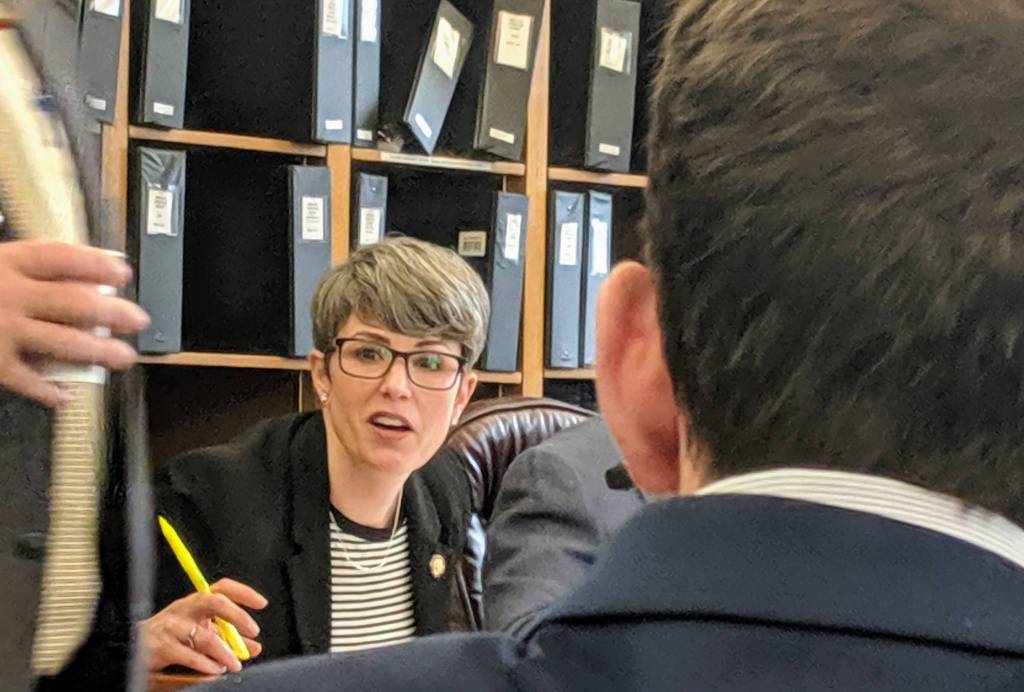
Rep. Kelly Merrick, R-Eagle River, noted the similarities between the bill passed by the Senate and a bill that previously fell short of the number of votes needed to draw from the CBR.

Rep. Kelly Merrick, R-Eagle River, speaks during a House Finance Committee meeting Saturday, July 20, 2019. (Ben Hohenstatt | Juneau Empire)

Rep. Kelly Merrick, R-Eagle River, speaks during a House Finance Committee meeting Saturday, July 20, 2019. (Ben Hohenstatt | Juneau Empire)

She asked why she and other lawmakers were called back to Juneau to vote on legislation that failed.

Rep. Jennifer Johnston, R-Anchorage, committee co-chair, said in light of concerns about the sweep, it’s hoped the bill passes.

Rep. Colleen Sullivan-Leonard, R-Wasilla, wasn’t a fan of the tactic.

She said she’s “mad as heck” about being away from her hometown to be in Juneau considering a bill that isn’t a compromise.

“It’s moving backwards,” Sullivan-Leonard said.


• Contact reporter Ben Hohenstatt at (907)523-2243 or bhohenstatt@juneauempire.com. Follow him on Twitter at @BenHohenstatt.

Sen. Bert Stedman, R-Sitka, speaks in favor of a senate bill that would reverse “the sweep” during a Senate floor session Saturday, July 20, 2019. (Ben Hohenstatt | Juneau Empire)

Sen. Bert Stedman, R-Sitka, speaks in favor of a senate bill that would reverse “the sweep” during a Senate floor session Saturday, July 20, 2019. (Ben Hohenstatt | Juneau Empire)

More in News

Sterling resident Jonny Reidy walks 11 miles from his dry cabin to his part-time job at Fred Meyer on Dec. 15, 2025. Reidy aims to walk 1,000 miles by midsummer, and he’s asking people to pledge donations to food banks for every mile he travels. Photo courtesy of Jonny Reidy
Sterling man is walking 1,000 miles for hunger awareness

Jonathan Reidy asks people to pledge donations to local food banks for every mile he walks.

Soldotna High School students learn how to prepare moose meat through the school’s annual Moose Permit Project, an educational partnership between SoHi and the Alaska Department of Fish and Game. Photo courtesy of Tabitha Blades/Soldotna High School
Soldotna students get hands-on moose harvest experience

SoHi’s annual Moose Permit Project is an educational collaboration between the school and the Alaska Department of Fish and Game.

A snowmachine rider takes advantage of 2 feet of fresh snow on a field down Murwood Avenue in Soldotna, Alaska, on Monday, Dec. 12, 2022. (Jake Dye/Peninsula Clarion)
Kenai refuge announces snowmachine opening

All areas traditionally allowing snowmachine use in the Kenai National Wildlife Refuge are now open.

Kate Rich’s play, “The Most Comfortable Couch in Town,” is performed during “Stranded: A Ten-Minute Play Festival” in August 2025 in Homer, Alaska. Photo provided by Jennifer Norton
Homer playwright receives fellowship award

Kate Rich is revising a new play, which she hopes to take to the Valdez Theatre Conference Play Lab.

A BUMPS bus waits for passengers in the Walmart parking lot in Kenai, Alaska, on Oct. 15, 2018. (File photo)
Ninilchik Traditional Council expands public bus service

The Homer-Kenai BUMPS bus will now run five days a week.

Balloons fall on dozens of children armed with confetti poppers during the Ninth Annual Noon-Year’s Eve Party at the Soldotna Public Library in Soldotna, Alaska, on New Year’s Eve, Tuesday, Dec. 31, 2024. (Jake Dye/Peninsula Clarion)
Out with the old, in with the new

The Peninsula Clarion looks back on 2025 in this “year in review.”

The sign in front of the Homer Electric Association building in Kenai, Alaska as seen on April 1, 2020. (Photo by Brian Mazurek/Peninsula Clarion)
State regulatory commission approves electric utility rate increase

The Homer Electric Association ratified a 4% base rate increase in November.

A map presented by the Alaska Department of Natural Resources during a virtual meeting on Dec. 11, 2025, shows the location of a potential Kenai Peninsula State Forest. Screenshot.
Community meeting in Homer to focus on proposed state forest

The Department of Natural Resources will continue to gather community input on the potential establishment of a Kenai Peninsula State Forest during a meeting on Tuesday at Kachemak Bay Campus.

File.
Soldotna aims to change short-term rental tax and permitting

Public hearings for two ordinances addressing existing short-term rental regulations will occur during the next city council meeting on Jan. 14.

Most Read