
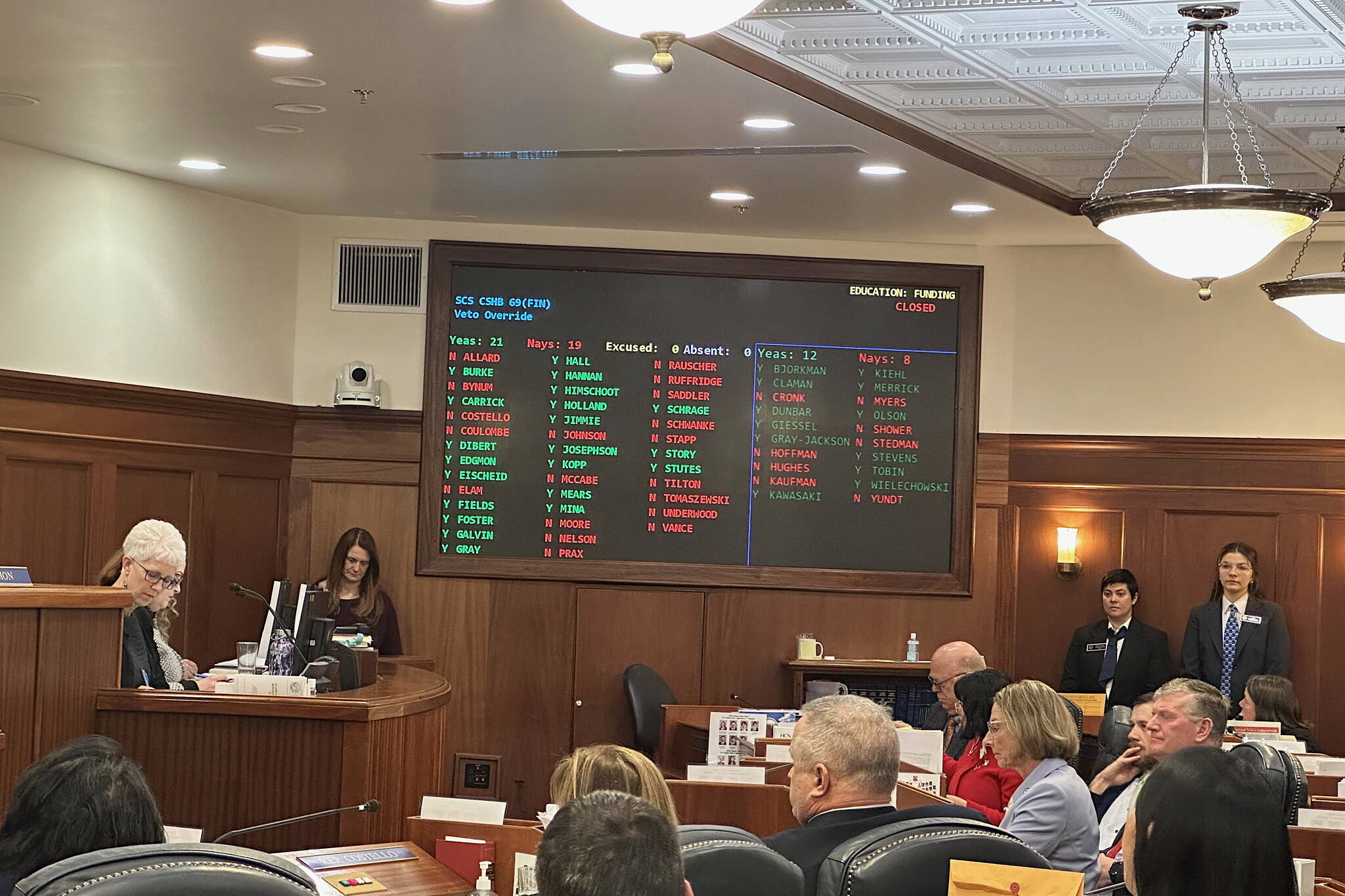
The $1,000 BSA bill is dead. Long live the $700 BSA bill.
A quick revival of efforts to increase the statutory $5,960 Base Student Allocation occurred Wednesday when the Senate Finance Committee attached a $700 BSA increase to a bill passed last week by the House requiring school districts to regulate students’ use of phones during normal school hours. The committee meeting lasted six minutes.
The change to House Bill 57 occurred one day after the Alaska Legislature failed to override Republican Gov. Mike Dunleavy’s veto of a bill increasing the BSA by $1,000. Lawmakers casting votes for and against the veto acknowledged Wednesday the lower BSA increase would likely get more support in another override vote.
The $700 hike matches what Dunleavy is proposing in a bill introduced this week — containing a $560 BSA hike and about $140 in per-student funding for dedicated policy purposes — and is comparable to a one-time BSA increase in effect this year.
The modifications made during Wednesday’s hasty committee meeting to HB 57, originally introduced by Rep. Zach Fields (D-Anchorage), also increases student transportation by 10%. Brief testimony supporting the changes was offered by Lisa Parady, executive director of the Alaska Council of School Administrators.
“We, on behalf of my members, greatly appreciate your efforts to continue the discussion about the critical nature of increasing the Base Student Allocation inside the formula,” she told the committee. “Additionally, the pupil transportation dollars are urgently needed as well. So we’re grateful for these efforts and look forward to the continued discussion.”
Sen. Jesse Kiehl, a Juneau Democrat and member of the Senate Finance Committee, said in an interview after the meeting that adding the BSA hike to a bill that’s already advanced through much of the process means there can be a quick Senate floor vote and a House concurrence vote on the changes. Dunleavy would then have 15 days to sign or veto it — and with 28 days left until the May 21 scheduled adjournment date “we would still be in session when the veto moves back.”
Tuesday’s veto override on the $1,000 BSA increase failed by a 33-27 vote, meaning seven additional votes would be needed for the bill with the $700 increase.
Two could come from Senate Finance Committee co-chairs who upheld the veto Tuesday, but have expressed support for a lower-level BSA increase. Senate Minority Leader Mike Shower (R-Wasilla) acknowledged in an interview Wednesday there could also be some defectors from the Republican minority caucuses in the House and Senate, all of whom voted Tuesday to uphold the veto.
“I think that if they did a stripped-down bill with $700 there’s probably some people that would cave on that due to pressure in their districts,” he said.
However, Shower said he questions if there will be enough support to pass legislation that contains only an increase in per-student funding. Dunleavy and minority caucus members have stated throughout the session they support some type of funding increase, but also want education policy changes that provide more support for charter schools and homeschooling, allow more flexibility for students to enroll in schools outside their home district, and impose academic accountability measures on districts.
Rep. Andi Story, a Juneau Democrat who co-chairs the House Education Committee, said Wednesday she was aware the Senate committee would be adding the BSA hike to HB 57 — and noted limitations on student cell phone use are an education policy goal with broad bipartisan support this session. She also noted her committee heard a bill Wednesday morning that increases support for school districts’ pre-kindergarten programs, which aligns with goals Dunleavy is seeking such as expanding the Alaska Reads Act to cover grades K-6 rather than the existing K-3.
“There are a lot of policy things that we can put in that we know move the dial,” she said.
• Contact Mark Sabbatini at mark.sabbatini@juneauempire.com or (907) 957-2306.
