
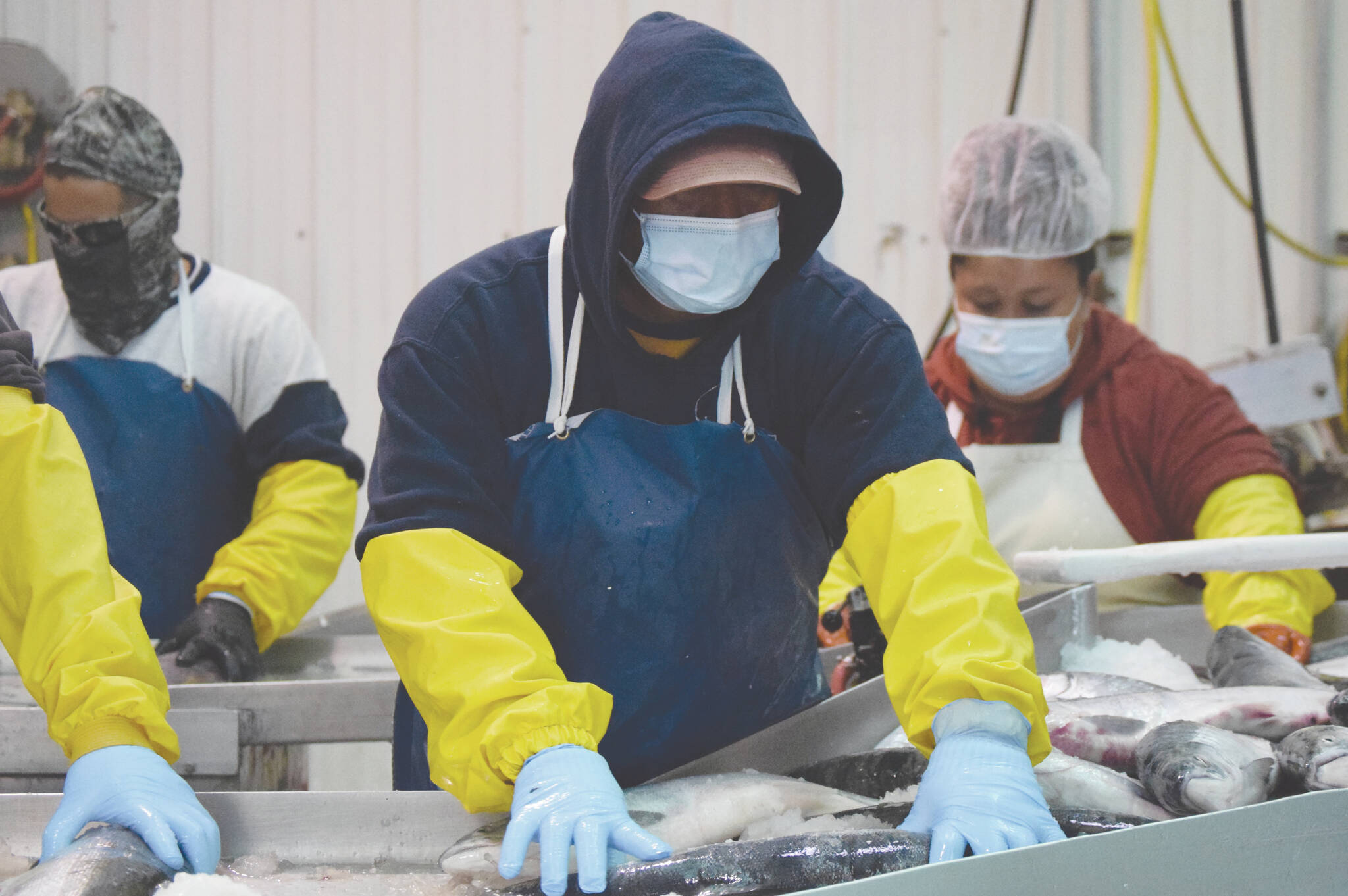
Joseph Lee, of Idaho, backed by Ivan Zarate, of Arizona, and Abiud Zarate, of Baja California, Mexico, arrange fish so their heads can be chopped off by a guillotine-style machine Tuesday, July 14, 2020, at Pacific Star Seafoods in Kenai, Alaska. Not only were seafood jobs lost due to COVID restrictions, infections among industry personnel affected the fishing season. (Photo by Jeff Helminiak/Peninsula Clarion)

Joseph Lee, of Idaho, backed by Ivan Zarate, of Arizona, and Abiud Zarate, of Baja California, Mexico, arrange fish so their heads can be chopped off by a guillotine-style machine Tuesday, July 14, 2020, at Pacific Star Seafoods in Kenai, Alaska. Not only were seafood jobs lost due to COVID restrictions, infections among industry personnel affected the fishing season. (Photo by Jeff Helminiak/Peninsula Clarion)

Seafood industry hit hard by pandemic

Overall fish harvesting jobs in Alaska dropped by the widest margin since 2000 — 14.1% — in 2020.

The seafood industry in Alaska has taken a historic hit since the coronavirus was first detected in the state nearly two years ago, according to the November edition of the Alaska Economic Trends magazine released by the Department of Labor and Workforce Development.

Overall fish harvesting jobs in Alaska dropped by the widest margin since 2000 — 14.1% — in 2020. In Southcentral, the average monthly job count dipped from 1,690 in 2019 to 1,419 last year, the department reported.

Joshua Warren, an economist with the state, said the seafood harvest industry accounts for about 6% of employment in Alaska.

With disruptions from the pandemic, Warren said the whole state felt the impacts.

“We saw decreases throughout the entirety of the state,” he said.

Some notable challenges posed by the pandemic included restaurant closures, quarantine mandates, travel restrictions and social distancing. The industry spent an estimated $70 million on COVID-19 mitigation in 2020, which included quarantines, facility modification, transportation, cleaning and personal protective equipment, according to the Trends report.

Salmon is the species most harvested in the Southcentral region, along with halibut and some other species.

The magazine stated that the groundfish harvest had already lost jobs a few months before the pandemic. The small shellfish fishery saw a 25% decrease in employment, but the herring fisher was “unaffected.”

Warren said the job losses in the seafood industry are significant.

“While it’s only 6% of state employment … for some regions fishing is their predominant economic impact,” he said.

Ted Crookston has been commercial fishing in Alaska for 57 years, and said the past two seasons have definitely put a strain on his operation.

“People were sent home (and) let go,” he said.

Crookston said the hardships brought on by the pandemic were exacerbated by the closures of the east side setnet fishery.

“We were certainly impacted by the closures,” he said. “We had geared up for the (COVID) regulations. … Had we been allowed to fish we would have gotten through that.”

When the king salmon sport fishery on the Kenai and Kasilof rivers was closed this July, it also forced a shutdown of the east side setnet fishery.

“We never had a chance to put our (COVID) measures to the test,” Crookston said.

Looking forward to next season, he said he is “ridiculously … optimistic,” likely because he has the “fisherman gene” in his blood.

“We will gear up constantly and cover our bases as best we can,” Crookston said.

According to the Trends report, the industry has recovered about 42% of the jobs it lost in the summer of 2020 — at the peak of job losses.

Travel restrictions have also affected the industry, as approximately 75% of seafood processing workers are from out of state.

Almost half of all the statewide seafood processors work in the Bristol Bay and Bering Sea fisheries, but the Gulf Coast — which includes the Kenai Peninsula — is the next largest area with about 5,200 out-of-state workers, Trends reported.

Not only were seafood jobs lost due to COVID restrictions, infections among industry personnel affected the fishing season.

According to Trends, through October 2020, there had been 663 confirmed COVID cases among seafood workers, which amounted to about 5% of Alaska’s total cases.

The largest COVID outbreak was recorded in the last two weeks of July 2020 during salmon season, before COVID-19 vaccines were approved by the Food and Drug Administration and the Centers for Disease Control and Prevention.

The magazine reported that COVID cases among seafood workers fell dramatically after vaccines became available.

Warren said he steers clear of making economic projections for the state seafood industry, but that he hopes more fishermen can come to Alaska next season.

The full Alaska Economic Trends magazine can be found at labor.alaska.gov/trends/nov21.pdf.

Reach reporter Camille Botello at camille.botello@peninsulaclarion.com.

More in News

A snowmachine rider takes advantage of 2 feet of fresh snow on a field down Murwood Avenue in Soldotna, Alaska, on Monday, Dec. 12, 2022. (Jake Dye/Peninsula Clarion)
Ice fishing opens on some Kenai National Wildlife Refuge lakes

Snowmachines are permitted for ice fishing access on Hidden, Kelly, Petersen, Engineer and Watson lakes.

The waters of Cook Inlet lap against Nikishka Beach in Nikiski, Alaska, where several local fish sites are located, on Friday, March 24, 2023. (Jake Dye/Peninsula Clarion)
Kenai asks for fishery economic disaster declaration

The Kenai City Council requested that Gov. Dunleavy declare a disaster and support a recovery plan for the Upper Cook Inlet East Side Set Net fishery.

The Kenai Peninsula Borough School District logo. (Photo courtesy of Kenai Peninsula Borough School District)
District superintendent dispels rumors about student construction

Superintendent Clayton Holland said student involvement in Seward High School construction is “based on rumor, not fact.”

Anchorage-based singer and songwriter Keeley Boyle is pictured in Anchorage<ins>, Alaska,</ins> on Sept. 26, 2023. Boyle, who was raised on the Kenai Peninsula, will use a $10,000 grant she received from the Rasmuson Foundation to create an album of songs about her grandparents’ home in Nikiski. Photo courtesy of Jovell Rennie
Musician hailing from Kenai receives Rasmuson grant

Keeley Boyle will record an album of songs about her grandparents’ Nikiski home.

Commercial fishing and recreational vessels are docked in the Homer harbor on Oct. 23, 2025. The commercial fishing industry endured a series of challenges over the year, some of them imposed by the new Trump administration. (Photo by Yereth Rosen/Alaska Beacon)
Alaska fisheries in 2025: turmoil, economic and environmental challenges and some bright spots

NOAA cuts, economic headwinds and invasive species pose problems, but there was some recovery in crab stocks and salmon harvests.

Cook Inlet near Clam Gulch is seen on Oct. 23, 2025. (Photo by Yereth Rosen/Alaska Beacon)
Disputed oil lease sale in Alaska’s Cook Inlet upheld in new Trump administration decision

After completing a court-ordered environmental study, the Bureau of Ocean Energy Management said no changes are needed for the 2022 sale that drew just one bid.

The Kenai Peninsula Borough School District logo.
School district projects $7.5 million budget deficit for fiscal year 2027

Decreased enrollment and increased property values mean less local and state funding.

The sign in front of the Homer Electric Association building in Kenai, Alaska as seen on April 1, 2020. (Photo by Brian Mazurek/Peninsula Clarion)
Homer Electric Association announces rate increase

The proposed increase, if approved by the Regulatory Commission of Alaska, will go into effect Jan. 1.

A photo of Anesha “Duffy” Murnane, missing since Oct. 17, 2019, in Homer, Alaska. (Photo provided, Homer Police Department)
Calderwood pretrial hearing rescheduled

The omnibus hearing for Kirby Calderwood was continued to Jan. 21. Trial week is currently scheduled for Feb. 17, barring finalization of a plea agreement.

Most Read