School district gives community a look at budget
Published 9:30 pm Sunday, February 23, 2020
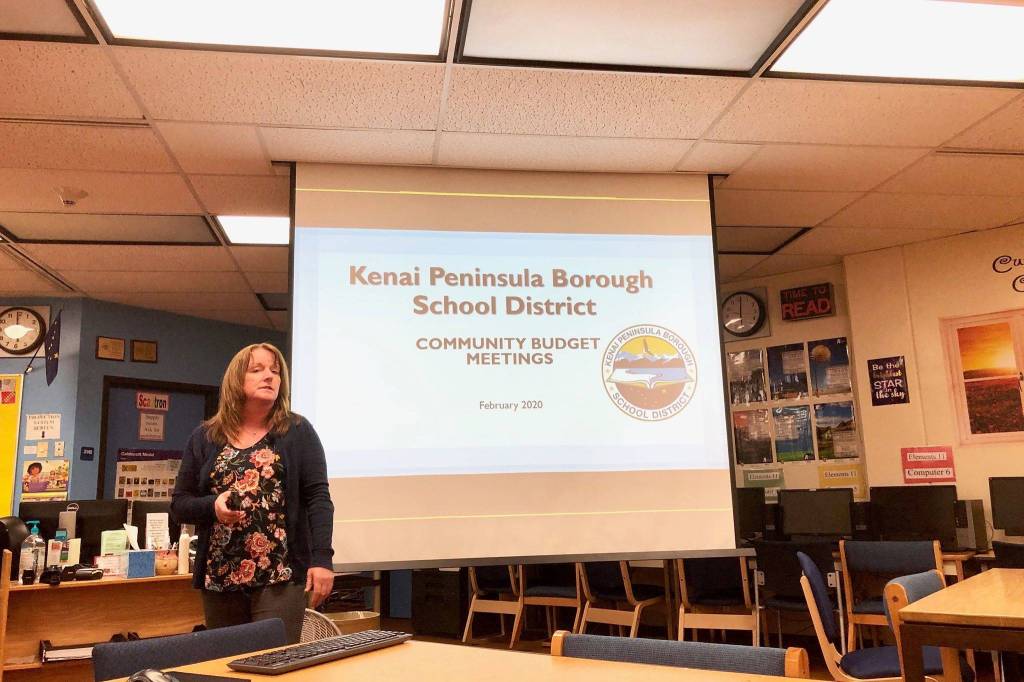

In an effort to engage the public in its budget process, the school district administration presented details about the upcoming budget to a group of 15 or so community members last Thursday at the Soldotna High School Library.
The event was a part of a series of budget meetings the Kenai Peninsula Borough School District has been holding across the peninsula to inform community members, parents and employees on the district’s spending and revenue history, as well as its current fiscal year 2021 budget outlook.
Many of the audience members at Thursday’s meeting in Soldotna were district employees working at schools in the area.
The principal of K-Beach Elementary, Janae Van Slyke, said she came to the meeting because she cares about her students and her school.
“We’re looking at the budget for the next school year and how it might impact our needs,” Van Slyke said.
A K-Beach Elementary paraprofessional, Jena Kruzick, said she came to the meeting to see what the upcoming FY21 budget might look like.
“I care about the school district and our school and it’s nice to see where the budget is going to go in the coming year,” Kruzick said.
With no major cuts in Gov. Mike Dunleavy’s proposed FY21 budget, the district’s budget outlook is less daunting. Last year, the district was looking at a potential loss of $20 million in revenue from Dunleavy’s proposed FY20 budget, which would have resulted in shuttered schools, loss of sports and activities in some areas and a higher pupil-to-teacher-ratio districtwide.
In the end, the district received some one-time funding, full funding from the borough and base funding from the state. Cuts were still felt, with the consolidation of Soldotna Prep School and Soldotna High School and an increase of five students to the pupil-to-teacher-ratio at the high school level.
Director of Finance for the district, Elizabeth Hayes, presented to the public at Thursday’s meeting. She said the district is not going to make cuts this year, in FY21. The FY20 budget is ending with about $3.9 million in unassigned fund balance, which will carry over to help meet the district’s deficit this year. However, next year’s budget is a different story.
If there are no changes at the state level, the district will be going back to see what they can cut in FY22, Dave Jones, the district assistant superintendent of instructional support, said at Thursday’s meeting.
“Next year, if we don’t have additional funding at the state level we’re going to be back to considering cutting programs that we need,” Jones said. “… The last couple budget cycles for us have been very horrendous with all the stuff we have been facing.”
The borough, which is the second biggest funder of the district behind the state, has told district administration they intend to fund them to the max at $52,776,437, Hayes said.
Money from the state and the borough make up nearly all of the revenue the district receives — 99% — with the state funding about 62% and the borough funding 37%. The state uses a foundation formula of $5,930 per student to allocate costs for districts.
In their FY21 budget, the district is looking at $3 million less revenue than last year, due to a lack of enrollment or any one-time funding similar to what they received from the Legislature last year.
The lack of enrollment is something the district has been steadily dealing with the last couple of years. Because of the foundation formula, every student lost in the district means nearly $6,000 less coming from the state level.
Jones said the district tries to keep track of where students go when they leave and what the district can do to bring students in. He said most students are leaving for state home-schooling programs or because their family is moving out of state due to a lack of jobs and the economy. The district offers a home-school program for students within the borough. But, other programs like Interior Distance Learning of Alaska, which operates out of Galena, targets students from across the state.
“We like to say we should shop local,” Jones said. “So if you’re the folks that would like to home-school your kids that’s great, but you should do it in the school district here where the money is spent. It supports the communities that you live in, not Galena or other places.”
On the expenditures side of the budget, district administration noted that since fiscal year 2015, the district has reduced expenditures by $11,091,048. About 80% of all expenditures, or $69,863,715, is for salaries and benefits of employees.
One audience member at the meeting asked district administration if any expenditure or in-kind services from the borough would be used to maintain aging school buildings. Jones said the district and the borough are working on a bond package that would help to pay for new heating control systems, new roofs, new windows, a new school in Kachemak Selo, and other worn infrastructure needs across the borough’s schools.
He said Homer High School’s heat control system is in need of repair. The system, which still uses floppy disk technology from the 1980s, failed over winter break, causing a pipe to freeze and burst. Maintenance workers who happened to be inside the school were able to address the issue the same day.
“They caught the water leak, otherwise the theater and the stage would have been a large loss,” Jones said. “So that’s why we need to (update) the heating control system. There are other ones like that across the district, maybe not quite as bad as the floppy disk (Homer High).”
In April, the Kenai Peninsula Borough School District Board of Education will finalize the FY21 budget for the district, which will then get handed to the borough and added to the borough’s final FY21 budget. After that, the district will wait on lawmakers to finalize the state budget.
Hayes and Jones said anyone who has any questions or concerns about the district’s budget process should reach out to them at 907-714-8888. They also encouraged people to voice their feelings on the state’s education funding to local lawmakers.