School board work sessions to tackle charters, 4-day week, cellphone policies
Published 9:30 pm Tuesday, October 29, 2024
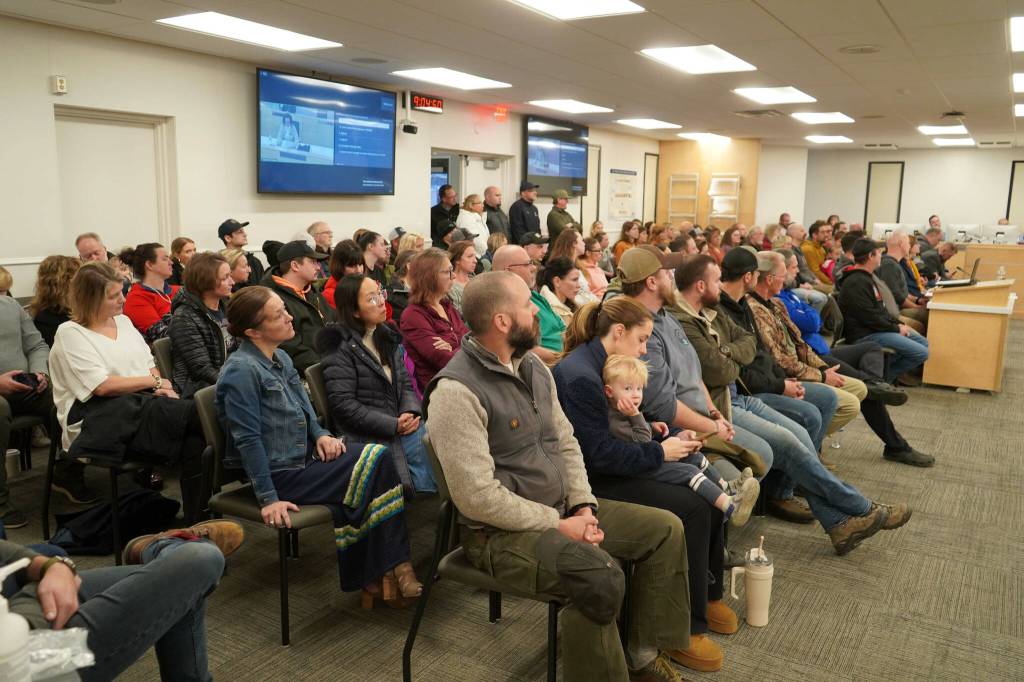
During work sessions Monday and Tuesday, the Kenai Peninsula Borough School District’s Board of Education will discuss several high-interest topics including a proposed four-day school week, an updated districtwide cellphone policy, a charter application from the Kenaitze Indian Tribe and a charter renewal from Aurora Borealis Charter School.
None of these items are set to also appear as action items on the board’s regular meeting agenda for Nov. 4.
On Monday, Nov. 4, work sessions are scheduled for both charter applications and an update on the four-day school week. The application by Kenaitze Indian Tribe is scheduled for 11 a.m., followed by the Aurora Borealis renewal at 1:30 p.m. The four-day school week update is set for 3:45 p.m.
During the board’s quarterly work session on Tuesday, Nov. 5, a “book discussion” on “The Anxious Generation: How the Great Rewiring of Childhood is Causing an Epidemic of Mental Illness” by Jonathan Haidt is scheduled for 8:45 a.m. and discussion of cellphone policy is set for 11:30 a.m.
Chatting about charters
The charter meetings follow two meetings held by the board’s Charter Oversight Committee in October where the two groups fielded questions about their charters and ultimately were forwarded to the board for full approval.
The proposal by the tribe, for Tułen Charter School, describes a K-3 school hosted at the Kahtnuht’ana Duhdeldiht Campus in Kenai. In response to committee questions, the tribe modified its proposed calendar — which includes a complete closure for Subsistence Week — and is continuing to explore staffing requirements for custodians and nurses.
After questions were asked of Aurora Borealis Charter School’s special education, transportation and food service programs during their first meeting on Oct. 14, the school returned with 100 supporters on Oct. 21.
Academic policy committee chair Daniel Mahr during the second meeting called board question of his school’s charter “accusations and attack.” He discussed, particularly, conversations by the board around funding calculated through the state’s foundation formula — exactly the same calculation as is directed at all public schools as part of the base student allocation — that cites “special needs funding.” That money, Mahr said, is not directed toward special education and instead is included with all other funding as a lump sum that can be spent for any of the school’s needs — a statement confirmed during the meeting by KPBSD Executive Director of Finance Liz Hayes.
Aurora Borealis also said it could not provide lunch service and that transportation would be unfeasible for its student population, and the charter’s application was advanced to the board without objection.
Considering a changed calendar
Starting in January, a temporary committee of the board explored the possibility of moving to a four-day school week in the district. That committee delivered their recommendation to the board in July — asking district leadership to create a possible plan for the model that could be brought to the community for input and consideration.
Included in the work session notes is a “Hypothetical 4 Day Week Calendar” that describes weeks running from Monday to Thursday starting in August 2025. School would start on Aug. 18 and run until May 21, and there are 15 Fridays that would remain teacher work days — roughly two per month.
Also included in the notes are a draft survey that could be employed to query the wider community about the idea and supporting information about the number of classroom hours students require, the number of days of in-service training teachers require and an exploration of how a change to the school week might interact with requirements for teacher retirement.
Pondering phone policies
The State Department of Education and Early Development in October began work on a policy that would limit the use of cellphones during class hours. Policies restricting the use of phones in the classroom are already in place at some KPBSD schools including Nikiski Middle/High School and Kenai Alternative High School.
The KPBSD school board will on Tuesday “discuss the current KPBSD cell phone policy.”
The current policy says that phones may be possessed and used by students outside of instructional time or during group activities like assemblies. Certain uses are prohibited such as accessing sites “otherwise blocked to students,” harassing or bullying other people, or recording the content of tests and homework without permission.
That conversation is scheduled to follow a discussion of Haidt’s “The Anxious Generation.” That book has been supported at several recent board meetings by Board Vice President Jason Tauriainen — to other board members and to members of the public.
“I do want to recommend this book to anybody that’s listening — ‘The Anxious Generation,’” he said on Aug. 5. “We need to do something about cellphones.”
On Sept. 9, Tauriainen said during a board meeting that the school board was reading “The Anxious Generation” as a collective.
That book argues that the rise of smartphones have directly correlated to a rise in the rate of childhood illness in children and teens — by moving children away from in-person play and exposing them to other harms — though critics of the book have argued that it fails to consider the impact on young people of global and societal issues like climate change and school shootings.
Board of Education agendas can be found at the KPBSD BoardDocs website.
Reach reporter Jake Dye at jacob.dye@cmg-northwest2.go-vip.net/peninsulaclarion.