
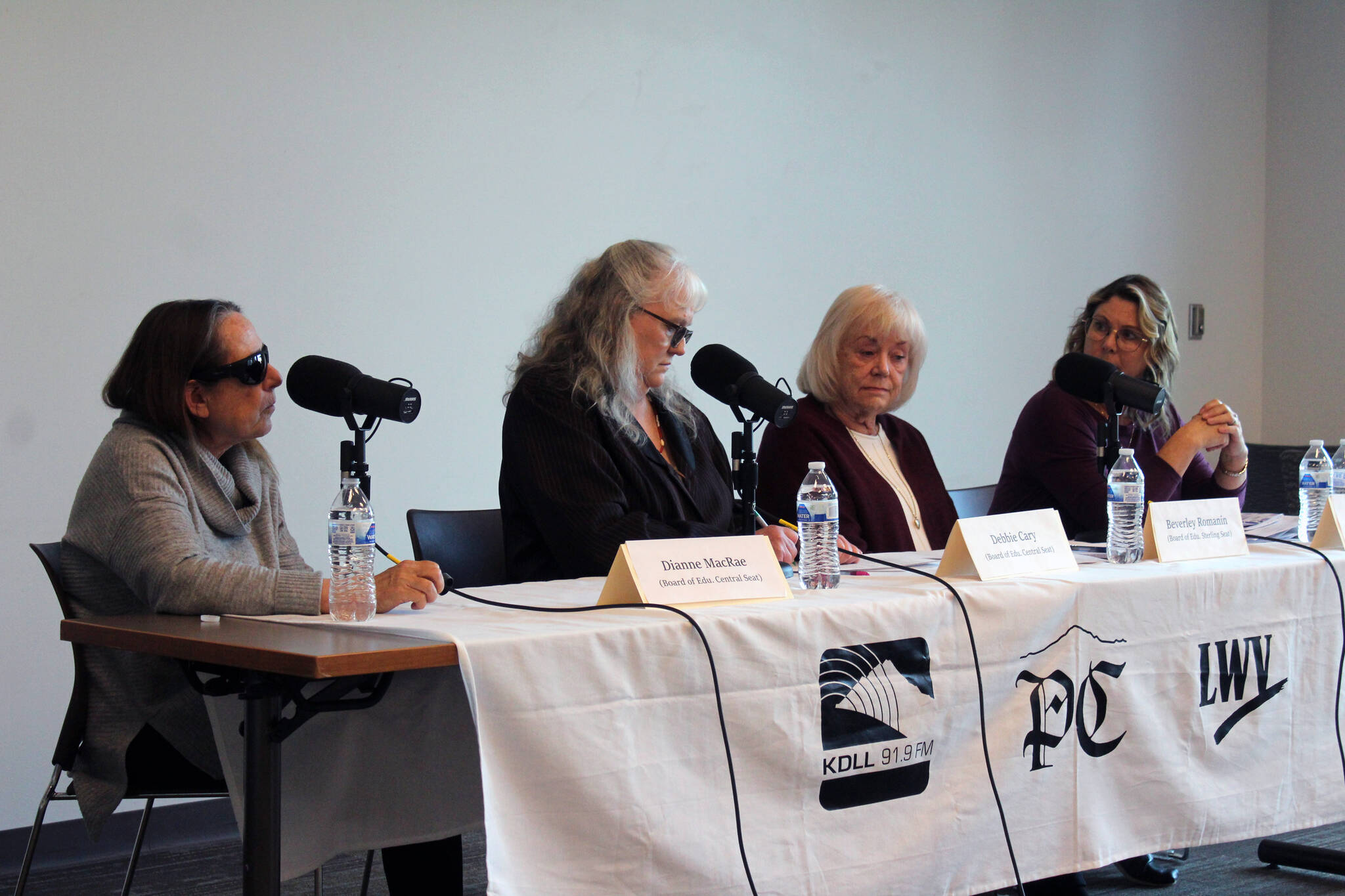
Candidates for seats on the Kenai Peninsula Borough School District Board of Education gathered Thursday in the Soldotna Public Library to talk about topics related to peninsula schools as part of a candidate forum moderated by the Peninsula Clarion and KDLL 91.9 FM public radio.
The forum, hosted in partnership with the Central Peninsula League of Women Voters and the Soldotna Public Library, was the last of eight held throughout September in advance of Tuesday’s municipal election.
Over the course of about an hour, candidates fielded questions from forum moderators Ashlyn O’Hara, the Peninsula Clarion’s government and education reporter, and Riley Board, a reporter at KDLL. Voters in the Kenai Peninsula Borough School District’s Soldotna, Nikiski, Sterling and Central districts will cast ballots for a school board candidate.
Whoever is elected to the assembly’s Central seat will serve a three-year term, while the person elected to the Sterling seat will serve a one-year term. That’s because they’ll be finishing out the term of Jessica Waller, who resigned her seat last fall and was first elected in 2021. A separate forum featuring candidates for the school board’s Nikiski and Soldotna seats was held Monday.
Participating in Thursday’s forum were Kelley Cizek, Beverley Romanin, Debbie Cary and Dianne MacRae. Cizek is challenging incumbent Romanin for the board’s assembly seat. MacRae is running against incumbent Cary for the Central seat.
Cary is the current president of the KPBSD school board and is a business owner in Ninilchik. MacRae holds a bachelor’s degree from St. Mary of the Plains College and is a former substitute teacher in Juneau.
Romanin is the sitting school board representative for the Sterling and Funny River area and has an extensive background in education working as a superintendent, principal, classroom teacher and long-term substitute teacher. Cizek holds a bachelor’s degree in economics and is a former office administrator at Cook Inlet Academy.
None of the candidates who participated in Thursday’s forum currently have children who attend KPBSD schools.
Cary said her youngest child graduated two years ago. Romanin said both children are grown and live out of state. Cizek also said her children are grown and later that they were home-schooled and attended Cook Inlet Academy. MacRae said her son is a graduate of Soldotna High School.
KPBSD Finance Director Liz Hayes told school board members earlier this month that the district will start the upcoming fiscal year with a minimum of a $13 million deficit. When faced with a similar situation for the current fiscal year, the school district implemented budget cuts to help offset the deficit amount, along with using federal COVID-19 relief funds and money from savings.
Candidates on Thursday’s had different strategies for handling budget cuts. Cizek mentioned school consolidation as an idea she’s heard community members express interest in, while MacRae said there may be opportunities to supplement school programming with community participation when it comes to things like art and music.
Cary and Romanin said their strategy is to keep budget cuts away from classrooms, with Cary adding the cuts to small schools often effectuate cuts to community hubs.
“My philosophy is always going to be to keep the cuts as far from the classroom as possible,” Cary said. “My hope is that we can come together as a state and we can say education is important, our children are important (and) we need to fund education.”
Relatedly, candidates also differed on their opinions about increasing the base student allocation, or the amount of money school districts receive per student from the State of Alaska. The amount has largely stayed flat since fiscal year 2017, and KPBSD lobbied heavily last session for a meaningful increase to the amount.
Cary and Romanin said directly that they support increasing the amount, with Cary saying that the district has made cuts annually during the six years she’s served on the board. Romanin said flat funding since fiscal year 2017 means education spending has not kept pace with inflation and that the buying power of school dollars has gone down.
MacRae said the question of whether or not to increase the BSA depends on whether such a move is feasible for the State of Alaska. Cizek said she thinks the amount is “probably OK where it’s at” and said she doesn’t see educational outcomes as being where they should be considering how much money the state spends per student.
“There is a lot of money per student that is going toward education and I don’t see the results that we want in how our kids are being educated right now,” Cizek said.
When it comes to recruiting and retaining quality educators, candidates were generally in agreement that a return to a defined benefit retirement plan for teachers and a healthy dialogue during upcoming contract negotiations between the school district and the district’s two unions are important.
MacRae said teachers aren’t always in it for the money, and that the district could try reaching out to new college graduates interested in relocating to Alaska. Cary also voiced her support for so-called “grow-your-own” programs, which help train KPBSD graduates to become KPBSD staff members.
Both Cizek and Romanin said a return to defined benefits for educators is key to reassuring district staff that they’ll have a place to land when they start thinking about retirement.
“People that live here and want to teach should have an opportunity to be able to do that, but I think the defined benefit is just going to have to happen or we’re not going to have anybody coming in,” Romanin said.
On the topic of home-schooling, candidates said communication between the school district and parents who home-school is key. More than 1,400 school-age children living on the peninsula attend a home-school program that isn’t Connections, KPBSD’s home-school program.
Cary plugged an Oct. 5 being held by the school district and the Kenai Peninsula Borough that is intended to start such a conversation about the topic, and Romanin agreed that the event is “a good place to start.” MacRae agreed that the school district should listen to what parents say during the town hall meeting before making any decisions about its own program.
“There must be a reason why they’re saying we’d rather go to IDEA,” MacRae said. “So let’s wait until we find out what the results are before we figure out what to do.”
Cizek, who temporarily home-schooled her two children, said Connections has, over the last 15 years, become more competitive with other Alaska programs.
“Parents want to have a choice of what their kids are learning, they want to know their kids are safe,” Cizek said. “They want to know that if they have the opportunity, they want to be able to be the ones to input that into their children. I think Connections is a good choice in our district.”
Cizek, Romanin and Cary said they think the Alaska Reads Act is a good thing for Alaska, with candidates offering different ideas for how to best support staff and students as they roll out programs mandated by the legislation, such as new literacy curricula and certifications for teachers.
Cary said giving teachers time to collaborate and compare notes with each other to find out what is and isn’t working is important, and Romanin said keeping teachers up to date with best practices is as advantageous as in any other field.
“We have to keep making these changes to stay up (to date),” Romanin said. “We wouldn’t want a surgeon going in and doing brain surgery on us if they hadn’t kept up with the latest research. It’s the same with teachers.”
MacRae and Cizek generally agreed that deviating from “tried and true” practices may be cumbersome for educators.
“Constant influx with the curriculum, I think, is causing a problem,” MaCrae said.
Tuesday’s election will come as the district works with the borough to spend $65.5 million worth of bonds approved by voters last fall to address deferred maintenance at district schools. Prior to that election, the district estimated that deferred maintenance projects totaled about $250 million.
Cizek said the longer the district and borough put off maintenance work, the more expensive that work is going to become. MacRae agreed that schools in need of repair are only going to get worse while waiting for improvements. Romanin said anyone who’s lived in an old home should be able to understand the work that goes into maintaining aging facilities.
Cary underscored the role the suspension of Alaska’s school bond debt reimbursement program has had on KPBSD maintenance, but said she’s optimistic about the way the borough and the school district are currently working together.
“I think that the borough and the school district at this point (are) communicating and doing an excellent job of saying, ‘This is what we’re going to do and this is how we’re going to do it,’” Cary said. “So let’s just stick to the plan and get it done.”
Candidates also talked about their vision for the school district over the next five to 10 years and were given the opportunity to make both opening and closing statements.
Election day is Oct. 3. Monday’s full candidate forum can be streamed on the Clarion’s Facebook page or on KDLL’s website at kdll.org.
Reach reporter Ashlyn O’Hara at ashlyn.ohara@peninsulaclarion.com.
