
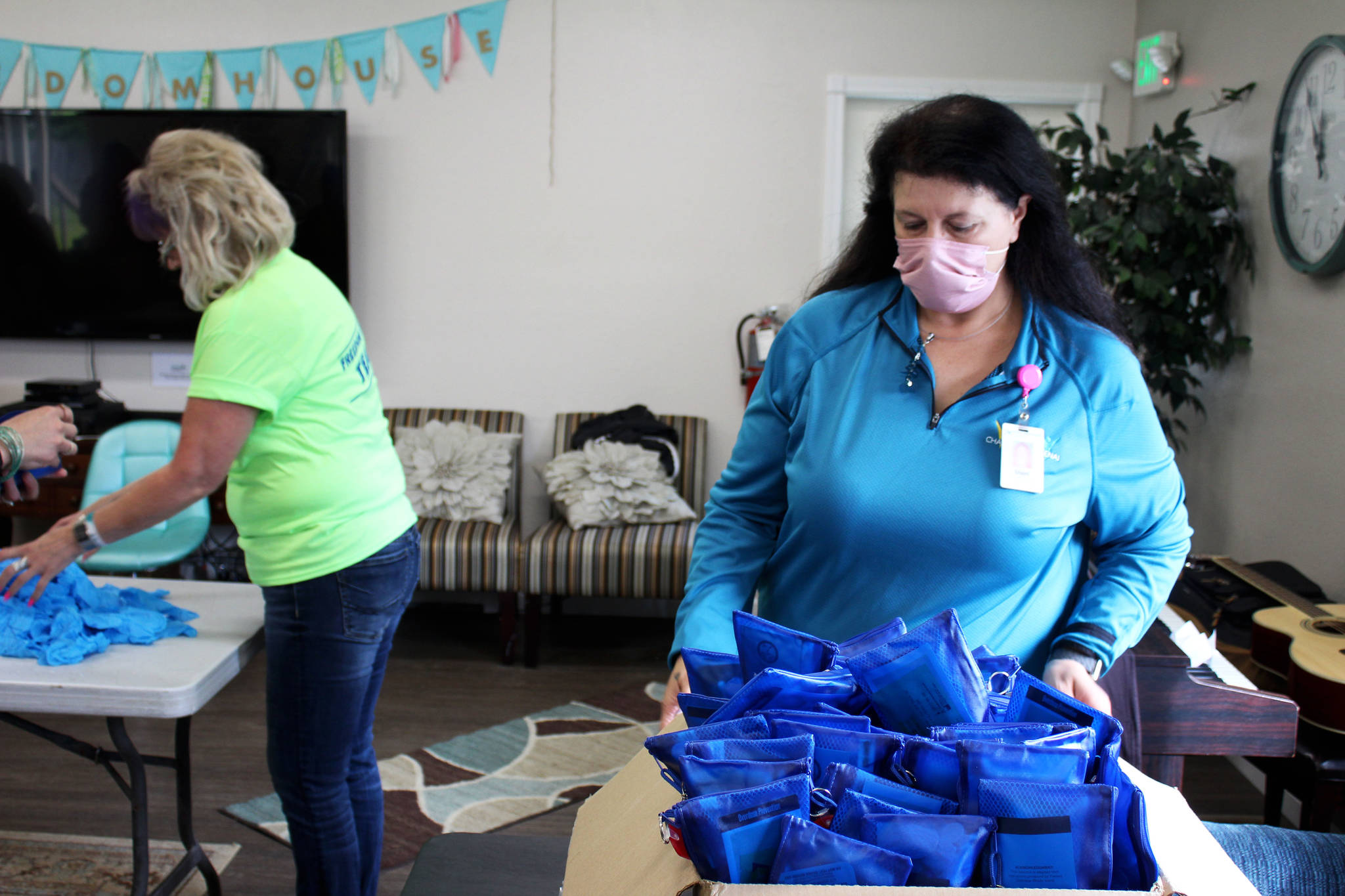
Shari Conner, a coalition coordinator for Change 4 the Kenai, adjusts a box of Narcan kits on Thursday, Aug. 12, 2021 at Freedom House in Soldotna, Alaska. (Ashlyn O’Hara/Peninsula Clarion)

Shari Conner, a coalition coordinator for Change 4 the Kenai, adjusts a box of Narcan kits on Thursday, Aug. 12, 2021 at Freedom House in Soldotna, Alaska. (Ashlyn O’Hara/Peninsula Clarion)

‘Save someone’s life’

Narcan kits assembled at workshop on preventing opioid overdoses.

“Overdoses are preventable.”

That was the message Shari Conner, a coalition coordinator for Change 4 the Kenai, sought to impart during a community event held Thursday at Freedom House in Soldotna.

The event explained how to administer Narcan and included the assembly of free Narcan kits by attendees. Narcan is a brand name version of the medication naloxone that is used in the event of an opioid overdose. It comes in the form of a nasal spray.

The National Institutes of Health describes naloxone as an “opioid antagonist,” meaning it attaches to opioid receptors and reverses and blocks the effects of other opioids.

Conner, who also works at Central Peninsula Hospital, said to think of opioids like tiny golf balls and someone’s neuron receptors like golf tees. As long as the opioid is active, it sits on the “tee” of someone’s receptors. When the opioid dies, it falls off the receptor and new opioids stick on them.

“The more opioids that are on your receptors, the more slowed down your central nervous system is until it goes to sleep and doesn’t work any longer,” Conner said.

Naloxone knocks all the opioids off their receptor tees.

The drug only has a half-life of about 30 minutes, however. Once it starts dying, opioids rush to fill those tees back up. That’s why it’s so important for the person responding to the overdose to call 911.

But how can you tell if someone has overdosed? According to the U.S. Centers for Disease Control and Prevention, signs of an opioid overdose include loss of consciousness, slow or shallow breathing, pale or blue skin, a limp body and constricted pupils, among others. The CDC instructs that if you find someone who you think is overdosing, call 911 immediately.

If the person is not responsive, Conner said to try and rouse them. That may include yelling the person’s name and administering a sternal rub, which involves rubbing your knuckles hard against the sternum of the person who is unresponsive. Then, move to naloxone. To administer Narcan, push the plunger into the nostril of the person who is unresponsive.

“They should immediately respond,” Conner said.

If they don’t, administer another dose. If they still do not respond, begin CPR and chest compressions, which should be administered to the beat of “Staying Alive” by the Bee Gees, Conner said.

Once someone regains consciousness, they may try to leave. Conner said it’s important that people do everything they can to stay with them, including following the person who has regained consciousness and telling emergency personnel where they are.

“The important part is to get those medical professionals there who … have lots more tools than you do to keep people alive,” Conner said.

If nothing else, Conner said, the information people should take away from the seminar is to call 911, always.

“Calling 911 helps save someone’s life,” Conner said.

One of the biggest hurdles in combating addiction, Conner said, is stigma. Normalizing conversations about things like Narcan kits, whether that’s at the doctor’s office when someone is being prescribed opioids or picking a kit up at the pharmacy, is one way to overcome that.

“Addiction is part of our nation if 80,000 people are dying from just opioid overdose,” she said.

The more normalized conversations about addiction and treatment become, Conner said, the less likely someone is to become a statistic.

Event attendees were invited to help assemble Narcan kits using supplies laid out on a table in the middle of the room following Conner’s presentation.

Included in each kit are two Narcan nasal sprays, a face shield to be used during CPR, a fentanyl test strip, two gloves and instructions on how to administer the nasal spray and test strip. Conner said they had the resources Thursday to assemble 500 kits, which she will be able to distribute throughout the community.

A 20-minute course explaining how to administer naloxone can be accessed at getnaloxonenow.org. More information about Change 4 the Kenai can be found at connectkenai.org.

Reach reporter Ashlyn O’Hara at ashlyn.ohara@peninsulaclarion.com.

More in News

David Ross is sworn in as Kenai Police Chief on Tuesday, May 31, 2016 at Kenai City Hall. The Alaska Association of Chiefs of Police named Ross the 2025 Police Chief of the Year, recognizing over two decades of service. Photo by Megan Pacer/Peninsula Clarion
Kenai police chief named 2025 Police Chief of the Year

The Alaska Association of Chiefs of Police recognized David Ross for his more than two decades of leadership.

The cast of Nikiski Middle School’s upcoming performance of “Alice in Wonderland” is pictured on Dec. 2, 2025. The upperclassmen-directed play opens on Friday, with additional showtimes Saturday and next weekend. Photo courtesy of Carla Jenness
Nikiski Middle School debuts student-led “Alice in Wonderland”

The show opens on Friday, with additional showtimes this weekend and next.

On Tuesday, the Kenaitze Indian Tribe unveiled Kahtnu Area Transit, a public transportation service open to the entire Peninsula Borough community. Photo courtesy of Kahtnu Area Transit
Kenaitze Indian Tribe unveils Kahtnu Area Transit

The fixed bus route offers 13 stops between Nikiski and Sterling.

The Kenai Chamber of Commerce and Visitor Center hosts the annual Christmas Comes to Kenai on Nov. 28<ins>, 2025</ins>. The beloved event began over 40 years ago, and this year over 1,000 attendees enjoyed hot chocolate, fireworks, pictures with Santa and shopping. Photo courtesy of the Kenai Chamber of Commerce
 Photo courtesy of the Kenai Chamber of Commerce
The Kenai Chamber of Commerce and Visitor Center hosted the annual Christmas Comes to Kenai on Nov. 28. The beloved event began over 40 years ago, and this year over 1,000 attendees enjoyed hot chocolate, fireworks, pictures with Santa and shopping.
Kicking off a month of holiday festivities

Last weekend’s holiday events, including the annual Christmas Comes to Kenai and the Soldotna Turkey Trot, drew folks from all over the Kenai Peninsula.

Starting Dec. 2, Aleutian Airways will offer roundtrip flights between Anchorage and Unalakleet every Tuesday, Friday and Sunday.
Aleutian Airways to offer roundtrip flights between Anchorage and Unalakleet

Starting Dec. 2, Aleutian Airways will offer three roundtrip flights per week.

The Trump administration’s “Big Beautiful Bill” act requires the Bureau of Ocean Energy management to hold at least six offshore oil and gas lease sales in Alaska between 2026-2028 and 2030-2032. The first of these sales — known as “Big Beautiful Cook Inlet 1,” or BBC1— is scheduled for March 2026. Photo courtesy of the Bureau of Ocean Energy Management
Cook Inletkeeper launches petition against federal government

The organization is calling for transparency in Cook Inlet offshore oil and gas sales.

Winter dining has always carried more weight than the menu might suggest. In the off-season, eating out isn’t just about comfort food or convenience; it’s a way of supporting local businesses as they hold steady through the slower months. Photo credit: Canva.
The ripple effect: How local spending builds stronger communities on the Kenai Peninsula

From cozy cafés to fine-dining bistros, purchases made close to home sustain local jobs and services

Courtesy Harvest
On the Kenai Peninsula, a dormant liquefied natural gas export plant could be repurposed to receive cargoes of imported LNG under a plan being studied by Harvest, an affiliate of oil and gas company Hilcorp. The fuel would be transferred from ships to the tanks on the left, still in liquid form, before being converted back into gas and sent into a pipeline.
Utilities say Alaska needs an LNG import terminal. Consumers could end up paying for two.

Planning for two separate projects is currently moving ahead.

A map shows the locations of the 21 Alaska federal offshore oil and gas lease sales proposed by the Trump administration. (Map provided by the U.S. Bureau of Ocean Energy Management)
Trump administration proposes offshore leasing in almost all Alaska waters

A new five-year offshore oil and gas leasing plan proposes 21 sales in Alaska, from the Gulf of Alaska to the High Arctic, and 13 more off the U.S. West Coast and in the Gulf of Mexico.

Most Read