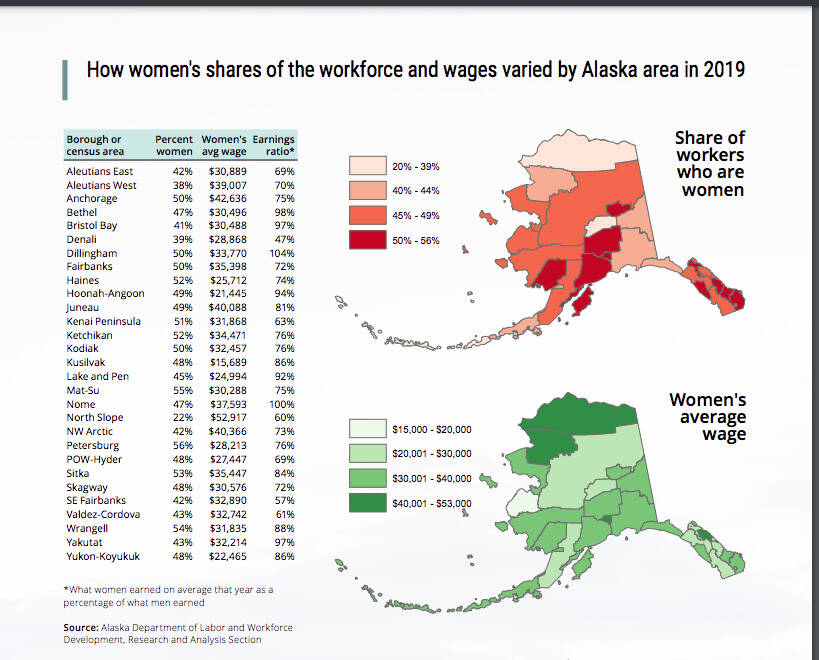
A graphic published in the October 2021 edition of Trends, published by the Alaska Department of Labor and Workforce Development, shows how women’s shares of the workforce and wages in Alaska varied by area in 2019. (Image via labor.alaska.gov)

A graphic published in the October 2021 edition of Trends, published by the Alaska Department of Labor and Workforce Development, shows how women’s shares of the workforce and wages in Alaska varied by area in 2019. (Image via labor.alaska.gov)

Report: Alaska women’s pay lags

On average, women earned about 72% of what men earned in Alaska in 2019.

Women in Alaska earned, on average, about 72% of what men earned in Alaska in 2019.

That’s according to the October issue of Trends, a publication distributed monthly by the Alaska Department of Labor and Workforce Development.

The publication broke down the earnings ratio — what women earned as a percentage of what men earned — in regions across the state.

Historical data show that the earnings ratio in Alaska has increased over the last 30 years, from 62% in 1990 to 72% in 2019. There are varying levels of disparity in different regions of the state.

The earnings ratio was highest in Dillingham and Nome, where the ratio was actually over 100% in 2019, meaning women earned more than men on average that year. The ratio was lowest in southeast Fairbanks and Denali, where the ratios are 57% and 47%, respectively. On the Kenai Peninsula, the earnings ratio is 63%, which ranks it 25 out of 29 Alaska regions.

A woman in Alaska made about $38,000 on average in 2019, whereas a man in Alaska made about $52,000. A woman on the Kenai Peninsula made $31,868 on average in 2019.

The survey found that the wage gap was smallest in Alaska’s urban areas, where women and men had roughly equal representation in the workforce, about 49% and 51% in 2019, respectively. That representation did not translate to wages, where women took home about 40% of wages in 2019 compared to men, who took home about 60% of wages in the same year.

“Although the genders participate in the workforce at nearly equal rates, men earn more in almost 80 percent of Alaska’s occupations and at every age and educational level,” the report says.

But there are several variables impacting how much money someone makes at their job, including education, training, discrimination and hours worked.

While women were found to work in all Alaska industries, the report says, almost 25% work in health care and social assistance, with the second largest industries being in local government, including public schools, and retail. That’s compared to the participation of female workers in industries with “high paying wages,” such as oil and gas, where the participation rate is 2.5%.

Even in industries where women account for most of the workforce they do not always take home the same proportion of wages.

“In all major industry groups, women earn proportionally less than men,” the report says. “Although women make up 76 percent of health care and social assistance, for example, they bring home 70 percent of the wages.”

To compile the data used for the report, the Alaska Department of Labor and Workforce Development matched data taken from Alaska’s unemployment insurance program with demographic data from Alaska Permanent Fund dividend applications.

The resulting database, however, is limited. For example, the two data sources do not allow the department to differentiate between full-time and part-time or seasonal workers, largely leave out nonresident workers, people who are self-employed, federal civilian and military workers and people who did not disclose their gender.

The inclusion of part-time and seasonal workers brings down the average for yearly wages. Additionally, nonresident workers — not included in the data — account for about 20% of Alaska’s workforce. All that means the data are limited, though not useless.

“The data shown here can suggest where further research would be most promising,” the report says.

The full issue of October Trends can be read at alaska.labor.gov.

Reach reporter Ashlyn O’Hara at ashlyn.ohara@peninsulaclarion.com.

More in News

A snowmachine rider takes advantage of 2 feet of fresh snow on a field down Murwood Avenue in Soldotna, Alaska, on Monday, Dec. 12, 2022. (Jake Dye/Peninsula Clarion)
Ice fishing opens on some Kenai National Wildlife Refuge lakes

Snowmachines are permitted for ice fishing access on Hidden, Kelly, Petersen, Engineer and Watson lakes.

The waters of Cook Inlet lap against Nikishka Beach in Nikiski, Alaska, where several local fish sites are located, on Friday, March 24, 2023. (Jake Dye/Peninsula Clarion)
Kenai asks for fishery economic disaster declaration

The Kenai City Council requested that Gov. Dunleavy declare a disaster and support a recovery plan for the Upper Cook Inlet East Side Set Net fishery.

Commercial fishing and recreational vessels are docked in the Homer harbor on Oct. 23, 2025. The commercial fishing industry endured a series of challenges over the year, some of them imposed by the new Trump administration. (Photo by Yereth Rosen/Alaska Beacon)
Alaska fisheries in 2025: turmoil, economic and environmental challenges and some bright spots

NOAA cuts, economic headwinds and invasive species pose problems, but there was some recovery in crab stocks and salmon harvests.

Cook Inlet near Clam Gulch is seen on Oct. 23, 2025. (Photo by Yereth Rosen/Alaska Beacon)
Disputed oil lease sale in Alaska’s Cook Inlet upheld in new Trump administration decision

After completing a court-ordered environmental study, the Bureau of Ocean Energy Management said no changes are needed for the 2022 sale that drew just one bid.

The Kenai Peninsula Borough School District logo.
School district projects $7.5 million budget deficit for fiscal year 2027

Decreased enrollment and increased property values mean less local and state funding.

The sign in front of the Homer Electric Association building in Kenai, Alaska as seen on April 1, 2020. (Photo by Brian Mazurek/Peninsula Clarion)
Homer Electric Association announces rate increase

The proposed increase, if approved by the Regulatory Commission of Alaska, will go into effect Jan. 1.

A photo of Anesha “Duffy” Murnane, missing since Oct. 17, 2019, in Homer, Alaska. (Photo provided, Homer Police Department)
Calderwood pretrial hearing rescheduled

The omnibus hearing for Kirby Calderwood was continued to Jan. 21. Trial week is currently scheduled for Feb. 17, barring finalization of a plea agreement.

Jake Dye/Peninsula Clarion
Joseph Miller Jr. and Jason Woodruff, Alaska State Troopers charged with felony first-degree assault, appear with their lawyers, Clinton Campion and Matthew Widmer, for an arraignment at the Kenai Courthouse in Kenai<ins>, Alaska,</ins> on Thursday, Nov. 14, 2024.
2 Soldotna troopers indicted on federal civil rights violations

Joseph Miller and Jason Woodruff were charged with federal criminal civil rights violations on Dec. 16.

Kevin Ray Hunter is actively sought by Alaska State Troopers on Friday, Dec. 19, 2025. Photo courtesy of Alaska State Troopers
Update: Troopers arrest Kenai man accused of sexual abuse of a minor

A judge issued an arrest warrant for Kevin Ray Hunter, who was indicted on Wednesday for allegedly abusing multiple juveniles.

Most Read