
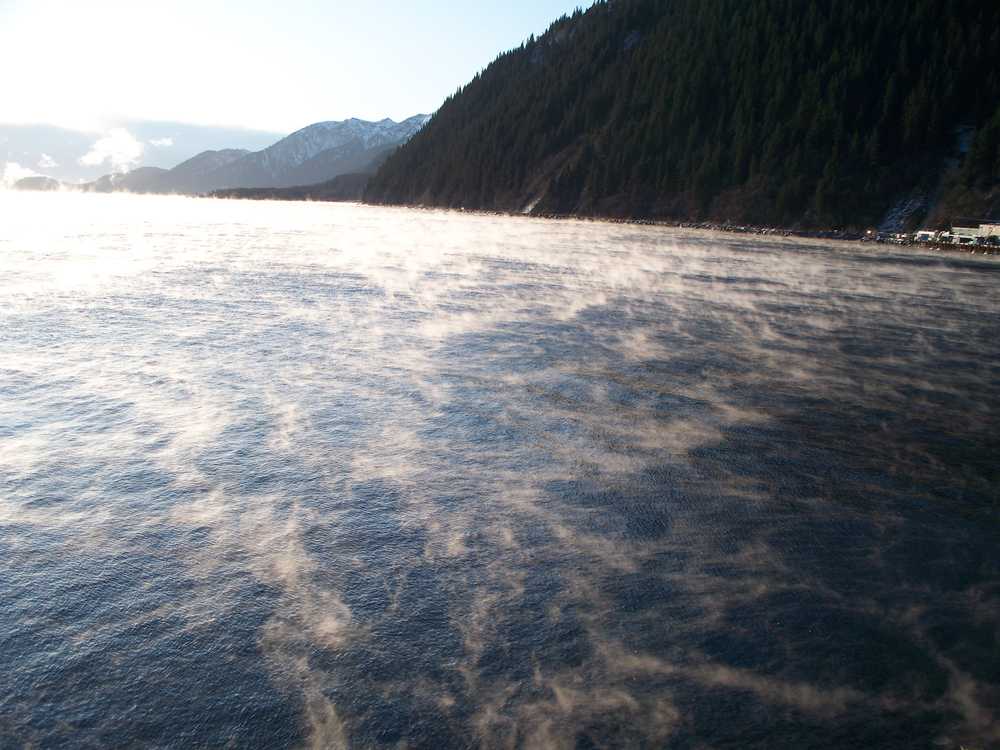
Seward’s Resurrection Bay is so warm it steams in the winter.
Seawater heated near the equator travels thousands of miles to reach Resurrection Bay, one of Alaska’s ice-free bays. The current brings water up the coast to the bay, where it remains about 50 degrees, even into November, when the air temperatures are routinely lower.
Hence, the bay steams. For the first time, residents of Seward will be able to harvest some of that warmth.
The Seward city council attracted statewide attention last month when it approved plans for a system to pull heat from the ocean to heat to four city-owned buildings — the library, city hall, an annex building and the fire hall.
“What we’re proposing here is that the city will do this as a utility,” said Seward Assistant City Manager Ron Long. “We’re geographically very lucky as this is all city-owned waterfront, and it would come up a city-owned road to supply city-owned buildings. The benefit goes to every taxpayer equally instead of creating a system that serves a few residences and a few businesses.”
It works like a backward refrigerator, Long said. Most refrigerators compress a refrigerant chemical and channel it through condensers and evaporators to draw heat from the air in the refrigerator box. That is why the space behind and below refrigerators tends to radiate heat, he said.
The city will drill a number of vertical shafts down into the waterfront where the tidal water washes in through the permeable gravel and install loops of dense plastic pipe filled with a water and propylene glycol mixture that will absorb heat from the seawater.
Long said the boreholes will not be visible once they are drilled. The pipes connect to heat pumps in the individual buildings, where the heat is actually produced.
Andy Baker, an independent renewable energy consultant who worked with the city on the project, said the proper name is an ocean-source heat pump system — the heat is coming from the ocean, but the pumps are still powered by electricity. One of the benefits is that no heat is lost from the pipes into the ground, the way it is in a traditional system, he said.
“You have 180-degree water in the pipes, and then you have 40-degree ground around it,” Baker said. “Hot moves to cold. It wants to move through the pipe to the insulation to the ground. You end up heating the ground, which isn’t helping anyone.”
Oil is expensive in Seward. Although using the heat pumps will hike up the city’s electricity bills, it will drastically cut down on diesel consumption. The conversion could save as much as $75,000, Long said.
If the project is successful and ocean-sourced heat pump systems become more widely used in the city, it could bring more development to Seward, he said.
“Energy is such a huge cost here,” Long said. “We have people paying more in energy costs than their mortgage payments. It’s hard to convince people that they should come and invest in their businesses here when the cost of energy is so high.”
The city took a cue from the Alaska SeaLife Center, which installed a seawater heating system a few years ago. The center’s administration began discussing the project in 2009, said special projects director Darryl Schaefermeyer.
The SeaLife Center based its heat pump system on the seawater intake system used to fill its marine animal tanks. With a grant provided from Alaska Energy Authority’s Renewable Energy Fund, the center installed the heat pumps and began operating the system in July 2011. Converting the building’s heat source was expensive, but because they were able to use grant funds, the SeaLife Center is already seeing returns on the project, Schaefermeyer said. The SeaLife Center spent more than $300,000 annually on heat before installing the seawater heating system. Once it was installed, the facility began saving $5,700 a month, he said.
“For every unit of electricity it costs to run the system, we’re getting anywhere from close to two or more units of heat back,” Schaefermeyer said. “That’s how heat pump systems save money. And we’re reducing our carbon footprint because we’re not using fossil fuels.”
The two systems differ — the SeaLife Center takes in seawater through its wet well, a massive structure where seawater is held in the facility. The city chose to do it with the pipes and boreholes because building the seawater intake system would be expensive and require permits, he said.
“We get constant temperature heat the way we’re doing it,” Schaefermeyer said. “Direct water is the best medium for recovering heat. That’s why it was very advantageous to do it the way we did.”
On the other side of the peninsula, in Seldovia, diesel fuel costs $5.99 per gallon as of August 2014 according to the Alaska Energy Data Gateway and natural gas lines are not coming any time soon.
On top of that, natural gas and fuel are likely to get more expensive. Long-term planning required alternatives to fossil fuel heat, and the Seldovia House senior housing facility did just that.
Seldovia House, home to approximately 20 people, installed an in-ground heat pump system in December 2014.
“So far, it seems to be working great,” said maintenance engineer Chris Lillo. “We don’t have a full year of numbers yet to figure out exactly how much savings we are going to have, but I shut the oil-fired furnace off in March, and it’s been off ever since.”
The housing facility is operated by Cook Inlet Housing Authority and was an experimental energy project for the organization, said Brent Hobe, a project manager for CIHA.
“We’re looking at saving $30,000 in our first year of operation,” Hobe said. “It just made a lot of sense at the time because there’s no chance gas is going to be delivered along the Railbelt in Seldovia.”
Seldovia uses neither tides nor seawater to heat its buildings; instead, it draws the heat directly from the rock beneath it, according to Baker, who worked on the Seldovia project as well as the SeaLife Center project.
The system was a good match for Seldovia because the village has relatively low electricity costs and high oil costs. Similar villages in the Interior might also be able to cut costs with heat pump systems, Baker said.
“The bigger goal is to get these buildings off oil and fossil fuel, both for price and our liability of pollution,” Baker said. “For oil, it starts from the drilling to the transport to the storage to the burning. Plus, you have to use fossil fuels to move fossil fuels.”
However, it doesn’t entirely eliminate the need for oil — the systems typically need backup oil furnaces in case of failure. Seldovia House kept one of its oil burners and turns it on when the temperature drops below 20 degrees, Lillo said. The SeaLife Center keeps an oil heater as well, Schaefermeyer said.
Baker said he sees potential for the system to expand in Seward in the future. The SeaLife Center could sell the excess heat to the northern end of downtown Seward, and a series of smaller heating districts could develop to eventually transition the whole town away from reliance on oil-generated heat.
This could draw more people to the downtown area, he said.
“If you lower the cost of heat, more people are likely to relocate their business there,” Baker said. “Why wouldn’t they? It will grow organically. There’s likely to be separate systems. But the main thing is that you start with a group of buildings and then connect them.”
Seward does not get natural gas service and has been looking at alternate energy sources for some time, according to Long. Among the plans are to use small hydroelectric plants on the streams on the mountains in the area. The heat loops cannot go everywhere and heat every home, Long said, so the city council will continue to look at oil alternatives to “wean people off of oil,” he said.
Even small measures help, he said. Since solar power has become more efficient, Long said he uses a small solar panel to charge the battery on his boat instead of plugging it in. The public has been receptive to the tidal energy project so far, and it will take public participation to transition away from fossil fuels, he said.
“People around the state are interested in, ‘How can I get in?’” Long said. “The cost of energy is killing us.”
Reach Elizabeth Earl at elizabeth.earl@peninsulaclarion.com.

Crews in Seward completed the first test borehole in August 2015.
