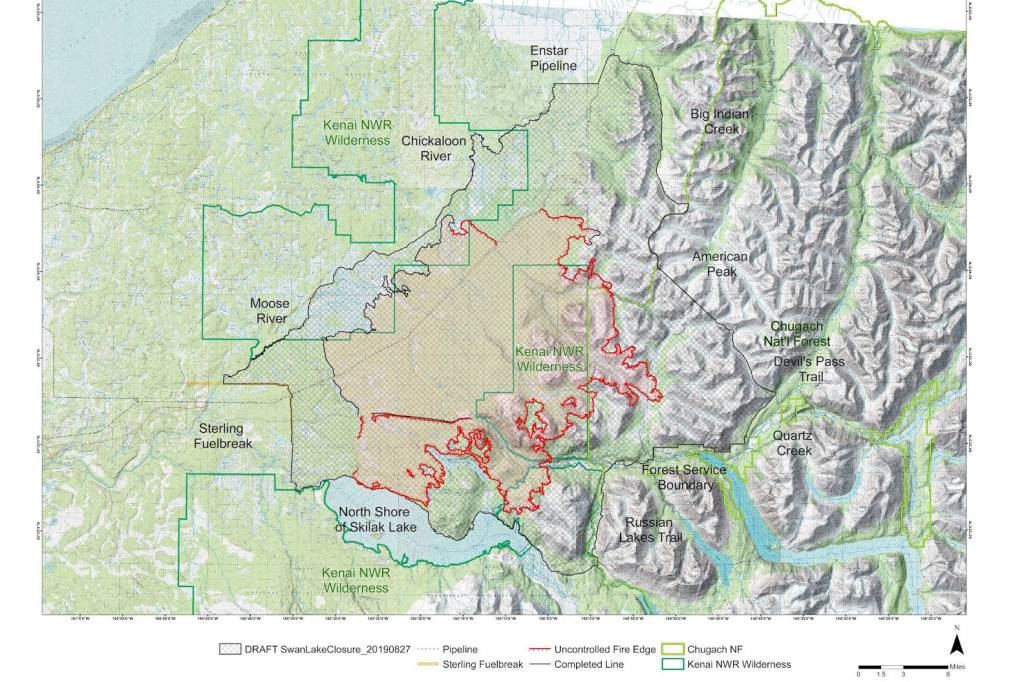
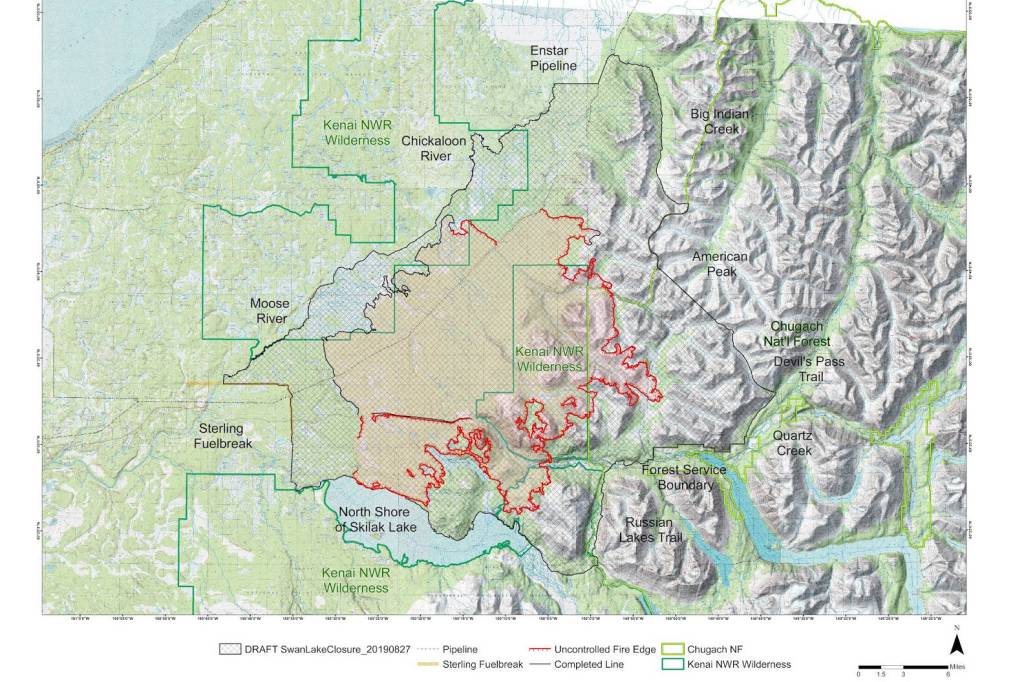
This map shows the combined emergency area closure for the Kenai National Wildlife Refuge and Church National Forest effective Wednesday, Aug. 28, 2019. (U.S. Forest Service)

This map shows the combined emergency area closure for the Kenai National Wildlife Refuge and Church National Forest effective Wednesday, Aug. 28, 2019. (U.S. Forest Service)

Public lands around fire closed

The closures are due to concern for public health and safety related to the Swan Lake Fire.

Continued wildfire activity has prompted the U.S. Fish and Wildlife Service and U.S. Forest Service to issue emergency area closures for portions of the Kenai National Wildlife Refuge and the Seward Ranger District of the Chugach National Forest.

Closures for the Chugach National Forest include: all National Forest Service (NFS) lands and facilities south of American Creek to its intersection with the Resurrection Pass Trail, all NFS lands west of Resurrection Pass Trail to Devil’s Creek Trail, all NFS lands west of Quartz Creek and north of the Sterling Highway to the Kenai National Wildlife Refuge/National Forest boundary and all NFS lands east of the Kenai National Wildlife Refuge Boundary to American Creek.

On the Kenai National Wildlife Refuge, closures include: all public use facilities within Skilak Wildlife Recreation Area, all refuge lands, trails and facilities adjacent to the Sterling Highway from the eastern boundary of the refuge at Mile 55 to the western boundary of the refuge at Mile 76 and the Sportsman’s Boat Launch Facility.

More details about the refuge closures as well as a map showing the areas affected can be found at https://www.fws.gov/refuge/kenai/. More details about the closures in Chugach National Forest can be found at https://www.fs.usda.gov/alerts/chugach/alerts-notices.

The closures are due to concern for public health and safety related to the Swan Lake Fire, which has been burning in the Kenai National Wildlife Refuge for 85 days and is currently at 161,921 acres. The closures will be in effect through Sept. 27, but may be rescinded or extended as conditions change.

According to the news release from USFWS, dangerous conditions within the burned area can cause serious injury. Deep ash pits can form in burned organic layers — also known as “duff” — and can stay hot under the surface while blending in visually. Stepping into an ash pit can cause serious burns.

In addition, burned trees have lost their root systems, leaving them weak and likely to fall down even in light winds. Falling trees can change trail access and create challenging hiking conditions where trails were easily accessible in the past.

The open-fire burn restriction remains in effect and includes warming and cooking fires.

More in News

Sterling resident Jonny Reidy walks 11 miles from his dry cabin to his part-time job at Fred Meyer on Dec. 15, 2025. Reidy aims to walk 1,000 miles by midsummer, and he’s asking people to pledge donations to food banks for every mile he travels. Photo courtesy of Jonny Reidy
Sterling man is walking 1,000 miles for hunger awareness

Jonathan Reidy asks people to pledge donations to local food banks for every mile he walks.

Soldotna High School students learn how to prepare moose meat through the school’s annual Moose Permit Project, an educational partnership between SoHi and the Alaska Department of Fish and Game. Photo courtesy of Tabitha Blades/Soldotna High School
Soldotna students get hands-on moose harvest experience

SoHi’s annual Moose Permit Project is an educational collaboration between the school and the Alaska Department of Fish and Game.

A snowmachine rider takes advantage of 2 feet of fresh snow on a field down Murwood Avenue in Soldotna, Alaska, on Monday, Dec. 12, 2022. (Jake Dye/Peninsula Clarion)
Kenai refuge announces snowmachine opening

All areas traditionally allowing snowmachine use in the Kenai National Wildlife Refuge are now open.

Kate Rich’s play, “The Most Comfortable Couch in Town,” is performed during “Stranded: A Ten-Minute Play Festival” in August 2025 in Homer, Alaska. Photo provided by Jennifer Norton
Homer playwright receives fellowship award

Kate Rich is revising a new play, which she hopes to take to the Valdez Theatre Conference Play Lab.

A BUMPS bus waits for passengers in the Walmart parking lot in Kenai, Alaska, on Oct. 15, 2018. (File photo)
Ninilchik Traditional Council expands public bus service

The Homer-Kenai BUMPS bus will now run five days a week.

Balloons fall on dozens of children armed with confetti poppers during the Ninth Annual Noon-Year’s Eve Party at the Soldotna Public Library in Soldotna, Alaska, on New Year’s Eve, Tuesday, Dec. 31, 2024. (Jake Dye/Peninsula Clarion)
Out with the old, in with the new

The Peninsula Clarion looks back on 2025 in this “year in review.”

The sign in front of the Homer Electric Association building in Kenai, Alaska as seen on April 1, 2020. (Photo by Brian Mazurek/Peninsula Clarion)
State regulatory commission approves electric utility rate increase

The Homer Electric Association ratified a 4% base rate increase in November.

A map presented by the Alaska Department of Natural Resources during a virtual meeting on Dec. 11, 2025, shows the location of a potential Kenai Peninsula State Forest. Screenshot.
Community meeting in Homer to focus on proposed state forest

The Department of Natural Resources will continue to gather community input on the potential establishment of a Kenai Peninsula State Forest during a meeting on Tuesday at Kachemak Bay Campus.

File.
Soldotna aims to change short-term rental tax and permitting

Public hearings for two ordinances addressing existing short-term rental regulations will occur during the next city council meeting on Jan. 14.

Most Read