
Homer City Council member Caroline Venuti saw plastic bags floating in the ocean and hanging in the trees. A lifelong Alaskan and a teacher, Venuti saw an opportunity to teach, while helping the environment and her community.
In September 2018, she introduced a measure at the city government level to place a question on the Oct. 1 ballot asking Homer voters if they want to prohibit retailers from providing thin, single-use plastic bags, those bags under 2.5 mils, or .0025 inches, thick. In a 4-2 vote the following month, the council agreed to ask voters what they wanted to do. A “yes” vote in the upcoming election on Oct. 1 will amend city code and prohibit retailers from providing those bags.
“It’s not a ban on all plastic bags — only on the lightest, most flimsy, most impractical bags,” said Venuti, who readily admits her reliance on other plastic bags, most notably the resealable kind.
She thinks times have changed since former city council member David Lewis introduced an ordinance banning the same kind of plastic bags in 2012. The measure passed the council, but was later overthrown by voters in a special election. Opponents of the measure said the council had overreached its authority.
Venuti believes voters will approve the measure next month because they have far more knowledge about what plastics are doing to the environment, to seabirds, to fish, to marine and land mammals, and to humans.
“People are more aware. The timing is right,” she said.
Other Alaska communities — including Anchorage, Soldotna, Kodiak, Hooper Bay, Bethel, Palmer, Unalaska and Wasilla — have already banned the bags, and Venuti doesn’t miss an opportunity to share informational tidbits with the public and council members about why a “yes” vote is the right thing to do. Some examples:
Did you know Americans use 100 billion plastic bags a year?
Did you know 1 million seabirds are killed by plastic bags annually?
Did you know the average American family takes home almost 1,500 plastic shopping bags a year? Plastic bags are used an average of 12 minutes.
“We can do better by our community,” said Venuti.
The Homer Community Food Pantry might well be a bellwether for the vote.
About two years ago, Cook InletKeeper gave the pantry several dozen reusable bags for their clients. The pantry started offering a special treat — something as simple as a jar of mayonnaise or a roll of crackers — to those who would bring back their reusable bags, said Pat Boone, vice president of the pantry’s board of directors. She is leading the effort to move the pantry away from plastic bags to reusable bags made of cloth or some other long lasting material.
The treats work, said Boone. Eighty-five percent of the food pantry clients use a reusable bag or something other than a plastic bag — a tub, a box, a backpack.
“Everybody likes to get a treat. … People are willing to help, if we just give them an opportunity and remind them of what needs to be done,” said Boone.
Still, the food pantry continues to need plastic bags and other plastic containers, like yogurt tubs. Dennis Weidler, the pantry’s coordinator, makes regular raids on Safeway’s plastic bag recycling bin, as do the pantry’s drivers. The community is invited to give donations of their plastic bags and other plastic containers like yogurt tubs and water bottles to the food pantry.
“I’m hopeful plastic bags are going to go away, so we’re trying to get ready for that,” said Boone. “If we at the food pantry can remember to do it, everybody can remember to do it.”
A change in global recycling markets may help boost the “yes” vote. WestRock Recycling in Anchorage, where the Kenai Peninsula Borough sends its recyclables, has stopped taking plastic bags and the clear plastic containers often called clam shells, which means Homer residents can no longer recycle them at the Homer Transfer Facility or any other borough-owned site.
As the lowest grade plastic, there’s no longer any market for the bags. In fact, the borough has been paying WestRock $150 per ton to accept the bags, said Kevin Mertzweiller, site supervisor for the Homer Transfer Facility, which is owned by the borough and operated by D & L Construction. Not long ago, WestRock said no more bags and the recycling container at the transfer site went away.
The so-called clam shells, which are frequently used for salads and other foods, are marked as recyclable, but because they are a lower grade plastic than plastic bottles they lower the value of the other recyclables and also are no longer being accepted by the recycling company, Mertzweillern said. Anything that is not a bottle or a jar — even if it has a recycling stamp — won’t be accepted, he said. That’s because of the global market conditions, not a local decision. The reason is the lower-grade plastic contaminates the rest of the recycling bale and likely would be rejected by the recycling mill where the plastics end up.
Several nonprofit organizations have come together on a “Yes to a Better Bag” campaign to encourage a “yes” vote on Oct. 1.
“It’s not just a feel-good thing,” said Bjørn Olson of the Kachemak Bay Conservation Society, one of the partners in the “better bag” campaign. “There’s actual physical harm being done.”
Among the statistics he finds troubling is this one: “If we carry on with business as usual, by the year 2050, there will be as much plastic trash in the ocean as there are fish.”
Olson sees the $4 billion that national retailers spend on plastic bags as a subsidy.
“We’re not having to take personal responsibility. We’re demanding industry subsidize our lazy and forgetful behavior,” he said, pointing out that many places, including the entire European Union, have foregone the use of the thin plastic bags, without issue.
He thinks Homer can do the same.
“The average U.S. family uses 1,500 single-use shopping bags every year. If you could visualize that, you might be emboldened to do something different,” Olson said.
The “Yes to a Better Bag” partners don’t want to see Homer move from one single-use bag made of plastic to one of paper. There are plenty of other options, said Henry Reiske, marine debris educator at the Center for Alaskan Coastal Studies, another partner in the better bag campaign.
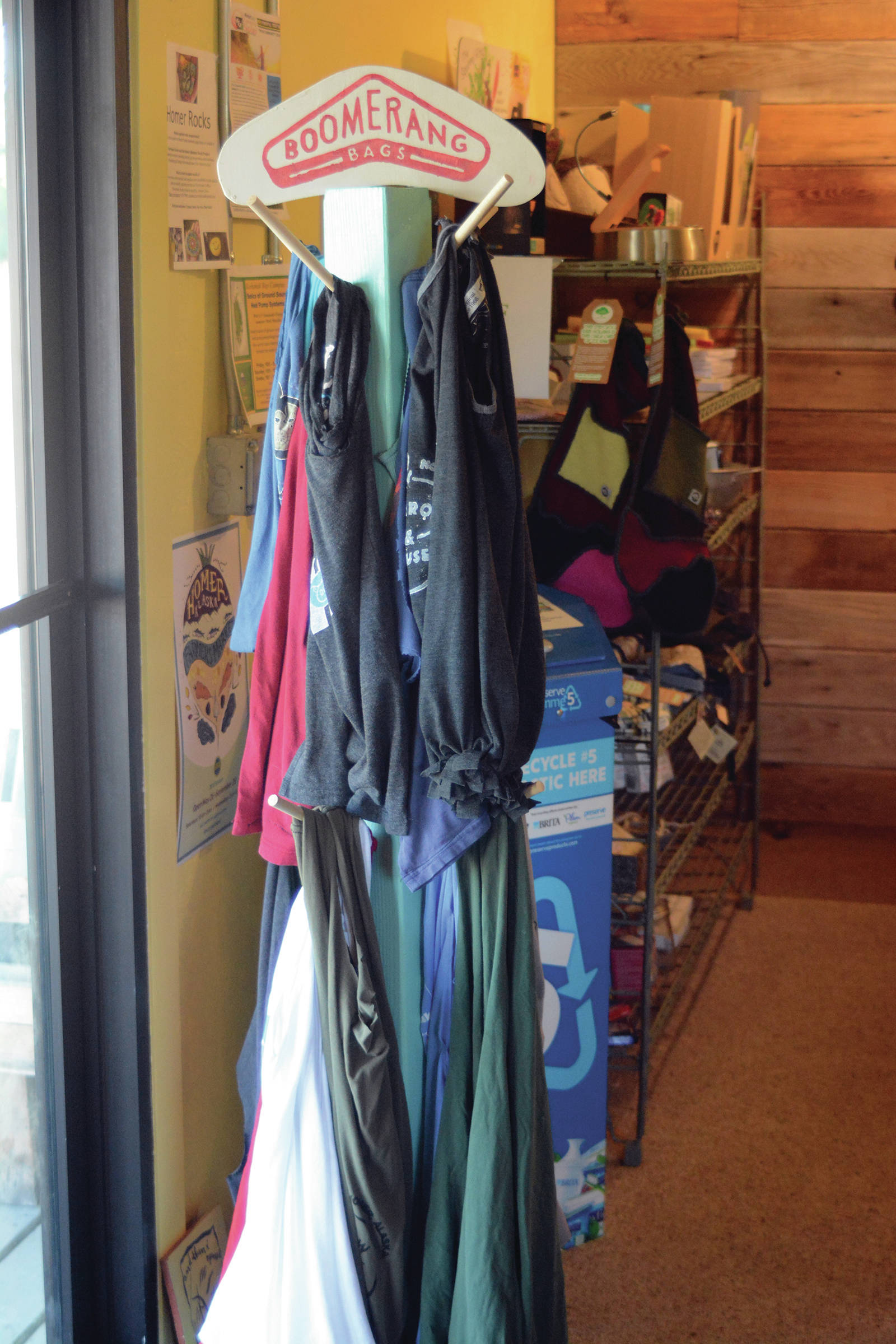
People can buy their own reusable bags — which come in a wide range of prices. They can use a box. They can use a Boomerang Bag, an international project which began in Australia and was adopted by the Kachemak Bay Girl Scouts and CACS. A number of local retailers offer the Boomerang Bags, which are made out of old T-shirts, including the Alaskan Center for Coastal Studies, Ulmer’s, the Homer Bookstore, Captain’s Toy Chest, Sustainable Wares, Cole’s Market, Wagon Wheel, Homer Shores Sunken Treasures and Grace Ridge Brewing. Other retailers who want the bags are invited to contact Coastal Studies.
Reiske wants people to understand how big the issue is, but also how it can be solved.
“There are 12 million tons of plastic going into ocean every year with that predicted to grow,” he said. “Out of that we tend to attribute most of it to things like shipping container spills and plastic litter from fishing, but the vast majority of debris is from people just living their everyday lives … which means people have the power to change this in their everyday lives. … It’s very easy to take little steps that build and build and build so you can reduce how much you’re contributing to this.”
Lori Evans is a freelance writer living in Homer and is the former editor and publisher of the Homer News.
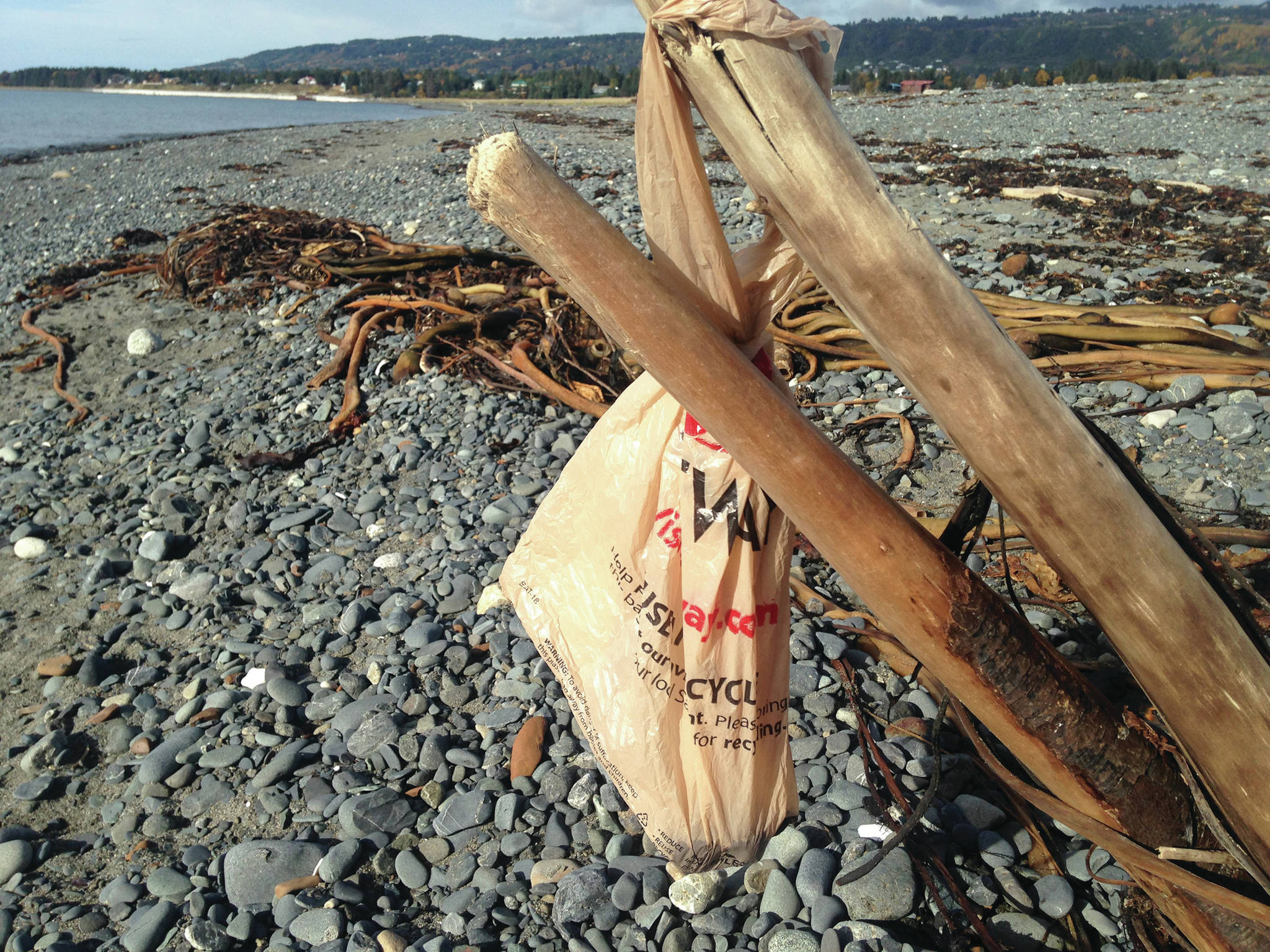
A single-use plastic bag hangs on a driftwood branch at Mariner Park on the Homer Spit on Oct. 5,2018, in Homer, Alaska. It appeared someone had reused the bag to collect dog poop but then left the bag on the beach. (Photo by Michael Armstrong/Homer News)
