
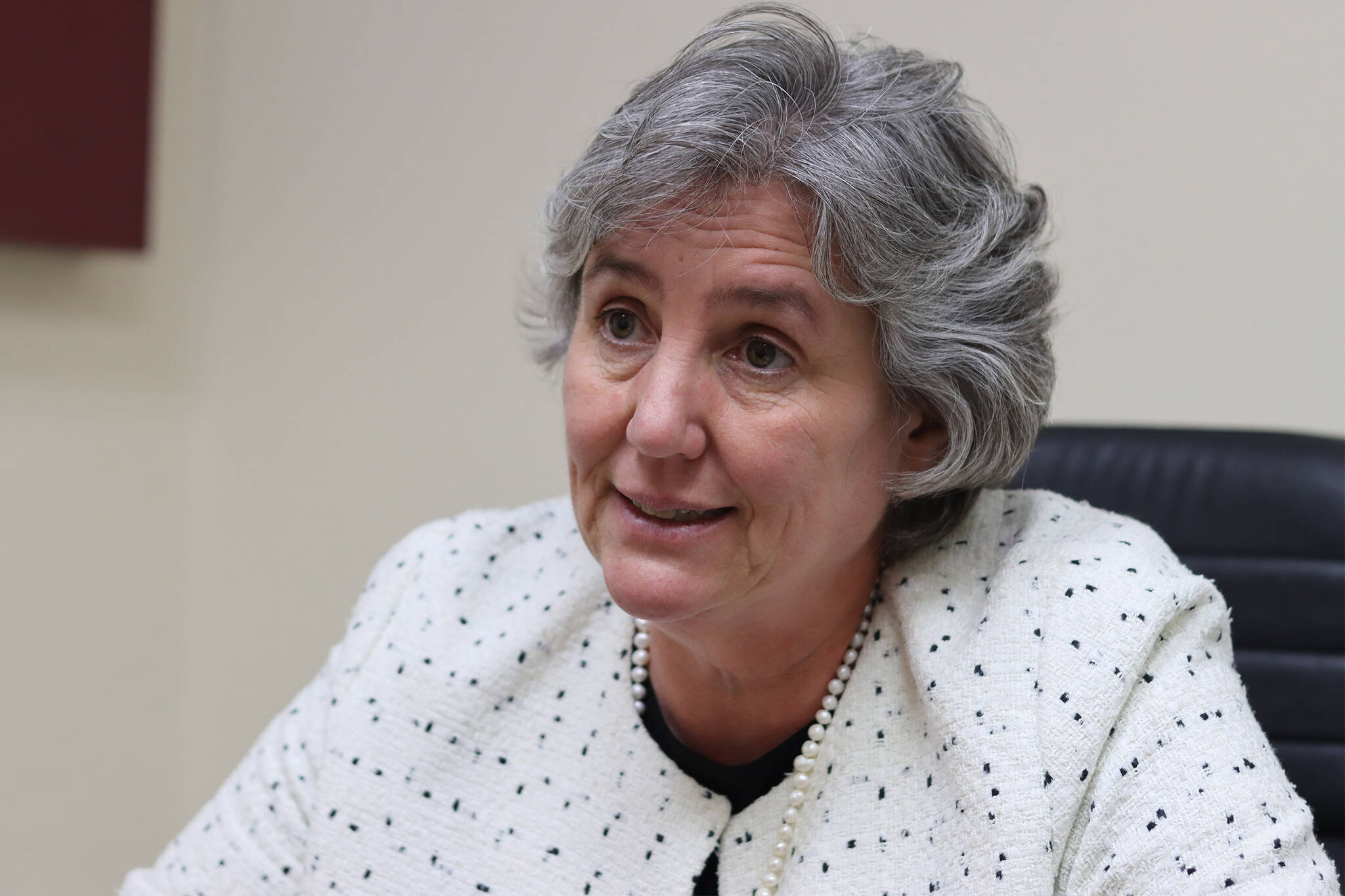
The University of Alaska has the programs to meet the state’s workforce needs, said President Pat Pitney, but UA faces a challenge in building enrollment.
“We have fewer programs but the programs we have, by design were prioritized to stay with those items that are the highest demand workforce in the state,” Pitney said in an interview at the Empire offices. “There’s not an employer that we’ve talked to that doesn’t need employees.”
Recently named president of the university, Pitney is the first woman in the system’s history to hold that role. She had been serving as interim president since July 2020 following the departure of former UA President Jim Johnsen.
Pitney took over the university amid deep budget cuts enacted by Gov. Mike Dunleavy followed by the COVID-19 pandemic, both of which caused massive disruptions to the system and interrupted students’ plans. One of the challenges now, Pitney said, is bringing students back and rebuilding enrollment.
“(We’re) really working for fall, to bring back the full vibrancy of our on-campus environments,” Pitney said.
Following recent guidelines from the Centers for Disease Control and Prevention, the university had recently lifted some of its masking requirements and was encouraging in-person classes. The sudden shift to entirely online classes disrupted enrollment, Pitney said, but many classes are now being offered in hybrid form — both in-person and online — which she hoped would encourage enrollment.
Following budget cuts and the pandemic, UA was forced to consolidate many of its services and rework degree programs. Pitney emphasized the system was focused on meeting workforce demands and offering flexibility to students and employers to meet their educational demands.
[Delegation urges energy production following State of the Union]
Most of the jobs they have require some sort of post-secondary education,” Pitney said. “Getting people through the pipeline to meet that need is really important. We’ve got many what we call ‘micro-credentials,’ fast track programs where people can get training in as short as seven weeks.”
The university has partnerships with private-sector companies that offer scholarships and career pathways for UA students, Pitney said. Many of those programs are sponsored by resource industry companies but other industries such as finance were looking at similar pathways. Pitney said UA was working with Alaska Native corporations on finance degree programs and scholarships.
“There are more jobs than there are people to take them,” Pitney said.
When she came into office, Pitney said her main focus was financial stability. She said there’s generally indications from the governor and the Alaska State Legislature that the university will continue to receive financial support. The university has put in a funding request for an additional $100 million which Dunleavy included in his proposed budget.
But the state recently won a case against a group of UA students who sued the Dunleavy administration regarding the Higher Education Investment Fund. That fund holds scholarship money for the Alaska Performance Scholarship and the Washington, Wyoming, Alaska, Montana, Idaho Program at the University of Washington School of Medicine. In a novel ruling in 2019, Dunleavy’s administration designated that fund as subject to a state accounting mechanism known as “the sweep.” The sweep empties certain state accounts at the end of each year and a two-thirds vote of the Legislature is needed to reverse it. Divisions in the Legislature have made that vote —which used to be a routine matter — into a political bargaining chip.
An Anchorage Superior Court judge ruled on Feb. 18, found in favor of the state but students immediately filed an appeal.
The university provided financial support to the students in that case, and Pitney said she’d like to see the higher education fund established on its own where it can be capitalized. On Tuesday, the Senate Finance Committee heard a bill — Senate Bill 224 — that would take the higher education fund and the Alaska Marine Highway Fund out of the general fund.
State officials are hopeful the federal infrastructure package will bring significant funding to Alaska, and lawmakers have said they prefer to have Alaskans working in those jobs.
Pitney also expressed hope federal spending would boost the Alaskan economy, and said the increased interest in critical minerals and American mining had already resulted in partnerships with the U.S. Department of Energy and Canadian mining company Ucore Rare Metals. Pitney said the partnership was focused on assessing the full breadth of Alaska’s minerals.
“We’re working on the strategic minerals and adding to that assets and also mining techniques,” Pitney said. “There is a gentleman, he is faculty as (UA Anchorage), and he is building a biological process to extract rare earth elements from coal waste.”
Pitney estimated the infrastructure bill could bring between 10-14,000 new jobs but noted Alaska will be competing with every other state for workers.
“It’s going to be much harder than during the pipeline days to import a workforce,” Pitney said. “We’ve got to create our own and we’ve got let everybody know that we need workers.”
Pitney will deliver her State of the University address during the Juneau Chamber of Commerce Luncheon at noon today at Elizabeth Peratrovich Hall.
• Contact reporter Peter Segall at psegall@juneauempire.com. Follow him on Twitter at @SegallJnuEmpire.
