
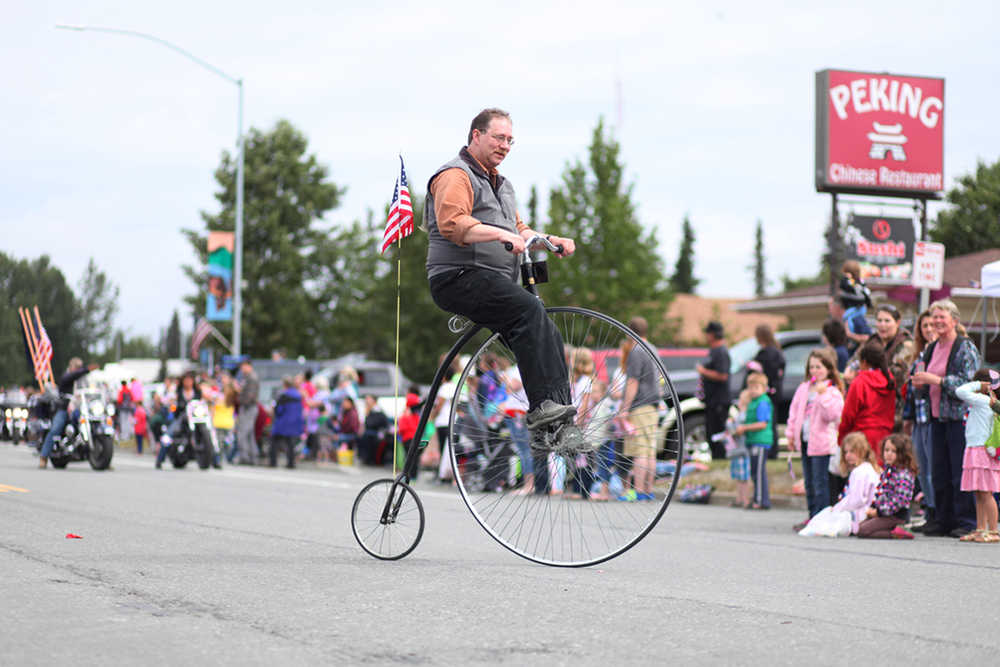
Photo by Kelly Sullivan/ Peninsula Clarion Doug Field rode his Penny-Farthing during Kenai's July 4th Parade on Monday, July 4, 2016 in Kenai, Alaska.

Photo by Kelly Sullivan/ Peninsula Clarion Doug Field rode his Penny-Farthing during Kenai's July 4th Parade on Monday, July 4, 2016 in Kenai, Alaska.

Penny-farthing owner keeps on riding

  • By Kelly Sullivan
  • Thursday, July 14, 2016 6:40pm
  • News

Doug Field of Kenai recently dusted off his penny-farthing replica for one of its biannual routes in the Kenai Fourth of July parade.

Balancing his weight between the 2-foot, minute back wheel and 4-foot, bulbous front wheel, the seasoned rider hopped on and off the bicycle to demonstrate the dismount, preemptively addressing regular shouts of, “How do you get on? How do you get off? How do you ride that thing?”

“Oh it is different, it is definitely different,” Field said with a laugh. “One of the major things that is different is that it doesn’t turn on a dime. It doesn’t have any brakes so you really have to watch where you are going, and plan your route. If you are going to make a turn you have to watch where you are going to see what you might run over, who you might run over.”

Field, who is the owner of Kenai Neon Sign Company, also takes the vehicle for a spin at Progress Days, because it is a real crowd pleaser for the parades.

“That is the major reason I enjoy having it and why I like riding it,” Field said. “People love it and it’s fun. It’s a lot of fun to get out there and show people something that they hardly ever see.”

The thin frame is metallic, save two solid tubes of rubber mounted on the wheels, doesn’t encourage recreational rides. Field’s father purchased the bicycle, built by the now out-of-business Boneshaker company, on impulse in San Fransciso for $250, which was considered a lot of money in the 1970s. The two trucked the find back up to Alaska, where it has resided ever since.

The penny-farthing was designed after one of the first velocipedes, which are land vehicles made in the early 1800s that require humans to manually power them. Some of the early models called Boneshakers were made of wood or had metal wheels.

The penny-farthing came after and eventually rubber was placed around the wheels preventing extensive rattling.

From personal experience, Field said the rubber is not much of an improvement. The penny-farthing is the predecessor to the modern bicycle, which was perhaps appropriately called the “safety bicycle,” he said.

“Remember the roads were very rough and bumpy back then,” Field said with a laugh. “This one doesn’t go over bumps worth crap, and doesn’t do soft ground. Sand is impossible. It would just stop, and yes I have ridden it through sand.”

Field said he has taken his fair share of falls. He first rode the bicycle when he was about 10 years old, and recalls his feet could barely reach the wheels. He said he has never landed on his side, back or bottom, but has had dire moments where a big jump was necessary to avoid scrapes and scratches.

Field’s father, Bill Field and original owner of Kenai Neon Sign Company, is retired from riding. When he was in possession of the bicycle he would take it out at local events, and even entered it in a local race from Kenai to Soldotna, Field said.

“He only made it a couple of miles but they gave him a certificate for bravery,” he said.

Sometimes Field said he feels the gearless vehicle can really move, but probably doesn’t reach more than 15 mph.

The penny-farthing has required little maintenance throughout the years. Occasionally the spokes need tightening, the handlebars were completely replaced recently and Field’s father once repaired a seam split in the wheel rubber.

While he would stop short of calling himself a “penny-farthing expert by any means,” he hasn’t yet met another owner in Alaska.

“I have never talked to anybody that has one, I would be surprised if there was no one else that has one, but probably you could count them on one hand,” Field said.


Reach Kelly Sullivan at kelly.sullivan@peninsulaclarion.com.

More in News

David Ross is sworn in as Kenai Police Chief on Tuesday, May 31, 2016 at Kenai City Hall. The Alaska Association of Chiefs of Police named Ross the 2025 Police Chief of the Year, recognizing over two decades of service. Photo by Megan Pacer/Peninsula Clarion
Kenai police chief named 2025 Police Chief of the Year

The Alaska Association of Chiefs of Police recognized David Ross for his more than two decades of leadership.

The cast of Nikiski Middle School’s upcoming performance of “Alice in Wonderland” is pictured on Dec. 2, 2025. The upperclassmen-directed play opens on Friday, with additional showtimes Saturday and next weekend. Photo courtesy of Carla Jenness
Nikiski Middle School debuts student-led “Alice in Wonderland”

The show opens on Friday, with additional showtimes this weekend and next.

On Tuesday, the Kenaitze Indian Tribe unveiled Kahtnu Area Transit, a public transportation service open to the entire Peninsula Borough community. Photo courtesy of Kahtnu Area Transit
Kenaitze Indian Tribe unveils Kahtnu Area Transit

The fixed bus route offers 13 stops between Nikiski and Sterling.

The Kenai Chamber of Commerce and Visitor Center hosts the annual Christmas Comes to Kenai on Nov. 28<ins>, 2025</ins>. The beloved event began over 40 years ago, and this year over 1,000 attendees enjoyed hot chocolate, fireworks, pictures with Santa and shopping. Photo courtesy of the Kenai Chamber of Commerce
 Photo courtesy of the Kenai Chamber of Commerce
The Kenai Chamber of Commerce and Visitor Center hosted the annual Christmas Comes to Kenai on Nov. 28. The beloved event began over 40 years ago, and this year over 1,000 attendees enjoyed hot chocolate, fireworks, pictures with Santa and shopping.
Kicking off a month of holiday festivities

Last weekend’s holiday events, including the annual Christmas Comes to Kenai and the Soldotna Turkey Trot, drew folks from all over the Kenai Peninsula.

Starting Dec. 2, Aleutian Airways will offer roundtrip flights between Anchorage and Unalakleet every Tuesday, Friday and Sunday.
Aleutian Airways to offer roundtrip flights between Anchorage and Unalakleet

Starting Dec. 2, Aleutian Airways will offer three roundtrip flights per week.

The Trump administration’s “Big Beautiful Bill” act requires the Bureau of Ocean Energy management to hold at least six offshore oil and gas lease sales in Alaska between 2026-2028 and 2030-2032. The first of these sales — known as “Big Beautiful Cook Inlet 1,” or BBC1— is scheduled for March 2026. Photo courtesy of the Bureau of Ocean Energy Management
Cook Inletkeeper launches petition against federal government

The organization is calling for transparency in Cook Inlet offshore oil and gas sales.

Winter dining has always carried more weight than the menu might suggest. In the off-season, eating out isn’t just about comfort food or convenience; it’s a way of supporting local businesses as they hold steady through the slower months. Photo credit: Canva.
The ripple effect: How local spending builds stronger communities on the Kenai Peninsula

From cozy cafés to fine-dining bistros, purchases made close to home sustain local jobs and services

Courtesy Harvest
On the Kenai Peninsula, a dormant liquefied natural gas export plant could be repurposed to receive cargoes of imported LNG under a plan being studied by Harvest, an affiliate of oil and gas company Hilcorp. The fuel would be transferred from ships to the tanks on the left, still in liquid form, before being converted back into gas and sent into a pipeline.
Utilities say Alaska needs an LNG import terminal. Consumers could end up paying for two.

Planning for two separate projects is currently moving ahead.

A map shows the locations of the 21 Alaska federal offshore oil and gas lease sales proposed by the Trump administration. (Map provided by the U.S. Bureau of Ocean Energy Management)
Trump administration proposes offshore leasing in almost all Alaska waters

A new five-year offshore oil and gas leasing plan proposes 21 sales in Alaska, from the Gulf of Alaska to the High Arctic, and 13 more off the U.S. West Coast and in the Gulf of Mexico.

Most Read