
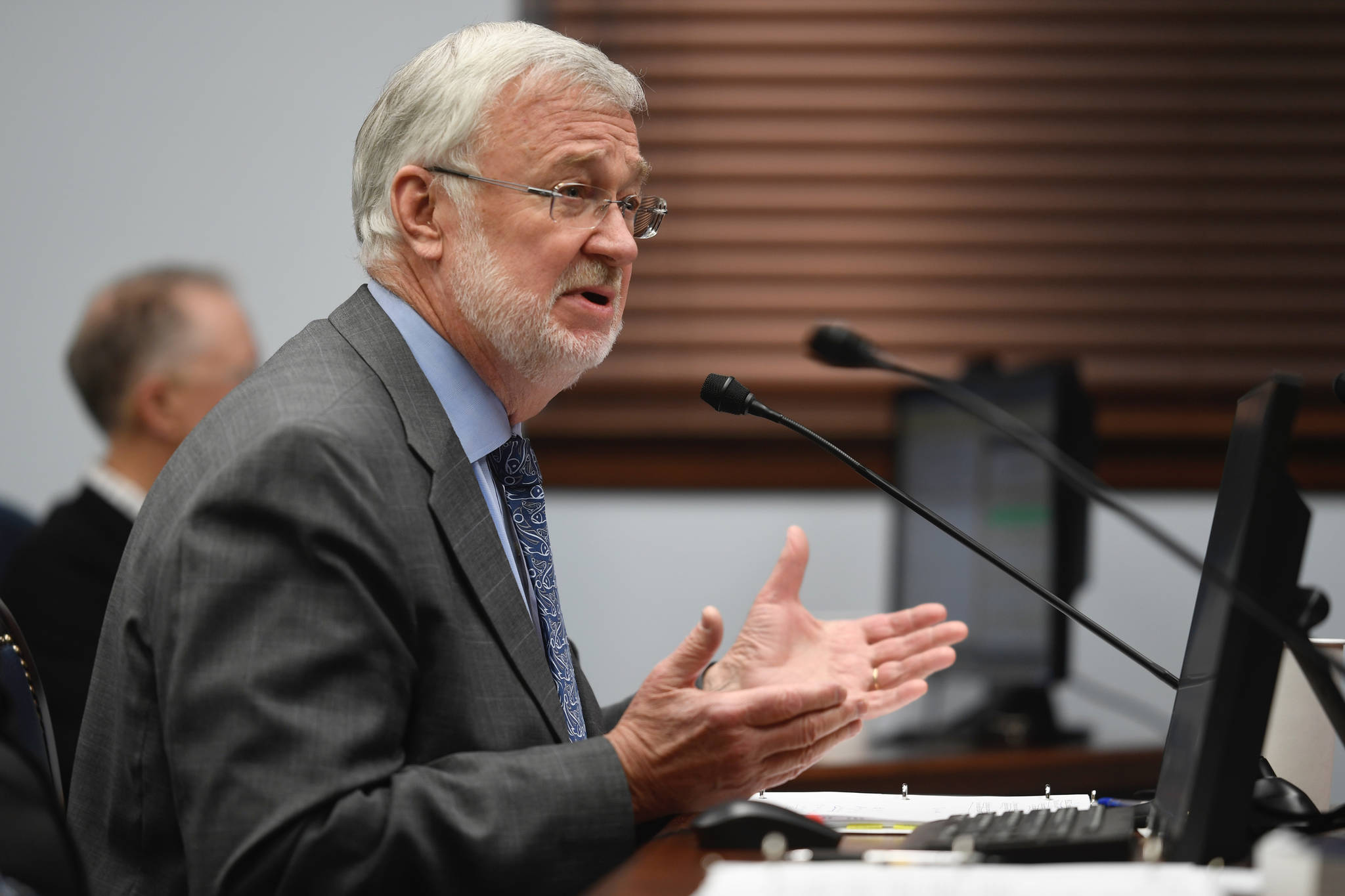
Sen. Gary Stevens, R-Kodiak, introduces Senate Bill 22 to the Senate Resources Committee at the Capitol on Jan. 30. The bill would allow organizations to obtain permits and enhance the habitat of shellfish in hopes of improving the seafood industry. (Michael Penn/Juneau Empire)                                Sen. Gary Stevens, R-Kodiak, introduces Senate Bill 22 to the Senate Resources Committee at the Capitol on Wednesday, Jan. 30, 2019. The bill would allow organizations to obtain permits and enhance the habitat of shellfish in hopes of improving the seafood industry. (Michael Penn/Juneau Empire)

Sen. Gary Stevens, R-Kodiak, introduces Senate Bill 22 to the Senate Resources Committee at the Capitol on Jan. 30. The bill would allow organizations to obtain permits and enhance the habitat of shellfish in hopes of improving the seafood industry. (Michael Penn/Juneau Empire) Sen. Gary Stevens, R-Kodiak, introduces Senate Bill 22 to the Senate Resources Committee at the Capitol on Wednesday, Jan. 30, 2019. The bill would allow organizations to obtain permits and enhance the habitat of shellfish in hopes of improving the seafood industry. (Michael Penn/Juneau Empire)

Peninsula educators support early funding for education

Last week, Sen. Mia Costello, R-Anchorage, introduced a constitutional amendment guaranteeing early funding for state K-12 public education. Several state entities and peninsula educators testified during the Senate Education Committee, which is chaired by Sen. Gary Stevens, R-Homer, in support of Senate Joint Resolution 9 Thursday morning.

The resolution would require the governor to submit a separate appropriation bill, alongside the operating budget, in order to fund public education. From there, the Legislature would have to approve the education funding by day 45 of each session.

“Education is one of the state’s core constitutional responsibilities,” Costello said in a press release. “This amendment will provide stability to Alaska’s education community by requiring legislators to act early.”

In the press release, Costello said the amendment would eliminate budget uncertainties for the state and local districts and schools.

Testifying at the committee hearing, Dr. Lisa Skiles Parady said removing this budget uncertainty could alleviate Alaska’s high teacher turnover rate, which she said is around 25 percent across the state, and can be up to 60 or 70 percent in some rural districts.

“We’re hemorrhaging teachers right now, right now, because of that uncertainty,” Parady said. “We’re in a shortage that we’ve never seen before in Alaska, against a backdrop of a national shortage, which is a crisis.”

Parady said reliable, timely and predictable funding is key to keeping teachers from moving on to other districts.

Alaska employs about 1,000 new teachers every year. Local universities graduate around 200-250 new teachers a year. To bring educators to the state, districts are forced to recruit from the Lower 48. With the University of Alaska Anchorage’s recent education school’s accreditation loss, finding teachers within Alaska could become even more of a challenge.

President of Alaska’s National Education Association Tim Parker also testified in support of the resolution. He said attracting teachers to Alaska is critical right now.

“It’s a competitive labor market out there and we’re not in that competitive nature,” Parker said. “The profession has been picked on a bit. The profession has been put down and insulted.”

Parker said enrollment in teacher colleges is dropping nationwide, making the market even more competitive. He also said Alaska has the worst retirement proposal for teachers in the country.

“It’s a pretty mammoth risk factor that our youngest educators are now realizing what they’re looking at and they’re leaving,” Parker said.

The resolution would also be beneficial to local governments, Nils Andreassen, executive director for the Alaska Municipal League, said.

“For municipalities too, this improves their ability to budget accordingly and plan for increases or reductions to local school districts,” Andreassen said.

On the Kenai Peninsula, principal of Paul Banks Elementary, Eric Pederson, called into the committee meeting to testify in support of the resolution. He said early funding for education is the most important topic in this session’s budget discussion.

“I currently have three teachers who do not have contracts for next year and because of not knowing where our funding is, they may leave,” Pederson said. “These are great teachers, and my fear is we are going to lose them.”

The principal of Nikiski Middle-High School, Dan Carstens, also called into the committee to testify in support of the early funding for education. He said many of the teachers at his school are at risk of getting pink-slipped.

“The reality of that is a lot of those teachers do not come back,” Carstens said. “Once they move out of state, it’s that costly to where they don’t come back.”

Carstens said the Kenai Peninsula Borough School District is required to submit a budget in April.

The resolution is still under review by the Senate Education Committee, and if the document is passed by the Legislature, the constitutional amendment will go to the ballot for the voters to decide.

More in News

Sterling resident Jonny Reidy walks 11 miles from his dry cabin to his part-time job at Fred Meyer on Dec. 15, 2025. Reidy aims to walk 1,000 miles by midsummer, and he’s asking people to pledge donations to food banks for every mile he travels. Photo courtesy of Jonny Reidy
Sterling man is walking 1,000 miles for hunger awareness

Jonathan Reidy asks people to pledge donations to local food banks for every mile he walks.

Soldotna High School students learn how to prepare moose meat through the school’s annual Moose Permit Project, an educational partnership between SoHi and the Alaska Department of Fish and Game. Photo courtesy of Tabitha Blades/Soldotna High School
Soldotna students get hands-on moose harvest experience

SoHi’s annual Moose Permit Project is an educational collaboration between the school and the Alaska Department of Fish and Game.

A snowmachine rider takes advantage of 2 feet of fresh snow on a field down Murwood Avenue in Soldotna, Alaska, on Monday, Dec. 12, 2022. (Jake Dye/Peninsula Clarion)
Kenai refuge announces snowmachine opening

All areas traditionally allowing snowmachine use in the Kenai National Wildlife Refuge are now open.

Kate Rich’s play, “The Most Comfortable Couch in Town,” is performed during “Stranded: A Ten-Minute Play Festival” in August 2025 in Homer, Alaska. Photo provided by Jennifer Norton
Homer playwright receives fellowship award

Kate Rich is revising a new play, which she hopes to take to the Valdez Theatre Conference Play Lab.

A BUMPS bus waits for passengers in the Walmart parking lot in Kenai, Alaska, on Oct. 15, 2018. (File photo)
Ninilchik Traditional Council expands public bus service

The Homer-Kenai BUMPS bus will now run five days a week.

Balloons fall on dozens of children armed with confetti poppers during the Ninth Annual Noon-Year’s Eve Party at the Soldotna Public Library in Soldotna, Alaska, on New Year’s Eve, Tuesday, Dec. 31, 2024. (Jake Dye/Peninsula Clarion)
Out with the old, in with the new

The Peninsula Clarion looks back on 2025 in this “year in review.”

The sign in front of the Homer Electric Association building in Kenai, Alaska as seen on April 1, 2020. (Photo by Brian Mazurek/Peninsula Clarion)
State regulatory commission approves electric utility rate increase

The Homer Electric Association ratified a 4% base rate increase in November.

A map presented by the Alaska Department of Natural Resources during a virtual meeting on Dec. 11, 2025, shows the location of a potential Kenai Peninsula State Forest. Screenshot.
Community meeting in Homer to focus on proposed state forest

The Department of Natural Resources will continue to gather community input on the potential establishment of a Kenai Peninsula State Forest during a meeting on Tuesday at Kachemak Bay Campus.

File.
Soldotna aims to change short-term rental tax and permitting

Public hearings for two ordinances addressing existing short-term rental regulations will occur during the next city council meeting on Jan. 14.

Most Read