
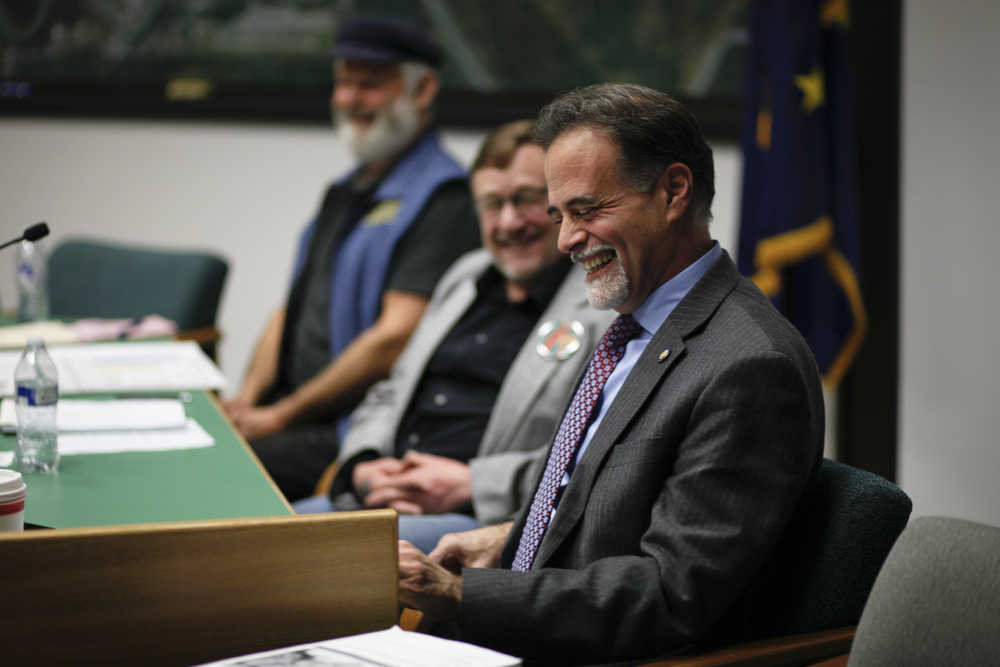
Candidates in several local races got one last chance to publicly challenge their opponents before Tuesday’s election.
About 30 people, including gubernatorial candidate Bill Walker, attended the short, informal debate sponsored by the Central Kenai Peninsula League of Women Voters, to hear seven candidates weigh on issues like education, renewable energy sources, minimum wage and health care.
Several candidates weighed in on education funding and the inherent instability in a system of funding that keeps the state’s districts guessing about finances each year.
Incumbent Rep. Kurt Olson, running to keep his House District 30 seat, said education could be improved in the state by ensuring that projects like the Alaska LNG pipeline were successful, thereby providing opportunities for Alaskan students who are more interested in vocational education than higher education. In addition, he said, the Kenai Peninsula Borough School District should be funded adequately by the state.
“We also need to take a look at the area cost differential again and make sure we’re getting adequate funding,” Olson said. “We got shorted on that a couple of years ago … I think getting what we deserve out of the pie would be my focus.”
Democrat candidate Rocky Knudsen, who is challenging Rep. Mike Chenault, R-Nikiski, to represent House District 29, said school districts needed more funding.
“They’re all saying that they’re going to need more funding,” he said “My priority is to get the funding to the schools that they need for teaching kids.”
On health care, opinions ranged the gamut on whether the state should have accepted an expanded Medicaid funding through Obamacare.
“I think there’s something like 40,000 people that fall into the donut hole that don’t get (Medicaid),” Knudsen said. “These are people that are working people, they’re hard workers … I believe they certainly deserve to get that.”
Chenault said he believed most Alaskans had access to health care.
“I don’t know of any hospital that turns people away,” Chenault said. “We need to try to ensure that our Alaskans do have access to health care … but I don’t believe that we should expand Medicaid and I think that there are other ways to address the lagging health care.”
Paul Seaton, who is running unopposed for House District 31, said he had voted to support the Medicaid expansion and would like to see it instituted in the state.
Olson and his opponent Shauna Thornton were opposed on the issue.
While Thornton said she believed that expanding Medicaid was a good answer, Olsen said the state could not afford it. When answering the question of whether Alaskans had access to quality health care, Olson said he thought “quality” was “setting the bar to high.”
“I think it should be reasonable health care, instead of quality health care,” he said. “We’re not going to be able to afford quality health care for everybody. We’re never going to be able to afford quality health care, that’s what’s killing the system now.”
Each of the candidates said they supported raising the minimum wage. Ballot Measure 3 on the Nov. 4 ballot would increase the state’s minimum wage from $7.75 to $9.75 by 2016. From then on, the state’s minimum wage would be adjusted based on inflation or remain $1 higher than the federal minimum wage, whichever amount is greater. The move means Alaskans would have one of the highest minimum wages in the country.
Senate District O candidates, incumbent Peter Micciche, R-Soldotna and Eric Treider, both support the measure, but cited different reasons.
“There’s a fallacy that minimum wage jobs are high school students that need money,” Treider said. “Half of them are adult women, 88 percent of them are over 20 years old. One-third have children, 55 percent of them work full time, 44 percent have some college… these jobs are vital for people who are in these positions. I believe we should substantially increase the minimum wage.”
Micciche took issue with Treider’s statistics.
“Well, I’m going to use Alaska statistics. This affects 3 percent of Alaskans. Three percent of Alaskans, and I support the minimum wage increase. I support it for this reason: it’s expensive to live in Alaska and I’d like to see a little bit of a premium on minimum wage here,” Micciche said. “But, everything you do has unintended consequences.”
Thornton said she also supported the increase.
“I was one of those workers for quite a many years while I put myself through college,” she said. “A lot of those workers are single women, or they’re women who have been — through no fault of their own — in a situation through domestic violence, who are now divorced, and they need that extra hand to move forward.”
Treider and Micciche again sparred over renewable energy.
Treider called the issue a central focus of his campaign.
“(We’re) trying to actually show a vision of Alaska being a manufacturer, developer and a manufacturer of gear for renewable energy,” he said. “We’re sitting on the second most abundant sources of tide power in the world. We’ve got wind, we’ve got solar. With the oil field jobs diminishing over the years, I think if we could develop an industry around renewable technology, we could develop high-tech, clean, enduring jobs that would last a long time.”
Micciche said he supported renewable energy but that progress on the issue needed to be slow and deliberate.
“You know what, when we get it as competitive as oil and gas … Alaskans will use it,” he said. “Right now, if you go to them and tell them ‘you know what? We expect you to spend 40 percent more for your electricity in your home or 60 percent more for (heat),’ I don’t think they’re going to be willing to do that. I think we have to get there gradually as the technology increases. Right now, we’ve got an economy that’s 92 percent based on oil and gas, it’s going to take a long time for that change to occur.”
Thornton said Micciche’s statistic on the state’s economy being oil-dependant was frightening.
“We need to diversify our economy and (renewable resource development) is one area that’s very, very able to do that,” she said.
Kenai Peninsula voters will get the chance to weigh in on each candidate during the general election on Tuesday.
Reach Rashah McChesney at rashah.mcchesney@peninsulaclarion.com.
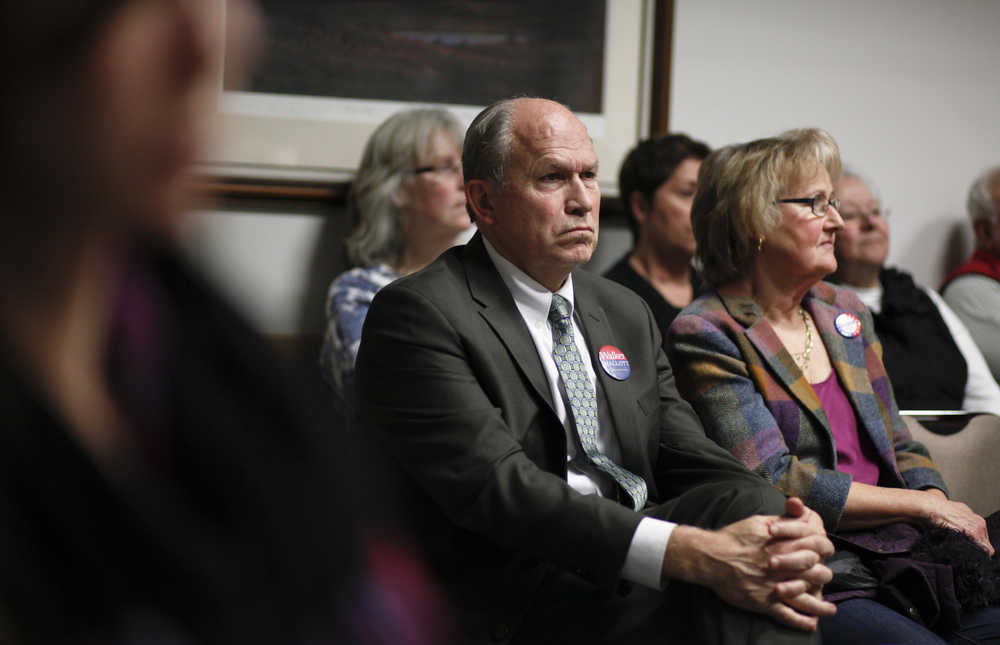
Photo by Rashah McChesney/Peninsula Clarion Gubernatorial candidate Bill Walker watches a Central Peninsula League of Women Voters candidate debate on Thursday Oct. 30, 2014 in Soldotna, Alaska.
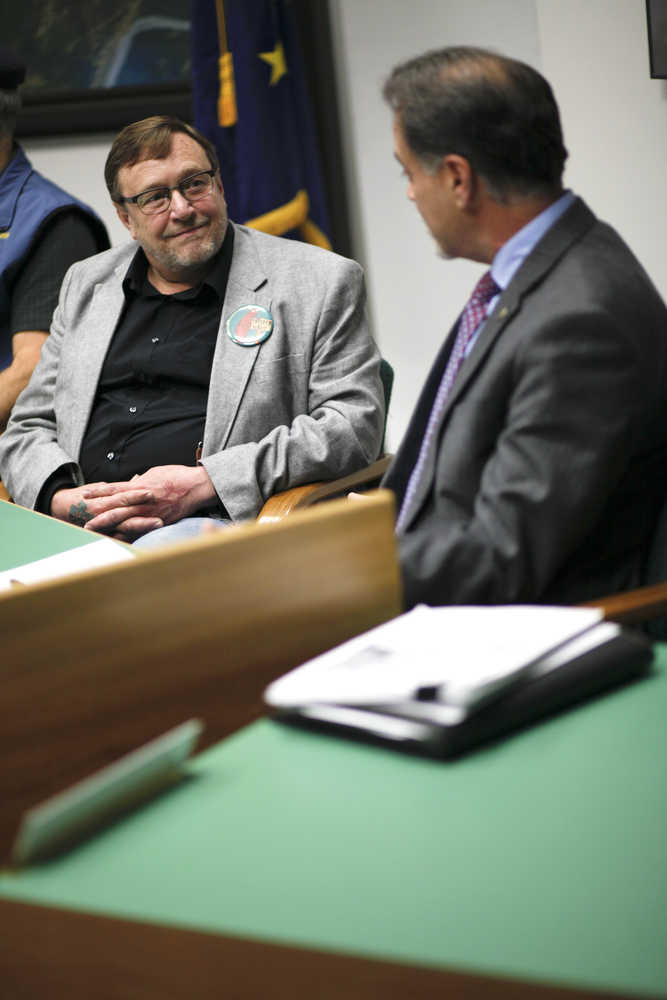
Photo by Rashah McChesney/Peninsula Clarion Eric Treider, candidate for State Senate District O, looks at incumbent Peter Micciche as the two discuss their political experience during a Central Kenai Peninsula League of Women Voters debate on Thursday Oct. 30, 2014 in Soldotna, Alaska.
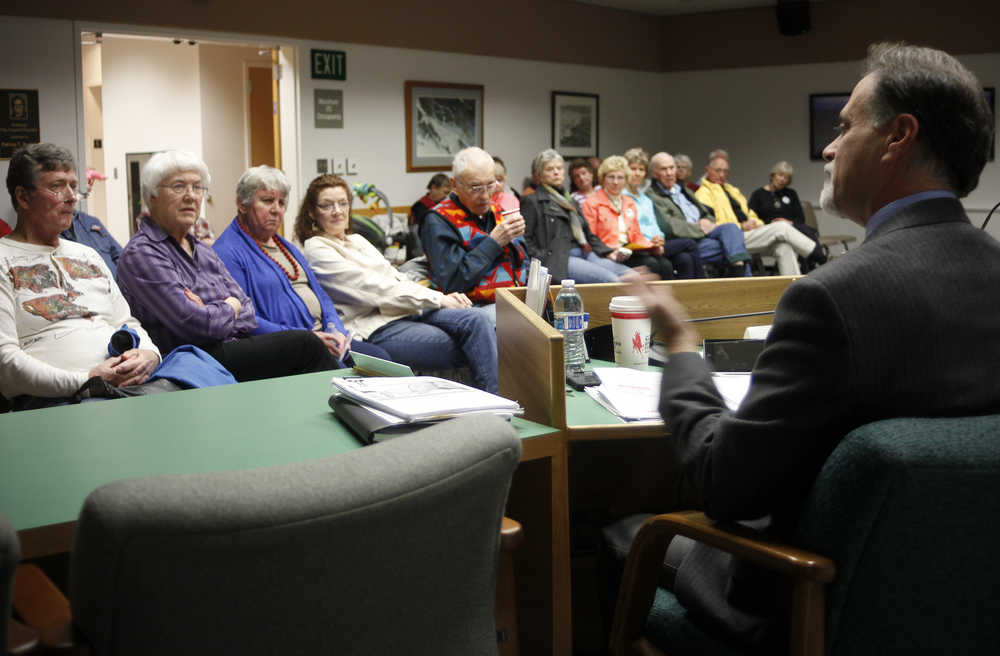
Photo by Rashah McChesney/Peninsula Clarion The Central Kenai Peninsula League of Women Voters held a debate for several local political candidates on Thursday Oct. 30, 2014 in Soldotna, Alaska.
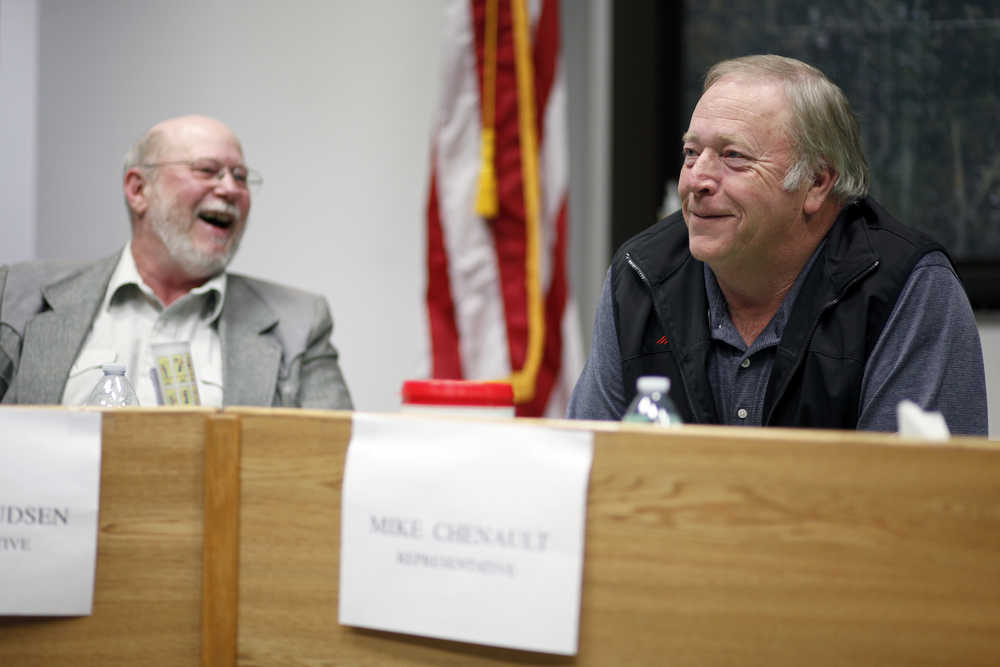
Photo by Rashah McChesney/Peninsula Clarion Candidates for House District 29 Rocky Knudsen and Mike Chenault share a laugh during a Central Kenai Peninsula League of Women Voters debate on Thursday Oct. 30, 2014 in Soldotna, Alaska.
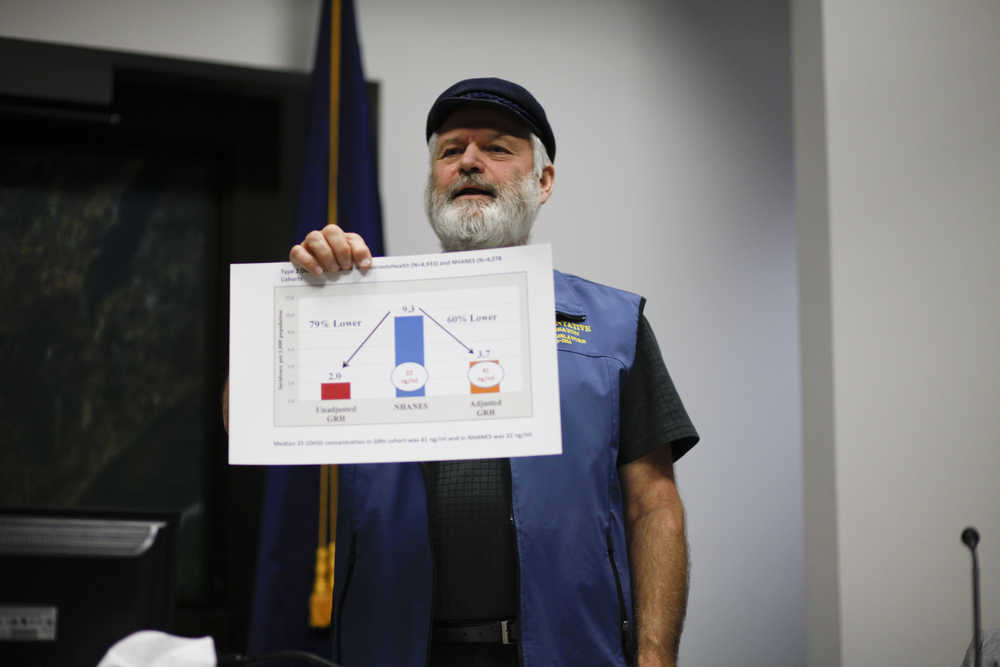
Photo by Rashah McChesney/Peninsula Clarion Rep. Paul Seaton, R-Homer, spent some time educating the audience on Vitamin D deficiencies and its effects on health, during a Central Peninsula League of Women Voters candidate debate on Thursday Oct. 30, 2014 in Soldotna, Alaska.
