
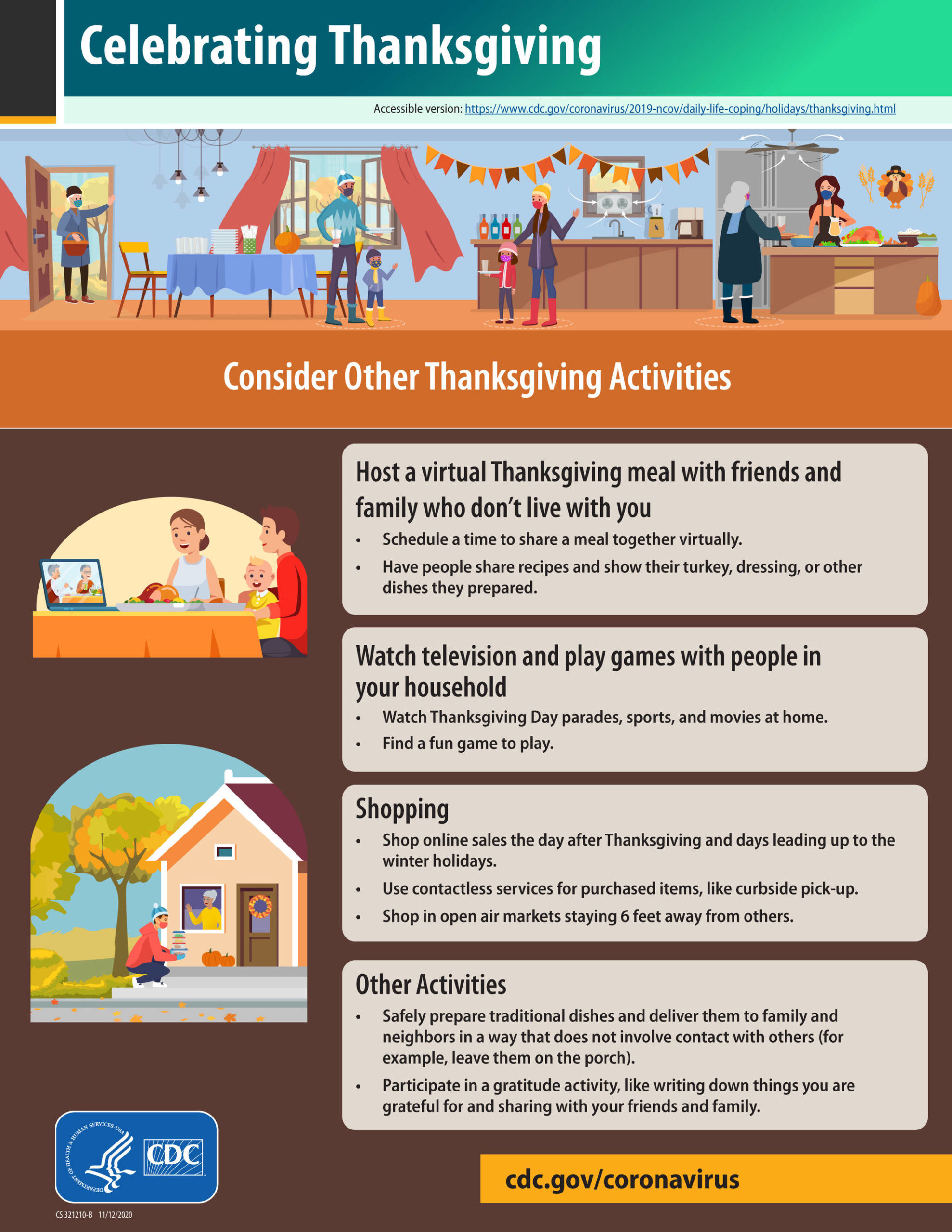
As Alaskans prepare to celebrate Thanksgiving this Thursday, the U.S. Centers for Disease Control and Prevention as well as Alaska’s Department of Health and Social Services are encouraging residents to keep their family gatherings small and holiday travel at a minimum in order to minimize the impacts of the ongoing COVID-19 pandemic.
“It’s personally my favorite holiday, where my family would try and stuff at least 50 to 100 people into a room for the holiday season,” Dr. Anne Zink, Alaska’s chief medical officer, said in an informational video conference with members of the media on Nov. 19. “Unfortunately, we won’t be doing that this year at all.”
The CDC has said celebrating Thanksgiving virtually or exclusively with members of your own household poses the lowest risk for spread. In this context, members of a household include anyone currently living and sharing a common space together. A college student returning home for the holidays after living and studying elsewhere, for example, should be considered part of a different household for the purposes of determining risk.
For anyone considering hosting or attending a gathering with multiple households, hosts should take a few steps to prepare for the event:
■ Check the COVID-19 infection rates in the areas where attendees live prior to the event. As of Nov. 24, Alaska’s 14-day case rate was 1,582 cases per 100,000 people. On the Kenai Peninsula the 14-day case rate was at 1,291.8 cases per 100,000 people. The higher the case rate is in a given area, the higher the likelihood that someone from that area could be exposed to the disease prior to attending a holiday celebration, according to the CDC.
■ Limit the number of attendees as much as possible so that members of different households can stay 6 feet apart. Guests from different households should avoid direct contact like handshakes and hugs.
■ Host outdoor events rather than indoor gatherings as much as possible, and require guests to wear masks when not eating or drinking, even when outside.
■ Avoid holding gatherings in poorly ventilated or crowded spaces, and increase ventilation by opening windows and doors or placing your central air and heating system on continuous circulation.
■ Encourage guests to wash hands with soap and water for at least 20 seconds as often as possible.
■ Limit contact with shared items like serving utensils, and use gloves when disposing of trash.
■ Treat pets like other family members and keep interactions within households as much as possible.
The CDC has said that there is no evidence to suggest that handling food or eating is associated directly with spreading COVID-19. It is possible to contract COVID-19 by touching a surface that has the virus on it and then touching one’s own mouth, nose or eyes, but this is not thought to be the main way that the virus is spread. The CDC still suggests limiting the use of common utensils and avoiding potluckstyle gatherings.
The CDC also advises that you should not attend an in-person gathering if you have recently been diagnosed with COVID-19, if you have symptoms of the disease, if you are awaiting test results, if you have been exposed to someone who is COVID-positive in the last 14 days or if you are at increased risk of severe illness from COVID-19.
Zink said Thursday that just over two-thirds of Alaskans have at least one underlying health condition that could lead to more severe cases of COVID-19. That number increases to 71% of Alaskans when age is also considered a risk factor.
The guidance offered by DHSS is similar to the recommendations from the CDC, advising that celebrating in person only with the people in your household is the safest way to celebrate.
“Unfortunately this is not the year to be gathering in large groups and traveling,” Zink said Thursday.
DHSS recommends doing things like hosting a virtual dinner with extended family and friends, heading outside or performing no-contact food deliveries for family and neighbors. DHSS also recommends doing your holiday shopping online rather than in person and avoiding crowded stores on Black Friday.
For the full CDC recommendations on holiday celebrations, go to www.cdc.gov/coronavirus/2019-ncov/daily-life-coping/holidays.html.
For the state’s recommendations on holiday celebrations, visit dhss.alaska.gov/dph/epi/id/pages/COVID-19/holidays.aspx.
