
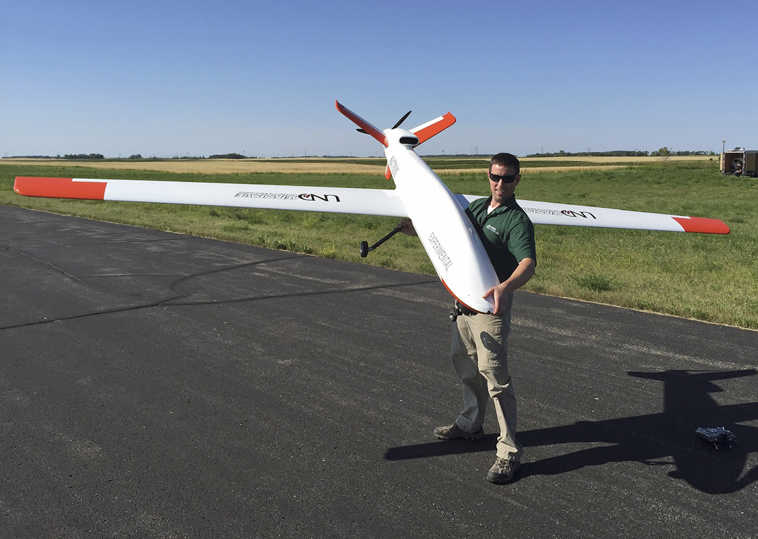
In this Aug. 4, 2015 photo provided by the University of North Dakota, UND pilot Schuyller "Sky" Andrew holds a Draganflyer X4ES drone that he flew on a test flight from the Lakota, N.D., airport that was conducted for the Northern Plains UAS Test Site. The North Dakota site has been granted approval by the Federal Aviation Administration to fly drones about 200 feet and fly them at night. It is the first of six national test sites to fly at night. (Andrew Regenhard/University of North Dakota via AP)

In this Aug. 4, 2015 photo provided by the University of North Dakota, UND pilot Schuyller "Sky" Andrew holds a Draganflyer X4ES drone that he flew on a test flight from the Lakota, N.D., airport that was conducted for the Northern Plains UAS Test Site. The North Dakota site has been granted approval by the Federal Aviation Administration to fly drones about 200 feet and fly them at night. It is the first of six national test sites to fly at night. (Andrew Regenhard/University of North Dakota via AP)

North Dakota drone test site set to fly high at all hours

  • By DAVE KOLPACK
  • Sunday, August 23, 2015 10:45pm
  • News

FARGO, N.D. — Of the six sites in the U.S. where researchers are trying to figure out how to integrate unmanned aircraft into civilian airspace, only North Dakota’s can fly high both day and night.

The Federal Aviation Administration approved a plan last week that allows drones to be flown up to 1,200 feet above the entire state and permits flights at night, a combination that makes North Dakota unique, since other test sites are limited to a 200-foot blanket and daylight hours.

“It really expands the type of operations you can conduct,” said Nicholas Flom, director of safety for the Northern Plains UAS Test Site.

For example, some precision agriculture sensors are designed to function at a minimum altitude of 250 feet, he said, and drones that would be flown to look for hot spots in wildfires or used for search-and-rescue missions generally work better at a higher altitude because it gives the cameras a broader range.

Alaska, New York, Nevada, Texas and Virginia also were selected in December 2013 as national test sites for unmanned aircraft, which the FAA does not currently allow for commercial use.

As for why North Dakota’s wide-open skies were chosen for the higher altitudes, the FAA referred questions to the North Dakota Department of Commerce.

Officials at the Northern Plains site wasted no time getting up in the air at night last week with the Draganflyer X4ES, which was monitored by three University of North Dakota pilots.

“With the lights on the aircraft, it’s uniquely easy to see it,” Flom said. “It’s a little bit different perspective when they take off and land, just from a depth perspective standpoint, but there’s no problem seeing anything.”

Flying drones at night can have many benefits, said Mark Hastings, the test site’s director of operations. Infrared sensors, which can detect people or animals on the ground, seem to work better in cooler temperatures. There’s also less air traffic in the nighttime hours and usually lower wind speeds, a challenge for drone pilots especially in North Dakota.

The schedule for nighttime and high-altitude flights has not been determined, but the FAA will be closely monitoring the number of flights, Flom said.

And getting high up has a lot of value, too, allowing cameras to collect more data over a larger area more quickly.

North Dakota State University professor John Nowatzki is spearheading a research project that would use a large drone to monitor crop conditions and plans to ask for a special permit to put an unmanned aircraft with a 35-foot wing span in the Red River Valley at heights of 3,000, 5,000 and 8,000 feet. The pictures from higher altitudes will be compared to those from a smaller drone at 400 feet and satellite images to see what’s best at identifying crop conditions such as nutrient deficiencies, disease symptoms and specific weeds.

“The value of flying higher is what our research is going to be about in 2016,” Nowatzki said.

More in News

The Challenger Learning Center is seen here in Kenai<ins>, Alaska,</ins> on Sept. 10, 2020. (Photo by Brian Mazurek/Peninsula Clarion)
Kenai City Council considers possible uses for Challenger Center

One option would assess the facility’s potential as the new public safety building.

A snowmachine rider takes advantage of 2 feet of fresh snow on a field down Murwood Avenue in Soldotna, Alaska, on Monday, Dec. 12, 2022. (Jake Dye/Peninsula Clarion)
Ice fishing opens on some Kenai National Wildlife Refuge lakes

Snowmachines are permitted for ice fishing access on Hidden, Kelly, Petersen, Engineer and Watson lakes.

The waters of Cook Inlet lap against Nikishka Beach in Nikiski, Alaska, where several local fish sites are located, on Friday, March 24, 2023. (Jake Dye/Peninsula Clarion)
Kenai asks for fishery economic disaster declaration

The Kenai City Council requested that Gov. Dunleavy declare a disaster and support a recovery plan for the Upper Cook Inlet East Side Set Net fishery.

The Kenai Peninsula Borough School District logo. (Photo courtesy of Kenai Peninsula Borough School District)
District superintendent dispels rumors about student construction

Superintendent Clayton Holland said student involvement in Seward High School construction is “based on rumor, not fact.”

Anchorage-based singer and songwriter Keeley Boyle is pictured in Anchorage<ins>, Alaska,</ins> on Sept. 26, 2023. Boyle, who was raised on the Kenai Peninsula, will use a $10,000 grant she received from the Rasmuson Foundation to create an album of songs about her grandparents’ home in Nikiski. Photo courtesy of Jovell Rennie
Musician hailing from Kenai receives Rasmuson grant

Keeley Boyle will record an album of songs about her grandparents’ Nikiski home.

Commercial fishing and recreational vessels are docked in the Homer harbor on Oct. 23, 2025. The commercial fishing industry endured a series of challenges over the year, some of them imposed by the new Trump administration. (Photo by Yereth Rosen/Alaska Beacon)
Alaska fisheries in 2025: turmoil, economic and environmental challenges and some bright spots

NOAA cuts, economic headwinds and invasive species pose problems, but there was some recovery in crab stocks and salmon harvests.

Cook Inlet near Clam Gulch is seen on Oct. 23, 2025. (Photo by Yereth Rosen/Alaska Beacon)
Disputed oil lease sale in Alaska’s Cook Inlet upheld in new Trump administration decision

After completing a court-ordered environmental study, the Bureau of Ocean Energy Management said no changes are needed for the 2022 sale that drew just one bid.

The Kenai Peninsula Borough School District logo.
School district projects $7.5 million budget deficit for fiscal year 2027

Decreased enrollment and increased property values mean less local and state funding.

The sign in front of the Homer Electric Association building in Kenai, Alaska as seen on April 1, 2020. (Photo by Brian Mazurek/Peninsula Clarion)
Homer Electric Association announces rate increase

The proposed increase, if approved by the Regulatory Commission of Alaska, will go into effect Jan. 1.

Most Read