
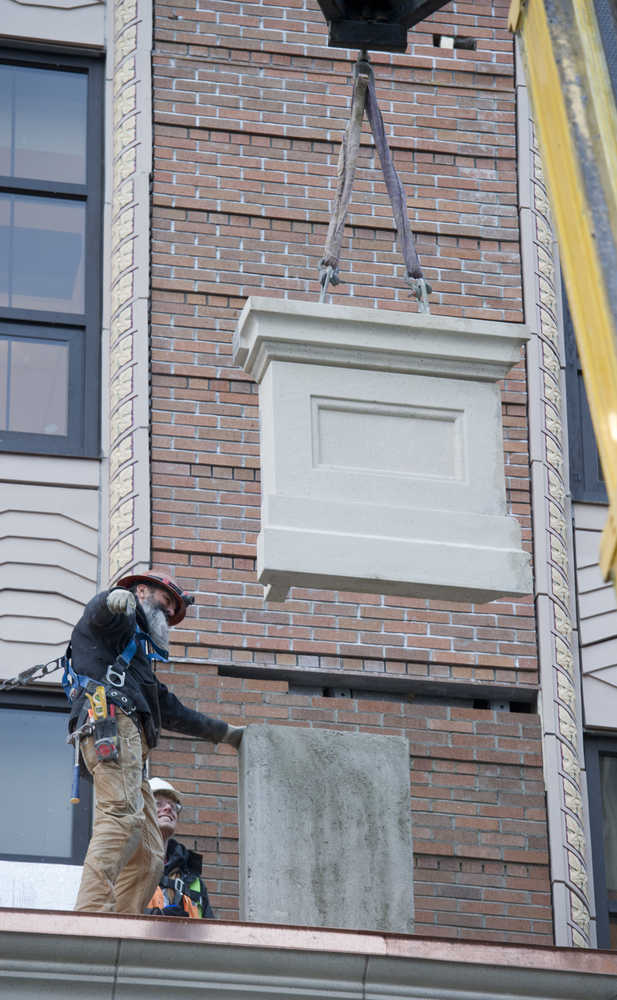
There are two ways to look at the just-completed four years of renovations at the Alaska State Capitol: Inside and out.
“I don’t think you’ll notice anything different,” said Pam Varni, executive director of the Legislative Affairs Agency, which oversaw the effort.
Since 2013, almost $36 million has been spent on renovations to the 85-year-old building. The effort was intended to reinforce the building against earthquakes, make its heating system efficient, and restore it to the way it looked in 1931.
When the Capitol opens for business at the end of December and the start of January, people walking its halls will be hard-pressed to tell what was done.
Jeff Goodell has been the building manager of the Alaska Capitol since 2014, and he’s been the renovation’s project manager.
“Just recently, I had the House Rules chair (Rep. Gabrielle LeDoux, R-Anchorage), and I had taken her into one of the suites, and she said, ‘Well, what was it you did in here? It all looks the same,’” Goodell remembered.
He had to explain to her that a few months before, the entire floor was gutted. There were no rooms, fittings or walls, just open air marred by concrete columns.
The walls might be a few inches thicker now than they were before — thank insulation for that — but few people will notice the difference. More are likely to notice the change in the exterior.
“It looks entirely different from the outside,” Goodell said.
The renovation removed the building’s old red-yellow brick and replaced it with darker masonry more resistant to rain and moisture. There’s fresh copper cladding and clean stonework throughout its facade.
“If you look at the building from the outside, you should notice quite a bit of difference,” Goodell said.
If you haven’t noticed, don’t worry — the windows, stonework and brick were deliberately chosen to match patterns and colors from the existing building as closely as possible.
Wayne Jensen is the architect behind the renovation, and he says most of the big changes in the past four years have been to the building’s concrete skeleton.
“There’s quite a bit of work you can’t see,” Jensen said. “You can’t see any of the structural work; it’s all buried in the walls.”
When the Federal and Territorial Building opened in 1931, it included federal offices, a post office, the territorial governor’s offices and the state museum. By the time Alaska became a state, the 90,000 square-foot building had been consumed by government offices.
It cost $1 million and took 18 months to construct, and when built, it consisted of a concrete skeleton covered by a skin of brick, limestone and terra cotta.
By the turn of the 21st century, the building was showing its age, and there were extensive talks about replacing the Capitol with a new building on Telegraph Hill.
After a final design was selected — and loudly rejected by the state’s residents — the existing capitol’s problems became a critical issue. Moisture had seeped into its walls, and its masonry was decaying.
The Alaska Legislature started setting aside renovation money in 2006, and the first contract was awarded to Jensen, Yorba, Lott (Jensen’s firm). The first construction contract came in 2013.
From the summer of 2013 through the end of December 2016, work progressed in a regular pattern: Contractors would set up shop once the Legislature adjourned for the summer, then take down their equipment each December and January.
“The hardest part, really, was the fact that it was a three-year deal,” Goodell said. “Mobilization and demobilization is very expensive, and it’s just problematic from a management standpoint.”
Goodell has worked in Juneau’s construction industry since 1988, and he’s never had a project like this one.
The building’s original skeleton consisted of concrete columns. In an earthquake, those columns might buckle, collapsing the Capitol. During the renovation, workers installed concrete walls to join the columns, stiffening the building’s structure. They also braced the building’s foundation.
To do that, they had to crawl into the muck beneath the building. In 2013, they exavated 66 dump-truck loads of glacial till, allowing space for future work. It was nasty, mucky work — and hot, since the building’s steam heat wasn’t replaced with a more efficient system until 2014.
In addition to the structural work, the renovation added six new rooms to the capitol — two each on the third, fourth and fifth floors — and even reinforced the marble columns on the building’s portico.
Some work remains to be done, Jensen said, but the unfinished items aren’t significant and should be cleared off the checklist without too much trouble next summer.
The state of Alaska paid for most of the project — the Juneau Community Foundation added about $1 million — and Goodell thinks the state’s residents have gotten the worth of their money.
“I think so, yes, and I hope the residents of the state feel the same way,” he said. “This building was in disrepair, things were falling off, and now it’s a thing of real beauty.”
