
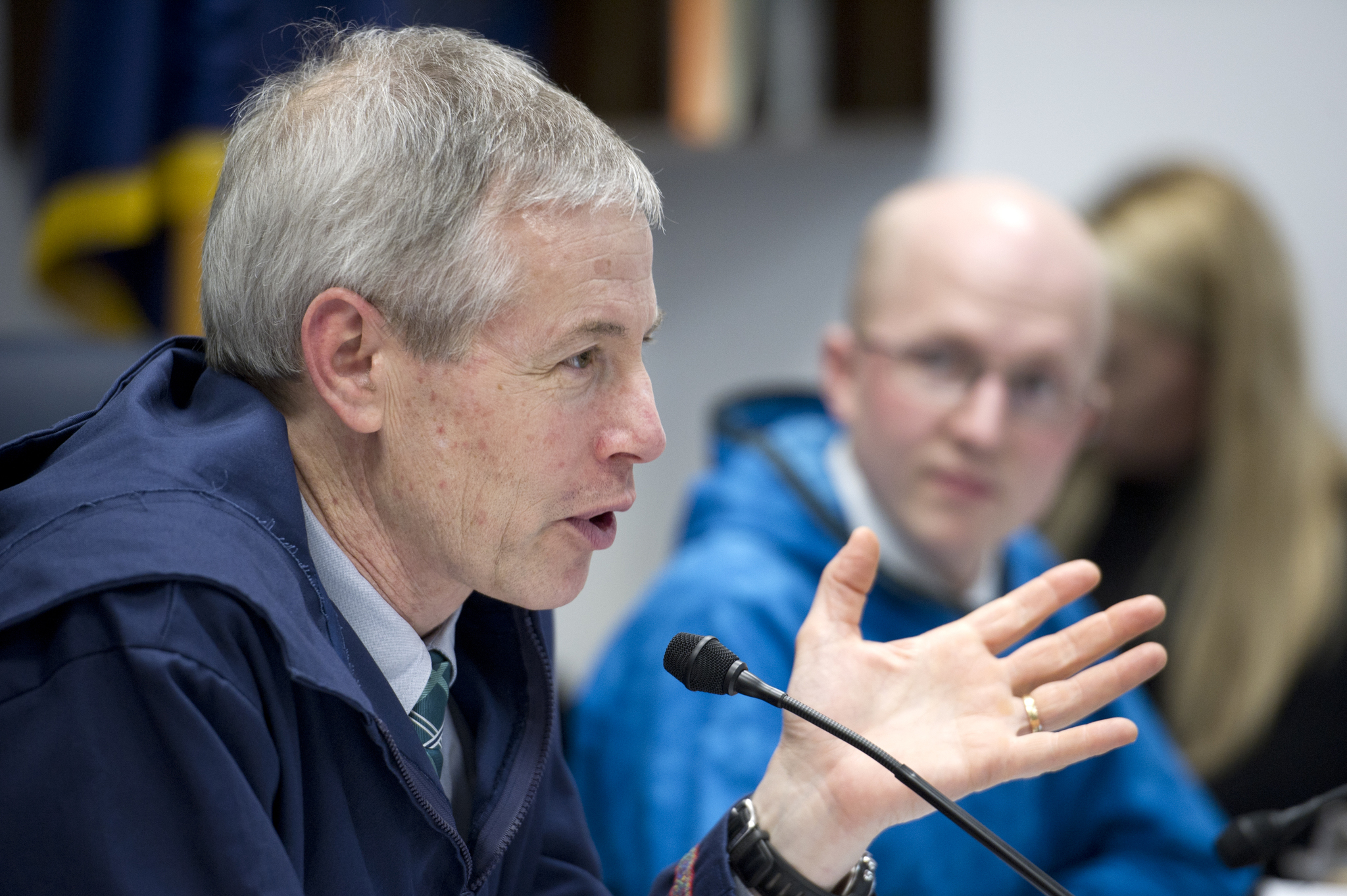
Rep. Matt Claman, D-Anchorage, Chair of the House Judiciary Committee presents a question to Rep. Jason Grenn, I-Anchorage, during his introduction of HB 44 in the at the Capitol on Friday. HB 44 would require a legislator to abstain from taking or withholding official action or exerting official influence that could benefit or harm an immediate family member or certain employers. Rep. Jonathan Kreiss-Tomkins, D-Sitka, is seen in the background. (Michael Penn | Juneau Empire)

Rep. Matt Claman, D-Anchorage, Chair of the House Judiciary Committee presents a question to Rep. Jason Grenn, I-Anchorage, during his introduction of HB 44 in the at the Capitol on Friday. HB 44 would require a legislator to abstain from taking or withholding official action or exerting official influence that could benefit or harm an immediate family member or certain employers. Rep. Jonathan Kreiss-Tomkins, D-Sitka, is seen in the background. (Michael Penn | Juneau Empire)

New lawmaker squarely targets Legislature’s conflicts of interest

Ray Metcalfe sat at a desk next to a wallet full of million-dollar bills and asked Alaska lawmakers to curtail corruption.

On Friday, members of the Alaska House Judiciary Committee heard testimony on House Bill 44 and House Concurrent Resolution 1, measures proposed by Rep. Jason Grenn, I-Anchorage, to identify conflicts of interest in the Legislature.

Metcalfe, who served in the House between 1978 and 1982, said he “saw bribery was rampant,” and he supports the effort by Grenn.

“It happens more often than you know,” said Metcalfe, who ran for U.S. Senate as a Democrat last fall.

Grenn’s proposals are the first by the Anchorage independent to get a hearing this session.

Advancing together, they would make it much more difficult for lawmakers to vote on a measure if they have a conflict of interest — something that would be defined as “substantial benefit or harm to the financial interest of the legislator’s immediate family member, the legislator’s employer, an immediate family member’s employer, a person with whom the legislator is negotiating employment, or from whom the legislator or immediate family member has received more than $10,000 in income within the last 12 months.”

The Legislature has no existing standard for conflict of interest, though lawmakers traditionally declare conflicts based on conscience.

Even when a lawmaker declares a conflict, it’s difficult for them to abstain. Only one lawmaker needs to object in order to force the conflicted lawmaker to vote.

Grenn’s HCR 1 proposal would change that rule: A majority vote would be required instead.

Speaking in favor of his legislation, Grenn said one of his goals is to improve transparency and accountability in government.

Members of the judiciary committee applauded that goal but wondered if Grenn’s strategy might have unintended consequences.

Rep. Chuck Kopp, R-Anchorage, asked whether a Legislative majority could manipulate Grenn’s rule to target members of the minority. In a close vote, the majority might declare a minority member has a conflict, then force them to abstain with a majority vote.

“There could be scenarios where what you’ve talked about potentially could happen,” Grenn said.

He added that if that happened, there would be a clear record and probable public condemnation.

“That vote now is public record, and the public can see that one side or the other is engaging in politics as opposed to engaging in good policy,” Grenn said.

Rep. Lora Reinbold, R-Eagle River, asked Grenn directly if he was attempting to engage in politics himself.

“Do you have any motivation in any way to alienate or target anyone associated with the oil and gas industry?” she said.

Grenn is a member of the coalition majority in the House, and that coalition has said that it intends to reform the state’s system of oil and gas drilling subsidies.

Sen. Peter Micciche, R-Soldotna, and Sen. Kevin Meyer, R-Anchorage, are each employed by oil and gas companies and declare conflicts when oil and gas issues come up for a vote.

Each time, including on the controversial Senate Bill 21 in 2013, they have been forced to vote.

“No, this is not meant toward anyone in this building in particular,” Grenn said. “There’s no target with this bill, other than to build public trust.”

After committee discussion, Grenn’s measures were held in committee ahead of possible amendments Monday.

Even if they advance through the House, they may encounter problems in the Senate.

On Friday morning, Senate President Pete Kelly, R-Fairbanks, said he isn’t personally convinced Grenn’s proposal is necessary.

“Everybody in the state of Alaska has a conflict,” he said. “We have business agents for unions working. We have people who have spouses who are teachers. They’re totally tied into the state budget.”

More in News

Low clouds hang over Cook Inlet north of Anchor Point on Oct. 23, 2025. (Photo by Yereth Rosen/Alaska Beacon)
Inletkeeper condemns federal management of Cook Inlet oil lease sale

The agency alleges an environmental study by the Bureau of Ocean Energy Management was conducted with a “serious” lack of transparency.

The Kenai Chamber of Commerce announced the winners of the 13th annual gingerbread house competition on Dec. 20, 2025. This creation by Sierra won the 2-5 year old age category. Photo courtesy of the Kenai Chamber of Commerce
Wrapping up the holiday season

The Kenai Chamber of Commerce’s Angel Tree program and gingerbread house competition spread Christmas cheer to hundreds locally.

The Challenger Learning Center is seen here in Kenai<ins>, Alaska,</ins> on Sept. 10, 2020. (Photo by Brian Mazurek/Peninsula Clarion)
Kenai City Council considers possible uses for Challenger Center

One option would assess the facility’s potential as the new public safety building.

A snowmachine rider takes advantage of 2 feet of fresh snow on a field down Murwood Avenue in Soldotna, Alaska, on Monday, Dec. 12, 2022. (Jake Dye/Peninsula Clarion)
Ice fishing opens on some Kenai National Wildlife Refuge lakes

Snowmachines are permitted for ice fishing access on Hidden, Kelly, Petersen, Engineer and Watson lakes.

The waters of Cook Inlet lap against Nikishka Beach in Nikiski, Alaska, where several local fish sites are located, on Friday, March 24, 2023. (Jake Dye/Peninsula Clarion)
Kenai asks for fishery economic disaster declaration

The Kenai City Council requested that Gov. Dunleavy declare a disaster and support a recovery plan for the Upper Cook Inlet East Side Set Net fishery.

The Kenai Peninsula Borough School District logo. (Photo courtesy of Kenai Peninsula Borough School District)
District superintendent dispels rumors about student construction

Superintendent Clayton Holland said student involvement in Seward High School construction is “based on rumor, not fact.”

Anchorage-based singer and songwriter Keeley Boyle is pictured in Anchorage<ins>, Alaska,</ins> on Sept. 26, 2023. Boyle, who was raised on the Kenai Peninsula, will use a $10,000 grant she received from the Rasmuson Foundation to create an album of songs about her grandparents’ home in Nikiski. Photo courtesy of Jovell Rennie
Musician hailing from Kenai receives Rasmuson grant

Keeley Boyle will record an album of songs about her grandparents’ Nikiski home.

Commercial fishing and recreational vessels are docked in the Homer harbor on Oct. 23, 2025. The commercial fishing industry endured a series of challenges over the year, some of them imposed by the new Trump administration. (Photo by Yereth Rosen/Alaska Beacon)
Alaska fisheries in 2025: turmoil, economic and environmental challenges and some bright spots

NOAA cuts, economic headwinds and invasive species pose problems, but there was some recovery in crab stocks and salmon harvests.

Cook Inlet near Clam Gulch is seen on Oct. 23, 2025. (Photo by Yereth Rosen/Alaska Beacon)
Disputed oil lease sale in Alaska’s Cook Inlet upheld in new Trump administration decision

After completing a court-ordered environmental study, the Bureau of Ocean Energy Management said no changes are needed for the 2022 sale that drew just one bid.

Most Read