
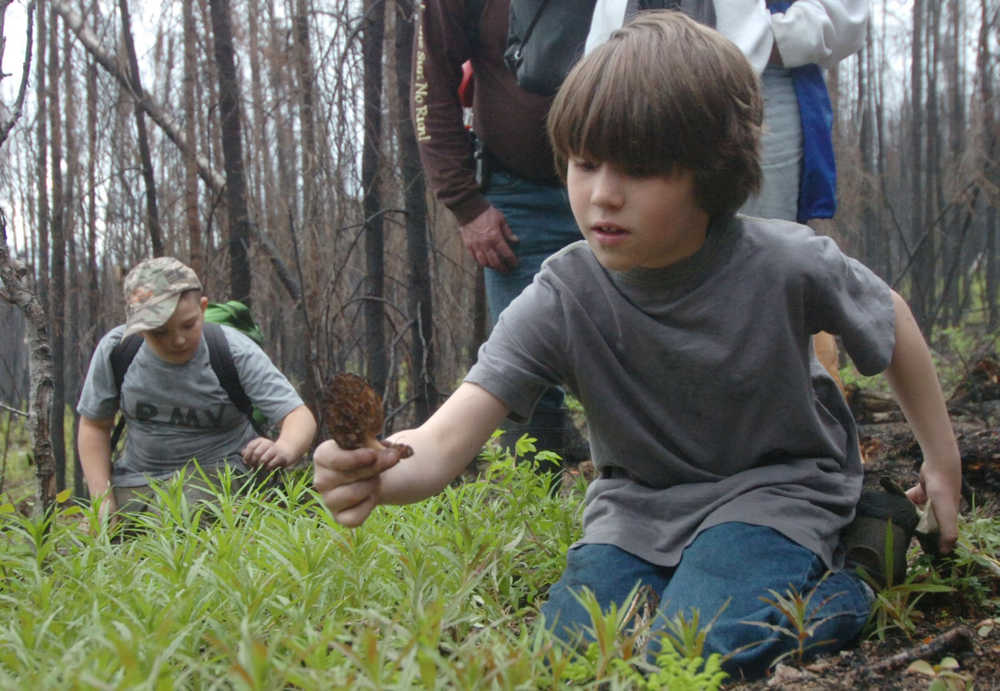
The Central Kenai Peninsula is projected to yield a bountiful harvest of morel mushrooms this season. Mushroom hunters are already on the move, combing through the undergrowth and forest floor.
Effort and attention is focused on the earth charred by last year’s Funny River Horse Trail wildfire — an ideal environment for the hearty fungi.
George Spady, who organizes the recently formed enthusiast group “Kenai Peninsula Mycology Society for the Study of Mushrooms and Lichen,” said foragers are finding varied sizes of fruiting bodies in Funny River, Kasilof, Nikiski and on the Kenai National Wildlife Refuge.
“It’s one of the first mushroom species of the year,” Spady said. “People haven’t had mushrooms in their mouth for eight months and now you have these beautiful, hearty morels.”
Where to find them
The first rule of morel hunting is don’t talk about morel hunting.
Most mushroom foragers will not divulge their secret spot, Spady said.
“Once you give up your spot, it is gone forever.”
The mushroom requires released spores to reproduce, which is why it is found in roughly the same spots year after year.
Spady carries what he has collected in a mesh bag so spores can spread on the walk back to the car.
Any fungus, including lichen, requires heat and moisture to flourish, he said.
In his own experience, even in the recently burned areas, Spady has found morels lining the south facing side of marshy areas, where both of their environmental needs are met.
This year the central Kenai Peninsula hasn’t seen much rainfall, which causes some question as to whether or not the burned areas will produce an above average yield, he said.
Better after the burn
The United States Department of Agriculture and United States Forest Service published the results of a study on after-burn yields titled “Harvesting Morels After Wildfire in Alaska” in 2005.
The dispersal of spores during a major event is massive, according to the study. Fruiting morels are found in areas categorized as undisturbed locations, and areas where there has been a large-scale disturbance.
Events that significantly disrupt an environment include timber harvest and scarification, insect infestation or wildfire, according to the study. Larger yields may last for the first two years after the event.
“In interior Alaska, morels are most likely to be found in moderately to severely burned areas near the bases of trees,” according to the study.
What to look for
At the least, it is easier to spot the distinctly ridged, conical caps among the char, Spady said. The mushrooms are always tan in color, with hues that determine common names, he said. On the Kenai Peninsula, black and white morels are plentiful, he said.
Cup-fungus, which also thrives in moist, burnt areas, is a good indicator that morels are near, Spady said.
Where other fungi are popping up means those spots are also ideal for morels, he said. Morels often saddle up next to trees as well.
“Like any other fungus, morels require a symbiotic relationship with another species to survive,” Spady said.
Kenai National Wildlife Refuge Entomologist Matt Bowser said it is easy to tell morels apart from the species that have even the closest resemblance. However, be sure to know the differences before foraging, he said.
False morels will make the consumer ill if eaten, Bowser said. People have been known to have bad reactions to even regular morels, he said.
Bowser, while an avid forager, won’t be seeking morels this season because some of his family members get sick when they consume the mushroom.
“I don’t bother anything I can’t serve at the dinner table,” Bowser said.
There is plenty of information on morels, and it is important to educate oneself before beginning, Bowser said.
The University of Alaska Fairbanks Cooperative Extension Service Kenai Peninsula District office has two free publications that cover foraging and identifying morels.
Personal use
Morels are known for their earthy flavor and meaty flesh, said experienced forager Janice Chumley, who has been hunting mushrooms on the Kenai Peninsula for nearly one decade.
Morels are versatile, Chumley said. They can be used in sauces, sautéed separately, included in side dishes and salads, she said.
There has always been a consistent public interest in mushroom picking and personal-use foraging for various species in the area, Chumley said. Community groups like the Mycology Society have formed and disbanded through out the years, she said.
“Morels are tasty,” Chumley said. “That’s the bottom line for me.”
The mushroom should not be eaten raw, Spady said. It needs to be cooked through completely or it can make people sick, he said.
Every year members of the public seek out mushrooms and berries within the Kenai National Wildlife Refuge, Bowser said.
While the practice is technically illegal, if picked for personal-use morels are recognized as harvestable and pickers will not be prosecuted, Bowser said.
The United States Fish and Wildlife Service is proposing a ruling for the refuge’s public-use regulations that would that would make taking plant species completely legal, Bowser said.
The refuge is taking public comments on the regulations through July 20, 2015, which are “aimed at balancing public use and safety with resource conservation,” according to the refuge’s website.
There is no limit to how much can be foraged, but “you really should not collect more than you can process,” Bowser said.
Reach Kelly Sullivan at kelly.sullivan@peninsulaclarion.com.
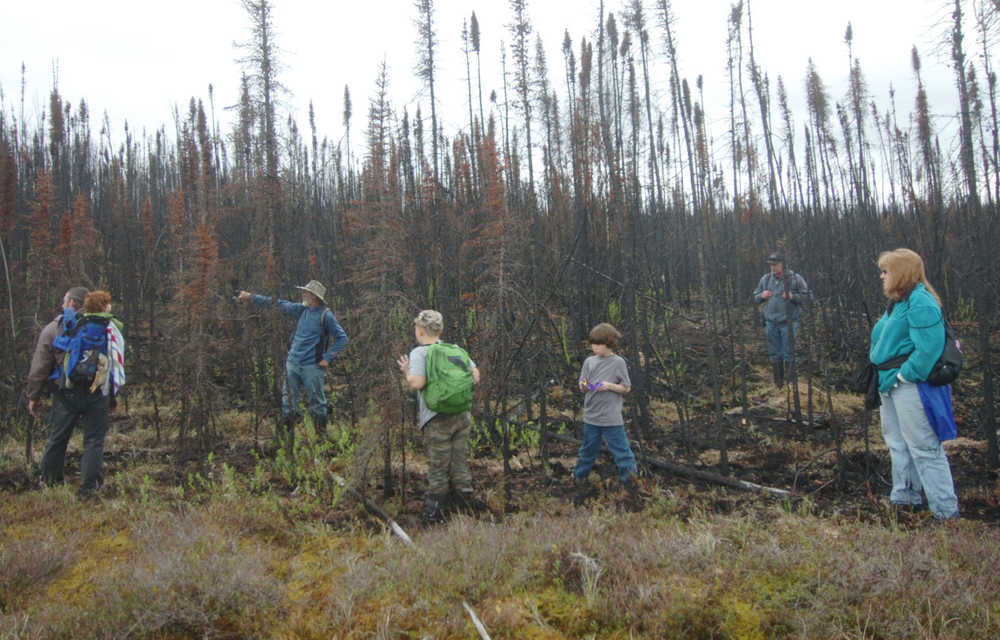
Photo by Kelly Sullivan/ Peninsula Clarion George Spady’s foraging group found a stash of morels among the area burnt by last year’s Funny River Horse Trail wildfire Saturday, May 23, 2015, in Funny River, Alaska.
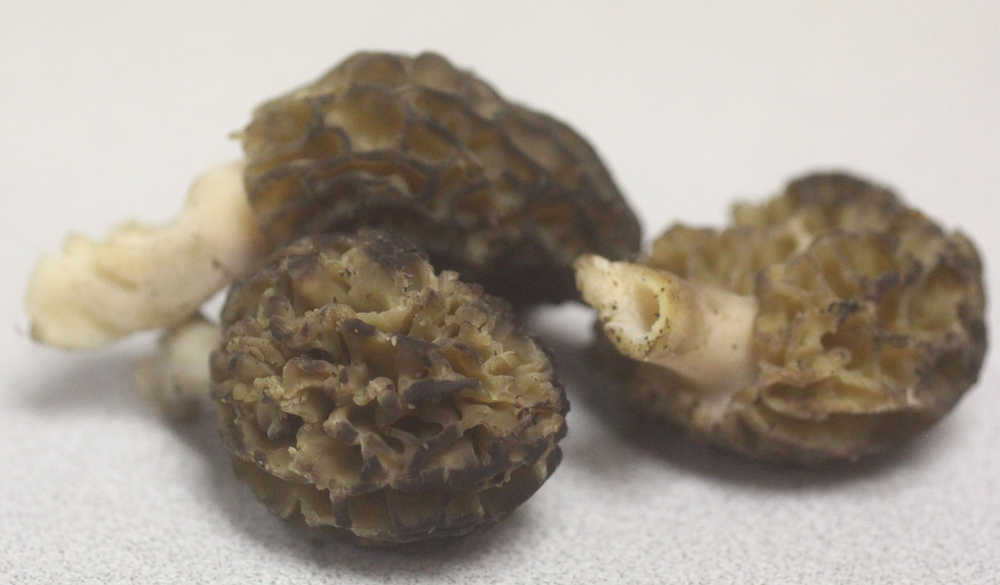
Photo by Kelly Sullivan/ Peninsula Clarion Silas Tucker picks up one of the first morels found by his foraging group Saturday, May 23, 2015, in Funny River, Alaska.
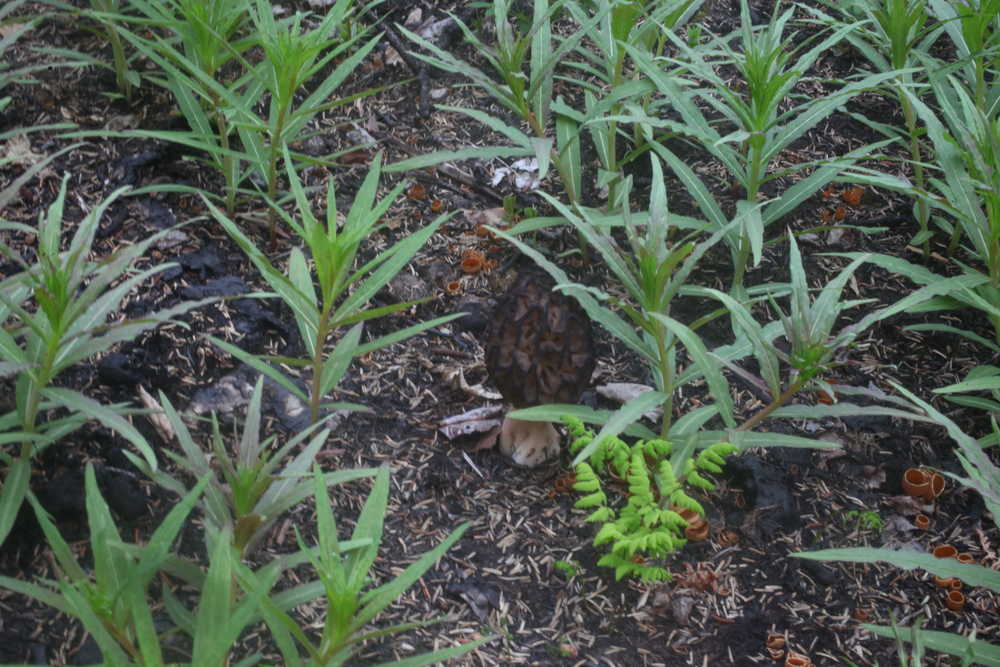
Photo by Kelly Sullivan/ Peninsula Clarion Most forages won’t divulge where they have found morels mushrooms, but many have located fruiting bodies in the areas burned by the 2014 Funny River Horse Trail wildfire Saturday, May 23, 2015, in Funny River, Alaska.
