
Editor’s note: This article has been updated to correct the word “fiscal” in a quotation.
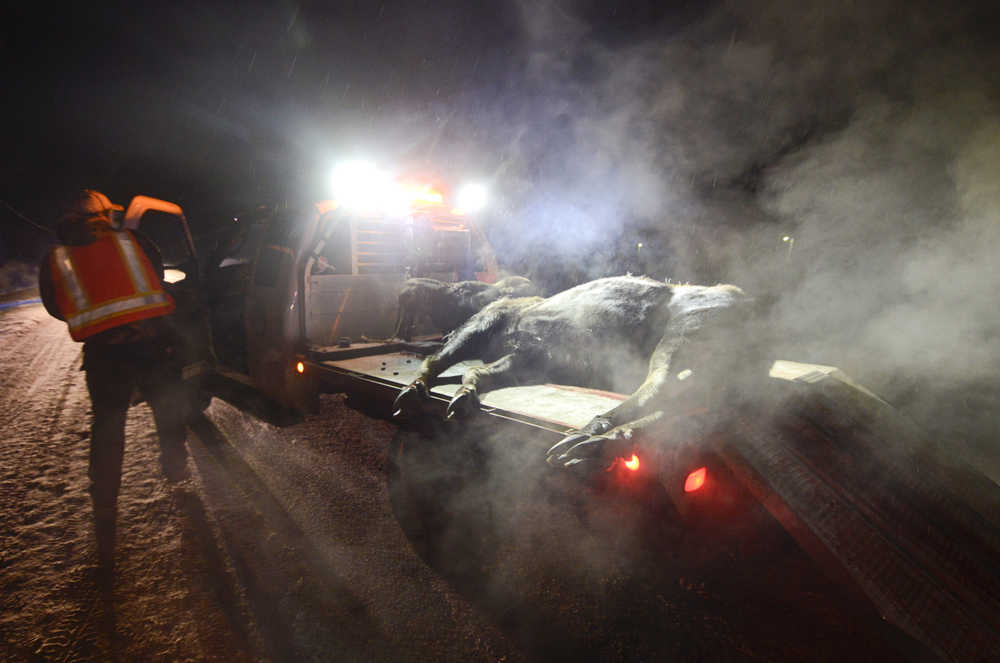
Moose traffic is picking up on the Kenai Peninsula, with six of the animals hit and salvaged within a 24-hour period this week.
Laurie Speakman, a volunteer driver for the Alaska Moose Federation, collected six moose in less than one day starting on Monday night. Her previous record was five moose in 24 hours, she said.
“It was kind of a little shocking to get that many in such a short amount of time,” Speakman said. “It’s getting darker and with some of the wet weather that we’ve been having… you cannot see these moose.”
The first call came in just after 8 p.m. on Monday for two calves, one on Mackey Lake Road and the other on the Sterling Highway. The calves were not that far away from each other, and Speakman said she suspects they were siblings. The next call was at approximately 7 a.m. on Tuesday for an adult cow at mile 5 of the Kenai Spur Highway, Speakman said. The last call came in just under the wire at 7:40 p.m. on Tuesday for a male calf at mile 103 of the Sterling Highway and for two female calves at mile 78.
These moose pick-ups come after the return of several of the federation’s trucks, which were out of commission being certified while the organization went through structural changes.
“A lot of people won’t slow down,” Speakman said. “Drivers need to be more aware of what’s going on on these roads.”
People using cellphones while driving is one reason Speakman personally suspects collisions with moose happen so often.
Lt. Dane Gilmore is the deputy commander of the Alaska State Troopers detachment covering the Kenai Peninsula, and also cited cellphones as devices that distract drivers.
He also added that people ought to make sure their headlights are clean before they drive.
“Those (two) things are the big contributing factors,” Gilmore said.
Unlike roads in the Interior, roads on the Kenai Peninsula tend to be more curved and winding, which Gilmore said makes it harder to see moose. Gilmore said roads on the peninsula tend to be darker and less clear, while the Interior often has moonlight reflecting off plenty of snow to help illuminate the sides of roads.
Don Dyer, the federation’s director since June, echoed Speakman’s surprise at the cluster of road kills.
“I know the record is seven (moose) in a 27-hour period, so that does happen at times,” he said. “We’ve got great drivers. Equipment is now in top condition, and it’s just a privilege to do this.”
Earlier this year, several of the Alaska Moose Federation’s trucks were out of use while being certified to Alaska Department of Transportation standards, and were therefore not able to collect moose off the roads.
Speakman said she is glad to have her vehicle back, and that all of the trucks should be back to work soon.
Dyer said all the trucks have been certified, and all but two have been put back on the roads. He plans to send one to Fairbanks, while the other might come to Kenai, he said
The Alaska Moose Federation has been undergoing leadership and structure changes for the last few months, Dyer said. These changes included altering the way the group is funded, with the federation switching from mostly collecting grants to a contract with the U.S. Department of Transportation.
As of Sept. 1, the DOT compensates the federation for cleaning moose off the roads for the Alaska State Troopers, Dyer said. The funding is handed down through the Alaska DOT.
Roger Healy is the chief engineer for the Division of Design and Engineering Services with the DOT in Alaska.
The department’s contract with the Alaska Moose Federation is part of a Highway Safety Improvement Plan, he said.
“Basically… the state of Alaska DOT receives money through the Federal Highway Administration and it’s an allocation annually,” Healy said. “There are a variety of different categories of funding within that.”
The federation’s work cleaning moose off the roads qualifies as a Highway Safety Improvement Project, making a contract with them attractive to the DOT, Healy said.
“Pretty much for our point of view, the service that had been provided under a state grant had interest to us on a highway safety improvement perspective, because basically getting moose off the road as quickly and as safely as possible… it improves the overall safety to the travelling public,” Healy said.
The contract is set to expire on June 30, 2016, after which there are two options for one-year renewals, Healy said. The contract is set to not exceed $300,000 annually, but Healy said the dollar amount can fluctuate depending on the number of moose the federation picks up and the number of vehicles it has in operation.
The money will be given to the federation in monthly allocations.
The contract with the DOT is supplemental and the federation will continue to rely on donations and fundraising, Dyer said.
“The work that we do with the salvage program with the DOT program doesn’t come close to funding our operational costs,” he said.
Dyer said the Alaska Moose Federation will still consider grant options, but will not give them too much thought because “we know the state’s fiscal condition.” Two fundraisers for the federation are being planned for this spring, Dyer said.
Reach Megan Pacer at megan.pacer@peninsulaclarion.com
