
Editor’s note: The article has been edited to correct an error with the moose survey numbers. It was originally stated that Fish & Game estimated there to be 1,177 moose in Unit 15C in 2013 and that by survival and productivity models, the number in 2015 was 488. Those numbers were misinterpreted — the actual point estimate for Unit 15C is 3,204 moose in 2013, and the 488 came from a composition count in 2015, which is used to estimate bull-cow and calf-cow ratios, not the entire moose population.
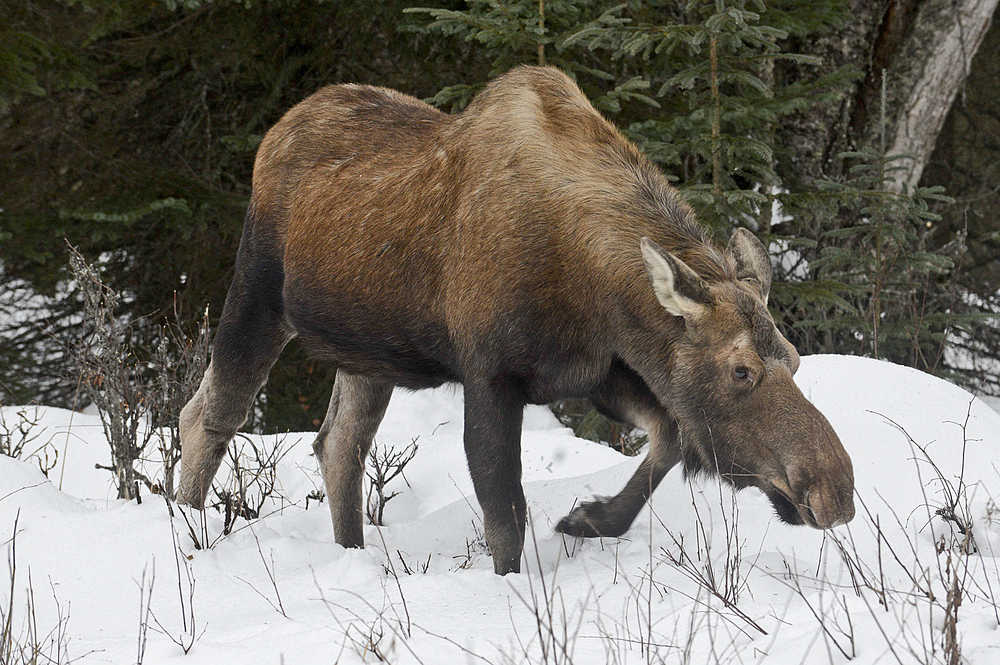
Observations of fewer hunters and fewer moose have led to questions about the annual antlerless moose season on the lower Kenai Peninsula.
The hunt, which takes place in the management unit around Homer, is held from Oct. 20-Nov. 20 and is open to Alaska residents and nonresidents. Fifty permits are issued.
The hunt has to be reauthorized every year by the Board of Game. The Kenai/Soldotna Fish and Game Advisory Committee debated a proposal to reauthorize the hunt during its Tuesday meeting.
Its purpose has primarily been to harvest nuisance moose that would otherwise be hit by cars or possibly die from lack of food. There are approximately 2.7 moose per square mile in the area, according to a moose census from 2013, the last year the Alaska Department of Fish and Game was able to do a full moose census. That population is stable enough to support a hunt, said Jeff Selinger, the area biologist for the Soldotna office of Fish and Game.
Because of low snowfalls in the last few years, it has been difficult to do a moose census, Selinger said. However, three years is an average amount of time between the surveys — more often, it’s five years or so, he said.
“We try to look at the bigger picture, if we can,” Selinger said. “We’ve got some folks down in 15C who say they’re seeing more moose than they’ve ever seen. We’ve got our pilot that we’ve flown with for years … saying, ‘There’s moose all over down here.’ We’ve got both sides.”
However, some have concerns about the moose population. Ninilchik resident Doug Blossom said at the meeting that he and a group of other hunters have noticed a drop in the moose numbers in the area.
“My observation is that our moose population on the lower peninsula is maybe starting to be in trouble,” Blossom said. “This year, I saw probably less than half the cows that I normally saw.”
Selinger said he did not want to discredit the observations of the hunters but that Fish and Game’s surveys turned up numbers he interpreted as stable. He said that if the majority of the advisory committees that have authority over the area where the antlerless hunt is being held do not support it, it goes away.
Several members of the advisory committee said they were also concerned about the moose numbers. Committee member Michelle Williams, who represents hunting, asked whether the number of hunters had decreased in the area.
The number of hunters was fairly average for the last few years but is significantly down from about five years ago. In 2014–2015, 1,769 people hunted on the peninsula. In 2010–2011, that number was 2,749.
Blossom said he would not want a hunt to be opened if the population really has decreased so much.
“The lower peninsula is just not that big of an area to hide moose,” Blossom said. “I would really caution on some of this.”
The 2013 moose census for Unit 15C — the sub-area where the antlerless moose hunt takes place — showed a point-estimate of 3,204. In last year’s composition count, an estimate used to determine bull-cow and calf-cow ratios, Fish & Game counted 488 moose in the area this last year, with a 46 bulls for every 100 cows. Because the snowfall has been low, the conditions for observing moose have been poor, and it’s possible that the surveyors missed some or that the moose have redistributed from the counting area.
The bull-to-cow ratio has been low but has begun climbing — during the 2013 survey, there were about 19 bulls for every 100 cows. The full reason for the drastic climb this year to 46 bulls for every 100 cows is unknown right now and it’s possible that the poor weather and snow conditions led to skewed data.
Paul Shadura II, a committee member who represents commercial fishing, said he understood Fish & Game’s confidence in the numbers but still wanted to be careful. He said he would not vote against the hunt but hoped the department would reduce the number of permits if the population became a concern.
“I thought there would be an increase (in moose hunting) in that area, in bulls that were shot,” Shadura said. “Apparently it’s not, which is distressing. I’m hoping the department will listen to that and consider it.”
Because the hunt would be gone permanently if it were voted down, the committee voted to continue the hunt with the caveat that Fish and Game use caution when issuing permits.
The proposal will be discussed at the Board of Game’s upcoming meeting in Fairbanks from March 18-28, along with a proposal to move Kalgin Island to management Unit 15 from Unit 16, which covers the west side of Cook Inlet. Kalgin Island is densely populated with moose, and another proposal to be discussed would open a moose hunt on the island.
Reach Elizabeth Earl at elizabeth.earl@peninsulaclarion.com.
