
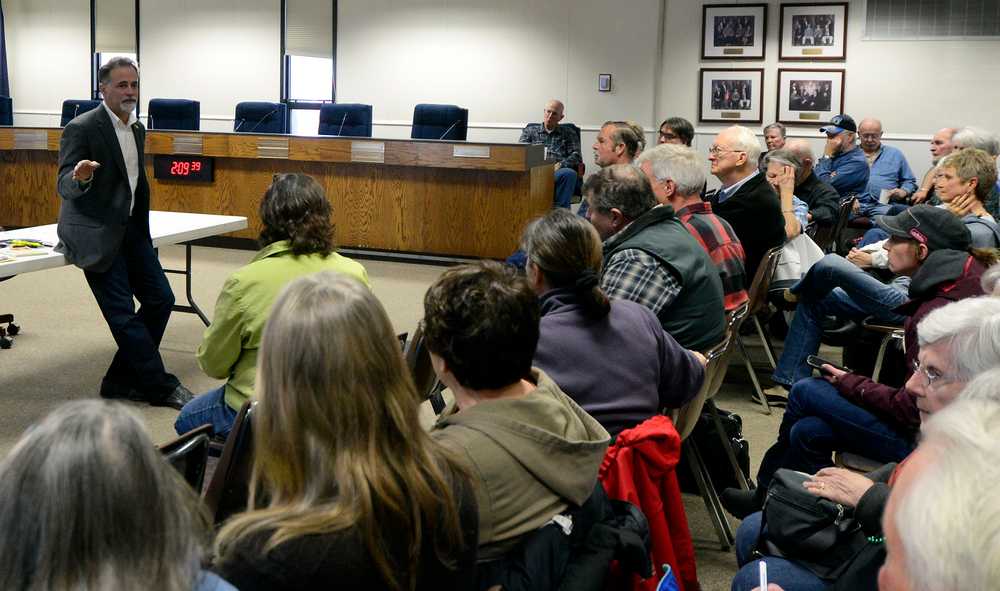
State Sen. Peter Micciche, R-Soldotna, returned from Juneau to answer questions at a wide-ranging town hall meeting in Soldotna Saturday afternoon.
After meeting in Homer Friday, the former Soldotna mayor was greeted by a capacity crowd at the Kenai Peninsula Borough Assembly Chambers. He gave an overview of his work at the mid-point in the legislative session and fielded questions on a number of issues, with the most popular topic referring to House Bill 77.
The bill, from Gov. Sean Parnell, is expansive, hitting on issues of land exchange, water use and permitting procedures. As it is currently written, it would remove the ability of groups to apply for water reservations to protect fish habitat and water quality while allowing the Natural Resources commissioner more authority to issue permits if the commissioner finds activity to unlikely cause “significant or irreparable harm” to state land or resources.
The measure, which passed the House last spring, is currently in the Senate Resources Committee, of which Micciche is a member. The committee will discuss the bill Monday. Several people in the audience Saturday were concerned about having enough time to read changes to the bill before being able to give public testimony.
The public has expressed displeasure for two portions of HB77: the restriction of public input on permits and the loss of personal access to water reservation.
Micciche said when he first read HB77, he did not support it and asked members of the Kenai Watershed Forum to review it and see how it would impact the Kenai Peninsula. During December meetings held in Homer and Soldotna about HB77, hundreds of people showed up and voiced their displeasure, which caught the state’s attention, he said.
Kasilof resident George Pierce said HB77 needed to be thrown away. Micciche said it doesn’t work like that.
“Most of the bill is current code,” he said. “We may not get everything we want but if we can compromise for adequate protection in a robust public process, then I’m going to be inclined to support the bill.”
Soldotna resident Penny Vadla said she appreciated his efforts in spearheading changes to the bill, but she didn’t think it would be enough protection.
“We have a commodity here, something we appreciate on a local and personal level,” she said in reference to the Kenai River. “For many fishermen it will affect how they maintain their livelihood and enjoyment in life.”
Dave Atchenson, of Sterling, said people still have problems with some of the amendments made to the bill and Alaskans are disenfranchised with outside companies getting preferential treatment. Still, he thanked the senator for his work to amend the bill.
Micciche opened up the town hall meeting with a presentation of his legislative work this session. He highlighted SB 148, a bill he sponsored that removed the Homer Harbor from the critical habitat area and was the first bill to pass this session.
In addressing education, Micciche said he is in support of increasing the base student allocation. He also said he did not expect Senate Joint Resolution 9 to receive the two-thirds votes needed to pass. SJR 9 and the companion bill HJR 1 proposing a constitutional amendment to allow public money to be used for private schools, is scheduled for a House vote Monday. He said while he supports choice with the great programs in the area, his concern is the cost.
A couple of people in the audience thanked Micciche for sponsoring SB 209 for smoke-free workplaces. SB 77, an act related to big game hunting with children, was also well received by the public.
When asked about for his opinion on the Board of Fisheries proceedings, Micciche said the process is flawed and that their should be more scientific reasoning in the process and less political influence.
Micciche, who is a drift commercial fisherman in the summer, said commercial fishing is the number one employer in the state and politicians are not showing them the support.
“It’s a numbers game. We are going to lose that game until we get everyone pulling together and understanding the value of all fisheries,” he said. “We are the farmers of Alaska. You would never see a Republican in Iowa go against an Iowan farmer. We need to turn that around.”
Micciche took a moment to clarify any confusion people may have had with his other jobs and his annual income.
He asked the audience if anyone was unaware of his employment with ConocoPhillips when he ran for senator to raise their hand. Nobody did, affirming everyone knew of his position as superintendent to the LNG plant in Kenai.
He said when he first came to Juneau he went to the ethics committee to check which measures he would have to watch to avoid a conflict of interest.
In a recent article in the Alaska Dispatch, from Feb. 11, it was reported his salary is listed as $200,000 to $500,000 a year.
He said last year he crossed over from $199,000 to more than $200,000 and salary earnings have not been released since he became a senator last year. He said the reporter confused readers into thinking the passage of SB 21 doubled his income, which is not accurate.
“I work very hard and am proud of the things I do,” he said. “If you don’t want me to go back next time get someone to run and make sure they win. If you send me back, I’m going to do the best to represent you the very best I can every day. I’m not embarrassed about where I work and the fact I make a decent living.”
The audience applauded his sincerity.
One woman in the audience asked Micciche to clarify the intention SB 21, a tax reform for oil and gas companies signed into law last June.
He said the intention is to spur economic growth by encouraging gas and oil production. Alaska still has the highest tax rate in North America, but by adjusting the tax rate, it makes the state more competitive, he said.
“Decline in revenues is because of a decline in oil production,” he said. “(SB 21) gives us a chance for positive results producing here again. Since we have seen new projects that have pulled the trigger and hundreds of jobs are filled that were not before.”
He said production declined under Alaska’s Clear and Equitable Share, known as ACES, and if there were a sustained decline in production, he would be the first to challenge the bill.
“I would not have pushed the green button if I did not believe in my heart this is the best thing for Alaska,” he said.
Micciche said he is proud to represent District O, but lamented the district change next year. He will go from representing Homer and Kenai to representing the Nikiski, Soldotna and Seward area.
When asked why government bodies like the fish board are selected from nominees by the governor rather than from biologists who understand fishery issues, Micciche’s response had everyone laughing.
“When I’m governor by golly I will take care of it,” he said. “Keep pushing and let your voice be heard. I am proud to represent this district and share your concerns at the state level.”
Reach Dan Balmer at daniel.balmer@peninsulaclarion.com.
