
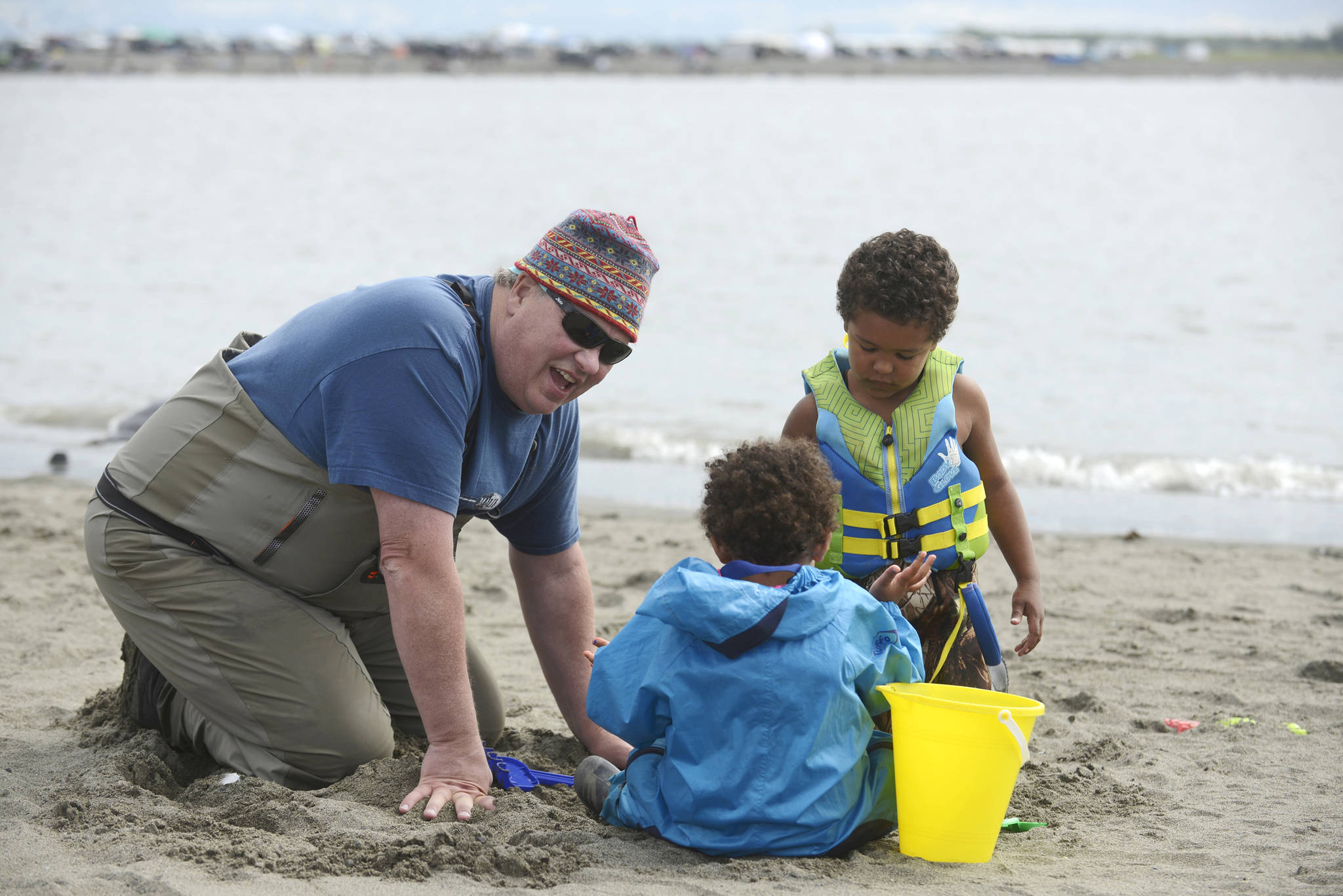
Dipnetter Brad Gamblin (left) digs in the sand of Kenai’s north beach with his grandchildren Stella (in blue) and Marly Wilson, on Thursday in Kenai. The three, plus grandmother Cher Gamblin, brought the grandchildren on their first dipnetting trip this year. The morning, Brad Gamblin said, “was very productive.” Getting up early, he said the family had caught a dozen salmon by 9 a.m. (Ben Boettger/Peninsula Clarion)

Dipnetter Brad Gamblin (left) digs in the sand of Kenai’s north beach with his grandchildren Stella (in blue) and Marly Wilson, on Thursday in Kenai. The three, plus grandmother Cher Gamblin, brought the grandchildren on their first dipnetting trip this year. The morning, Brad Gamblin said, “was very productive.” Getting up early, he said the family had caught a dozen salmon by 9 a.m. (Ben Boettger/Peninsula Clarion)

Kenai’s exclusivity offering fails to bring vendors to the dipnet

This year’s personal-use dipnet fishery hasn’t draw many vendors to the north and south beaches along the mouth of the Kenai River. Nor did the Kenai city government’s new strategy of offering exclusive permits for selling coffee and ice.

Past dipnet fisheries have usually brought around 20,000–25,000 people to Kenai’s beaches between July 10 and July 31. Food trucks, ice vendors and snack stands have often followed to capitalize on the concentration of people. Traditionally, vendors have accessed the beaches just like the general public — paying the normal daily dipnet parking fee of $20 to bring their trucks or trailers to the beach or parking lot, plus obtaining the city’s mobile food vendors permits ($120 for a year, according to Kenai’s fee schedule) or transient merchant permits ($25 for a year). If a vendor goes to the dipnet every day of the season, that’s $420 to park.

At its Dec. 6, 2017 meeting, the Kenai city council began discussing other possibilities: issuing vendors exclusive permits to sell certain goods, limiting or restricting non-local vendors from the beaches, and installing utilities for the use of vendors.

The council returned to the subject at its May 16 meeting, when Kenai Clerk Jamie Heinz presented the results of a survey of dipnet vendors which had shown “that most vendors felt the venue could be better, wanted to see some sort of exclusivity, easier access, a specific vendor area, and suggested on-site electric and potable/grey water dumping and refill site nearby,” according to a memo from Heinz to the council. While the additional utilities “will need to be accomplished in future years,” Heinz wrote, the city did carry out plans to offer exclusive spots in the beach parking lot at the end of South Spruce Street to two — a coffee and an ice vendor — chosen from applicants that would be ranked by their experience, facilities, bid amount (the minimum bid was $950) and the time they planned to operate, with extra points given to vendors within the city of Kenai.

“By also selecting vendors that will commit to operating for the most amount of time, we hope that over time, the fishery users see this consistency and will utilize these vendors instead of bringing loaded coolers from their hometowns,” Heinz wrote.

Kenai mailed application packets to vendors that had previously operated during the dipnet fishery.

“Nobody applied for it,” Heinz told council members at their July 5 meeting. “We heard two comments that the price was too high. We put it back out.”

Heinz said Kenai administrators believed vendors were comparing the minimum bid for exclusive space with the lower cost of using the parking lot under the old process, and were counting on the latter. The second solicitation on June 8 kept the $950 minimum bid, but if “not enough applications are received” would raise the daily parking fee for vendors to $100, “to encourage them to use this new process,” Heinz told council members.

Again, there were no responses by the July 3 deadline.

“Because there were no applicants under the new process, it is clear the venue has not developed into something lucrative enough for the bidding process,” the clerk’s office wrote in a letter to vendors.

Heinz summarized the comments of vendors for the council members.

“They all mention how they could go to other places and make more money, so it seems like it’s obvious that they go to other events where people are there to eat,” Heinz said. “But here in this venue people are here to fish, and eating is a secondary thought.”

With no exclusive permits given this year, beach vendors have been following the usual procedure of bringing in their vehicles under normal parking fees. Not many have done so, however. On Thursday afternoon, there were no food trucks or trailers parked in north beach parking lot. North beach fee shack attendants recalled letting vendors down to the beach only on one or two days during the fishery this year.

Reach Ben Boettger at bboettger@peninsulaclarion.com
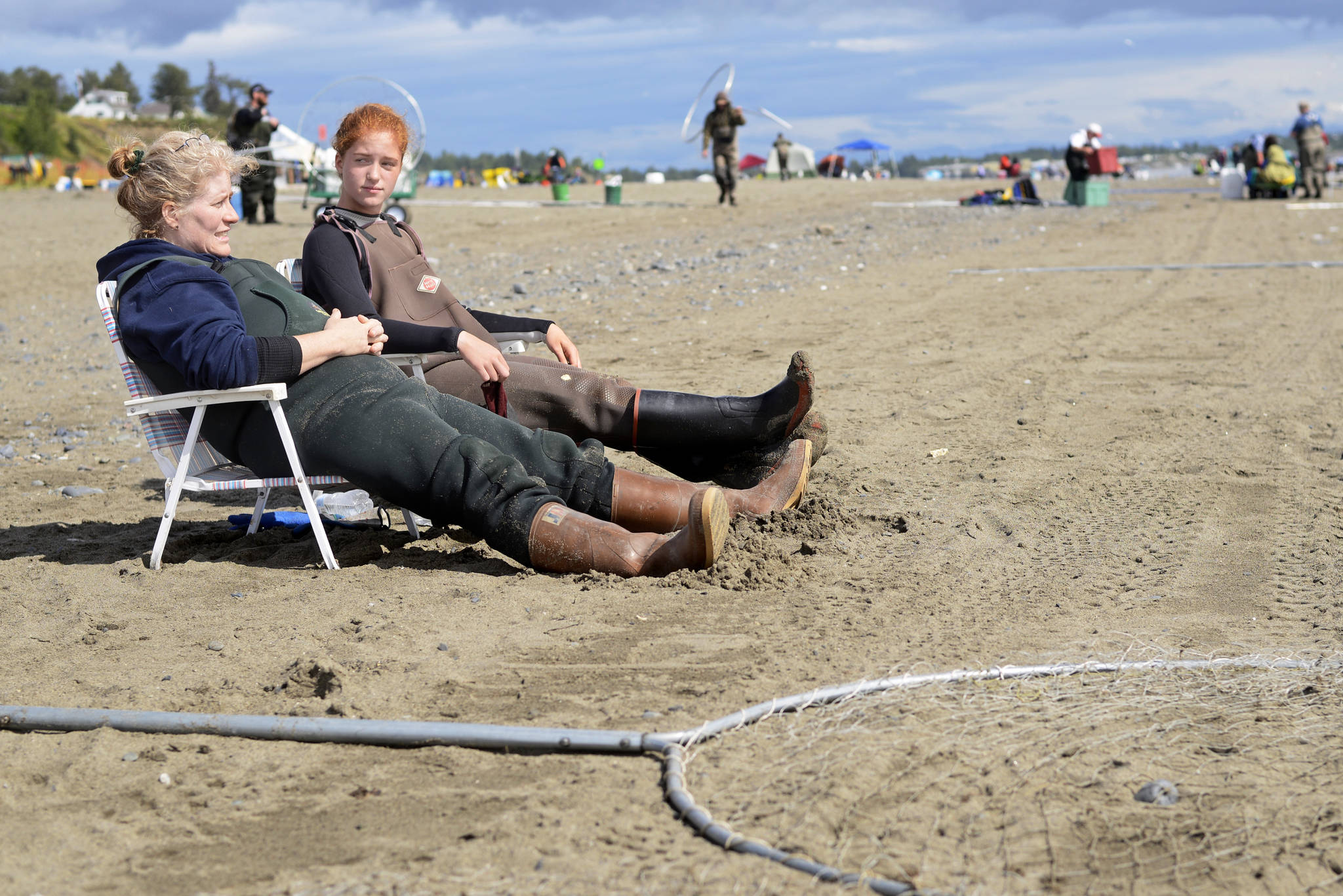
Tiffany Musgrave (left) and daughter McCady Musgrave take a break from dipnetting on Kenai’s north beach on Thursday, July 26, 2018 in Kenai, Alaska. Tiffany Musgrave said the family had caught two salmon that day and four the previous day, making this year’s dipnet one of the worst she remembered — one year, she recalled, she and her husband had caught 64 fish in four hours on Kenai’s south beach. (Ben Boettger/Peninsula Clarion)
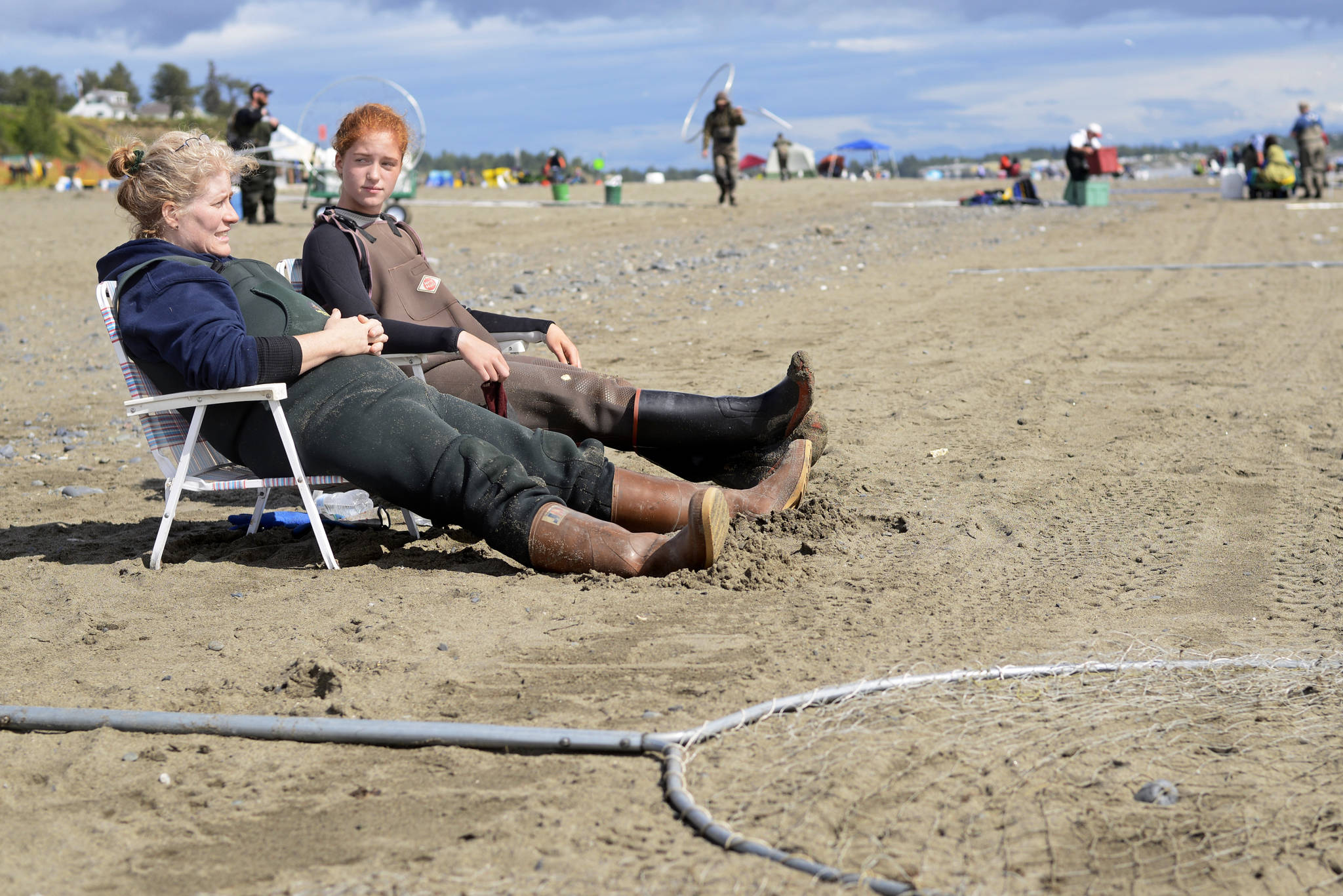
Tiffany Musgrave (left) and daughter McCady Musgrave take a break from dipnetting on Kenai’s north beach on Thursday, July 26, 2018 in Kenai, Alaska. Tiffany Musgrave said the family had caught two salmon that day and four the previous day, making this year’s dipnet one of the worst she remembered — one year, she recalled, she and her husband had caught 64 fish in four hours on Kenai’s south beach. (Ben Boettger/Peninsula Clarion)

Tiffany Musgrave (left) and daughter McCady Musgrave take a break from dipnetting on Kenai’s north beach on Thursday in Kenai. Tiffany Musgrave said the family had caught two salmon that day and four the previous day, making this year’s dipnet one of the worst she remembered — one year, she recalled, she and her husband had caught 64 fish in four hours on Kenai’s south beach. (Ben Boettger/Peninsula Clarion)

Tiffany Musgrave (left) and daughter McCady Musgrave take a break from dipnetting on Kenai’s north beach on Thursday in Kenai. Tiffany Musgrave said the family had caught two salmon that day and four the previous day, making this year’s dipnet one of the worst she remembered — one year, she recalled, she and her husband had caught 64 fish in four hours on Kenai’s south beach. (Ben Boettger/Peninsula Clarion)

More in News

David Ross is sworn in as Kenai Police Chief on Tuesday, May 31, 2016 at Kenai City Hall. The Alaska Association of Chiefs of Police named Ross the 2025 Police Chief of the Year, recognizing over two decades of service. Photo by Megan Pacer/Peninsula Clarion
Kenai police chief named 2025 Police Chief of the Year

The Alaska Association of Chiefs of Police recognized David Ross for his more than two decades of leadership.

The cast of Nikiski Middle School’s upcoming performance of “Alice in Wonderland” is pictured on Dec. 2, 2025. The upperclassmen-directed play opens on Friday, with additional showtimes Saturday and next weekend. Photo courtesy of Carla Jenness
Nikiski Middle School debuts student-led “Alice in Wonderland”

The show opens on Friday, with additional showtimes this weekend and next.

On Tuesday, the Kenaitze Indian Tribe unveiled Kahtnu Area Transit, a public transportation service open to the entire Peninsula Borough community. Photo courtesy of Kahtnu Area Transit
Kenaitze Indian Tribe unveils Kahtnu Area Transit

The fixed bus route offers 13 stops between Nikiski and Sterling.

The Kenai Chamber of Commerce and Visitor Center hosts the annual Christmas Comes to Kenai on Nov. 28<ins>, 2025</ins>. The beloved event began over 40 years ago, and this year over 1,000 attendees enjoyed hot chocolate, fireworks, pictures with Santa and shopping. Photo courtesy of the Kenai Chamber of Commerce
 Photo courtesy of the Kenai Chamber of Commerce
The Kenai Chamber of Commerce and Visitor Center hosted the annual Christmas Comes to Kenai on Nov. 28. The beloved event began over 40 years ago, and this year over 1,000 attendees enjoyed hot chocolate, fireworks, pictures with Santa and shopping.
Kicking off a month of holiday festivities

Last weekend’s holiday events, including the annual Christmas Comes to Kenai and the Soldotna Turkey Trot, drew folks from all over the Kenai Peninsula.

Starting Dec. 2, Aleutian Airways will offer roundtrip flights between Anchorage and Unalakleet every Tuesday, Friday and Sunday.
Aleutian Airways to offer roundtrip flights between Anchorage and Unalakleet

Starting Dec. 2, Aleutian Airways will offer three roundtrip flights per week.

The Trump administration’s “Big Beautiful Bill” act requires the Bureau of Ocean Energy management to hold at least six offshore oil and gas lease sales in Alaska between 2026-2028 and 2030-2032. The first of these sales — known as “Big Beautiful Cook Inlet 1,” or BBC1— is scheduled for March 2026. Photo courtesy of the Bureau of Ocean Energy Management
Cook Inletkeeper launches petition against federal government

The organization is calling for transparency in Cook Inlet offshore oil and gas sales.

Winter dining has always carried more weight than the menu might suggest. In the off-season, eating out isn’t just about comfort food or convenience; it’s a way of supporting local businesses as they hold steady through the slower months. Photo credit: Canva.
The ripple effect: How local spending builds stronger communities on the Kenai Peninsula

From cozy cafés to fine-dining bistros, purchases made close to home sustain local jobs and services

Courtesy Harvest
On the Kenai Peninsula, a dormant liquefied natural gas export plant could be repurposed to receive cargoes of imported LNG under a plan being studied by Harvest, an affiliate of oil and gas company Hilcorp. The fuel would be transferred from ships to the tanks on the left, still in liquid form, before being converted back into gas and sent into a pipeline.
Utilities say Alaska needs an LNG import terminal. Consumers could end up paying for two.

Planning for two separate projects is currently moving ahead.

A map shows the locations of the 21 Alaska federal offshore oil and gas lease sales proposed by the Trump administration. (Map provided by the U.S. Bureau of Ocean Energy Management)
Trump administration proposes offshore leasing in almost all Alaska waters

A new five-year offshore oil and gas leasing plan proposes 21 sales in Alaska, from the Gulf of Alaska to the High Arctic, and 13 more off the U.S. West Coast and in the Gulf of Mexico.

Most Read