
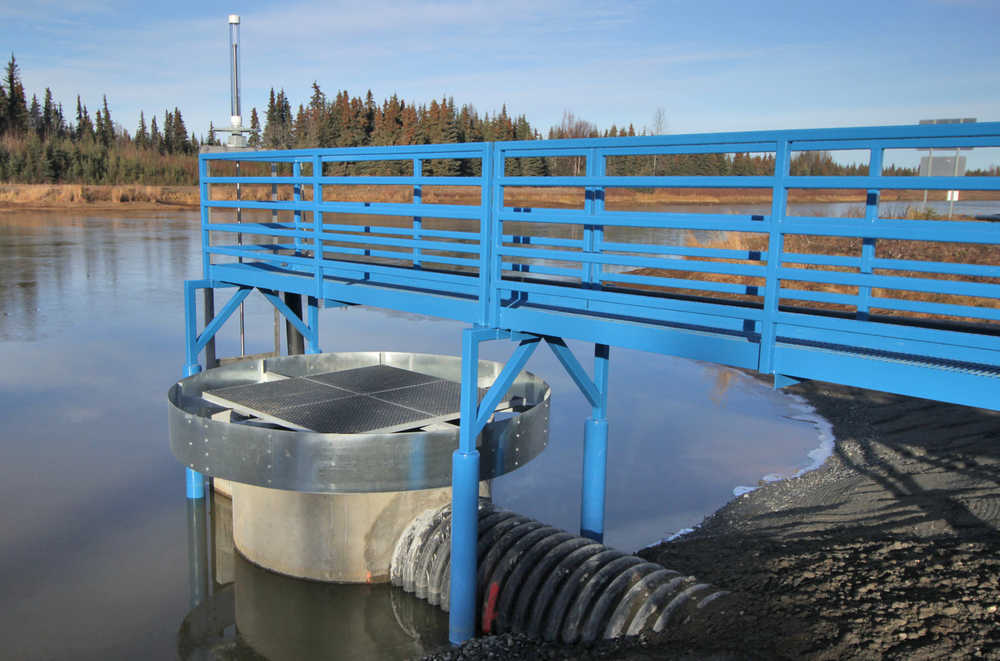
After a summer spent holding visiting floatplanes from around the state, the Kenai Municipal Airport’s floatplane pond is now a landing site for small groups of ducks who paddle around ice plates in the semi-frozen water.
With the floatplanes stored away or converted to wheels, the pond was drained to its winter depth in late September, and will remain so until the drainage gate is shut, allowing the pond to refill with natural groundwater to its summer depth of about 6 feet by the time the pond opens in May. The structure controlling both these processes is a newly installed concrete and steel drain, which recently replaced the pond’s aging gated culvert.
“(The old culvert) was installed in 1986, and it was corroded and failing,” said Kenai Airport Manager Manager Bondurant.
Engineer Kirk Hollinger of the Kenai-based engineering firm Wince-Corthell-Bryson inspected the project. He described the old drainage structure as “just a culvert sticking in the ground, with stuff welded to it, like the gate.”
“It just started to rust apart,” he said.
The new drainage has a concrete foundation and a stainless steel ring to prevent debris from settling in the grate. It incorporates both the drainage gate that takes the pond to its winter level and a taller drain that prevents the pond from flooding when at its summer level. The water it takes in flows to a culvert under the Kenai Spur Highway, then into Cook Inlet.
The new drainage structure’s main advantage will be greater durability, Hollinger said.
“I don’t see this thing falling apart in any of our lifetimes,” he said.
The floatplane pond, which Bondurant said has 32 spaces pilots can rent from May to October, was expanded to its present size in 2008. The airport still uses the piles of material dug out during its construction to sand-coat its icy runways, saving the expanse of procuring sand that Bondurant estimated could cost up to $30,000 per winter.
Replacing the drain cost $379,643. Approximately 93 percent of the project was paid for by the Federal Aviation Administration, and the Kenai City Council voted to appropriate the remaining $23,728 on Sept. 7.
The floatplane pond is usually allowed to refill with natural rain and groundwater starting in mid-winter, but Bondurant said this year the drain will be kept open longer, keeping the pond lower and more likely to freeze to its bottom. The hope is that that a deep, solid freeze will solve the problem of the thick weeds that have infested the pond. If the pond fails to freeze through this winter and kill the weeds, Bondurant said machines will begin scooping them out next year.
“We’ve kept it drained the past couple winters, but we’ve had such mild winters it hasn’t done much good,” she said.
In addition to the floatplane pond drainage, Wince-Corthell-Bryson also did some unplanned engineering work at the airport this fall: filling two sinkholes, between four and five feet deep, that appeared off the end of the runway. The FAA requires the airport maintain a safety zone extending 1,000 feet from the end the runway, which according to FAA rules must be free of “potentially hazardous ruts, humps, depressions or other surface variations” in case a plane enters it during take off or landing.
In late October the airport shut down the runway between 11 p.m. and 5 a.m so a work crew could dig to the bottom of the sinkholes, uncovering the corroded drainage metal pipe (unrelated to the floatplane pond drainage system) that had collapsed, causing the sinkhole.
“It could have been a result of the earthquake in January that they pulled apart,” Bondurant said of the pipes, referring to the Jan. 24, 2016 Iniskin earthquake that shook the Cook Inlet region. “We don’t know. We haven’t come across this problem before.”
Hollingsworth said the pipe under the sinkhole was newer than the floatplane drainage and speculated on other reasons it could have failed. The airfield drainage pipe was installed in 1992.
“That’s now rotting away,” he said. “Which shows to me that soils around here are little more acidic than we realized… Over in Soldotna, there’s older pipe that looks a lot better. Soldotna doesn’t have as much acidity to in the soil and the groundwater.”
After patching the pipes with new sections of metal, Hollingsworth’s crew filled the sinkholes in. Bondurant said the FAA allowed Kenai to use the floatplane pond drainage grant to fill the sinkholes because both involved the drainage system.
Hollinger estimated there are about 2200 feet of drainage pipe under the Kenai airfield. If any inspection or repair is done to these pipes, it will take place in the spring. Bondurant said that after having replaced the floatplane pond drain, filled the sinkholes, and paved a tie-down lot and taxiway in early October, the Kenai airport is now finished for the year with its construction projects.
Reach Ben Boettger at ben.boettger@peninsulaclarion.com.
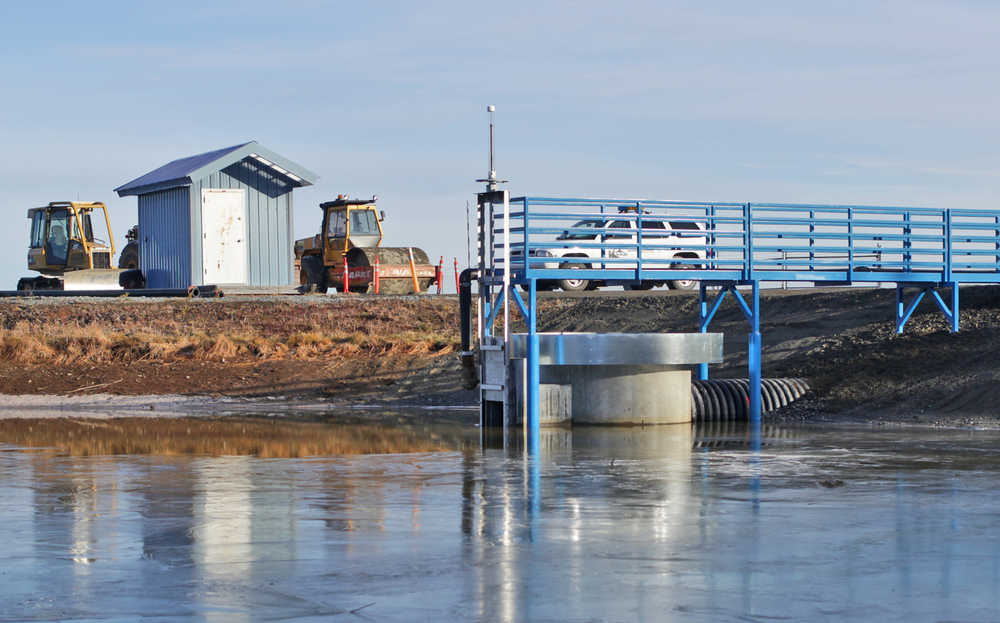
Photo by Ben Boettger/Peninsula Clarion The new outflow structure in the Kenai Municipal Airport’s floatplane pond sits with its lower intake open, allowing the pond to drain for the winter to an approximate 4 depth on Thursday, Nov. 3, 2016 in Kenai, Alaska.
