
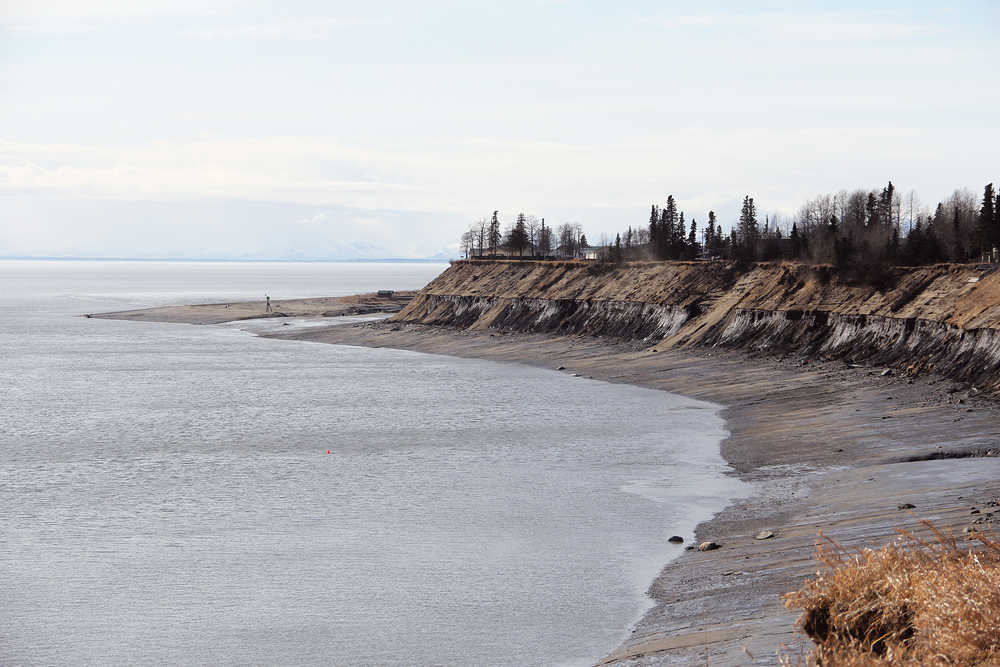
Photo by Dan Balmer/Peninsula Clarion The view of north beach from Eric Hansen Scout Park in Kenai Sunday. The city council amended and passed a resolution for fee charges to the dipnet fishery.

Photo by Dan Balmer/Peninsula Clarion The view of north beach from Eric Hansen Scout Park in Kenai Sunday. The city council amended and passed a resolution for fee charges to the dipnet fishery.

Kenai adjusts dipnet fees

  • By DAN BALMER
  • Sunday, April 6, 2014 10:05pm
  • News

As the Kenai River personal use fishery has grown over the years, the City of Kenai has had to adapt with it.

In an effort to clarify confusion on the fishery use fee structure, the Kenai City Council amended and approved a resolution to enact fee changes for the 2014 personal use fishery at the April 2 meeting.

Finance director Terry Eubank said one of the biggest misunderstandings people had last year was how a vehicle parking fee was not included in the camping fee.

For parking at both the north and south beaches users paid $20 from midnight to midnight. For participants with a vehicle or two all-terrain vehicles, camping is now defined as overnight parking with a cost of $55. Combining vehicle parking and camping fees into one fee is expected to eliminate the confusion, he said.

Eubank said he saw the young adults who operated the fee shacks bullied by fishery users over because of the confusion with fees.

One of the proposals the council were at odds with was the addition of a $10 vehicle or all-terrain vehicle drop-off or pick-up fee.

City Manager Rick Koch said over the last few years the city has became aware of users being dropped off and avoiding paying fees for use of city services. The intention of having a drop-off fee is to make sure everybody who uses the dipnet services are charged accordingly, he said.

With more users being dropped off, another benefit would be a reduction of congestion on city streets caused by vehicles parking, he said.

Council member Ryan Marquis said he would have a hard time supporting a drop-off fee because it could be charging the wrong people. He asked why charge drivers dropping off dipnet users for using city services, if the drivers may not be using the services themselves. He said it is easy to lose sight of all the benefits in sales tax the city receives from the influx of fishery users.

“We need to try to figure out ways to take advantage, not take it for granted,” he said. “We want people to spend money while they’re here and share with the private sector, not all with the government.”

The council amended and approved fees, rates and charges for the 2014 personal use fishery by a 7-1 vote. Marquis cast the lone no vote.

Boyle motioned to delete the $10 drop-off fee. The council voted 6-2 to remove the $10 fee. Mayor Pat Porter and council member Brian Gabriel voted against the amendment to remove the drop-off fee.

Gabriel said the city is close to a break-even point in running the fishery. The city expends money before the fishery even starts without knowing how the season will pan out, he said. If the city doesn’t cover the expenses, the residents could be stuck to cover the costs.

Gabriel said over the years dipnet users have found creative ways to avoid fee stations. With Kenai residents making up only 5 percent of all dipnet users, he said he didn’t think it is fair for them to subsidize the cost.

“We have higher participation rates but are generating less revenue,” he said. “If we don’t cover our expenses, City of Kenai residents foot the bill and I don’t think they should have to do that.”

Koch said it is the city’s intention to collect more fees from all participants, not to increase the price of fees.

Council member Terry Bookey said more fees could cause other problems with people finding other ways to get to the beach as cheaply as possible.

Porter said it is important to her that Kenai residents not have to pay for the fishery while the people who try to avoid fees get charged for the services they use.

“Its like getting into the movie theater and not paying for it,” she said. “We don’t ask for the fee because we want to. If we didn’t charge, our beaches would be a mess.”

Porter recommended city attorney Scott Bloom look at what the city can offer residents to access the fishery for free.

The council also unanimously passed an ordinance that prohibited camping, fires and parking on a section of south beach during dipnet season, in response to the complaints of private property owners. The prohibited area goes from the city boundary line at Old Cannery Road and extends north to the most northerly residence, an area of 2,200 lineal feet.

The ordinance suggested by Porter and Navarre is intended to decrease conflicts between private property owners and the public, decrease risks to environmentally sensitive areas and increase the city’s efficiency in cleanup.

The next council meeting is at 7 p.m. April 16 at Kenai City Hall.

Reach Dan Balmer at daniel.balmer@peninsulaclarion.com

More in News

David Ross is sworn in as Kenai Police Chief on Tuesday, May 31, 2016 at Kenai City Hall. The Alaska Association of Chiefs of Police named Ross the 2025 Police Chief of the Year, recognizing over two decades of service. Photo by Megan Pacer/Peninsula Clarion
Kenai police chief named 2025 Police Chief of the Year

The Alaska Association of Chiefs of Police recognized David Ross for his more than two decades of leadership.

The cast of Nikiski Middle School’s upcoming performance of “Alice in Wonderland” is pictured on Dec. 2, 2025. The upperclassmen-directed play opens on Friday, with additional showtimes Saturday and next weekend. Photo courtesy of Carla Jenness
Nikiski Middle School debuts student-led “Alice in Wonderland”

The show opens on Friday, with additional showtimes this weekend and next.

On Tuesday, the Kenaitze Indian Tribe unveiled Kahtnu Area Transit, a public transportation service open to the entire Peninsula Borough community. Photo courtesy of Kahtnu Area Transit
Kenaitze Indian Tribe unveils Kahtnu Area Transit

The fixed bus route offers 13 stops between Nikiski and Sterling.

The Kenai Chamber of Commerce and Visitor Center hosts the annual Christmas Comes to Kenai on Nov. 28<ins>, 2025</ins>. The beloved event began over 40 years ago, and this year over 1,000 attendees enjoyed hot chocolate, fireworks, pictures with Santa and shopping. Photo courtesy of the Kenai Chamber of Commerce
 Photo courtesy of the Kenai Chamber of Commerce
The Kenai Chamber of Commerce and Visitor Center hosted the annual Christmas Comes to Kenai on Nov. 28. The beloved event began over 40 years ago, and this year over 1,000 attendees enjoyed hot chocolate, fireworks, pictures with Santa and shopping.
Kicking off a month of holiday festivities

Last weekend’s holiday events, including the annual Christmas Comes to Kenai and the Soldotna Turkey Trot, drew folks from all over the Kenai Peninsula.

Starting Dec. 2, Aleutian Airways will offer roundtrip flights between Anchorage and Unalakleet every Tuesday, Friday and Sunday.
Aleutian Airways to offer roundtrip flights between Anchorage and Unalakleet

Starting Dec. 2, Aleutian Airways will offer three roundtrip flights per week.

The Trump administration’s “Big Beautiful Bill” act requires the Bureau of Ocean Energy management to hold at least six offshore oil and gas lease sales in Alaska between 2026-2028 and 2030-2032. The first of these sales — known as “Big Beautiful Cook Inlet 1,” or BBC1— is scheduled for March 2026. Photo courtesy of the Bureau of Ocean Energy Management
Cook Inletkeeper launches petition against federal government

The organization is calling for transparency in Cook Inlet offshore oil and gas sales.

Winter dining has always carried more weight than the menu might suggest. In the off-season, eating out isn’t just about comfort food or convenience; it’s a way of supporting local businesses as they hold steady through the slower months. Photo credit: Canva.
The ripple effect: How local spending builds stronger communities on the Kenai Peninsula

From cozy cafés to fine-dining bistros, purchases made close to home sustain local jobs and services

Courtesy Harvest
On the Kenai Peninsula, a dormant liquefied natural gas export plant could be repurposed to receive cargoes of imported LNG under a plan being studied by Harvest, an affiliate of oil and gas company Hilcorp. The fuel would be transferred from ships to the tanks on the left, still in liquid form, before being converted back into gas and sent into a pipeline.
Utilities say Alaska needs an LNG import terminal. Consumers could end up paying for two.

Planning for two separate projects is currently moving ahead.

A map shows the locations of the 21 Alaska federal offshore oil and gas lease sales proposed by the Trump administration. (Map provided by the U.S. Bureau of Ocean Energy Management)
Trump administration proposes offshore leasing in almost all Alaska waters

A new five-year offshore oil and gas leasing plan proposes 21 sales in Alaska, from the Gulf of Alaska to the High Arctic, and 13 more off the U.S. West Coast and in the Gulf of Mexico.

Most Read