
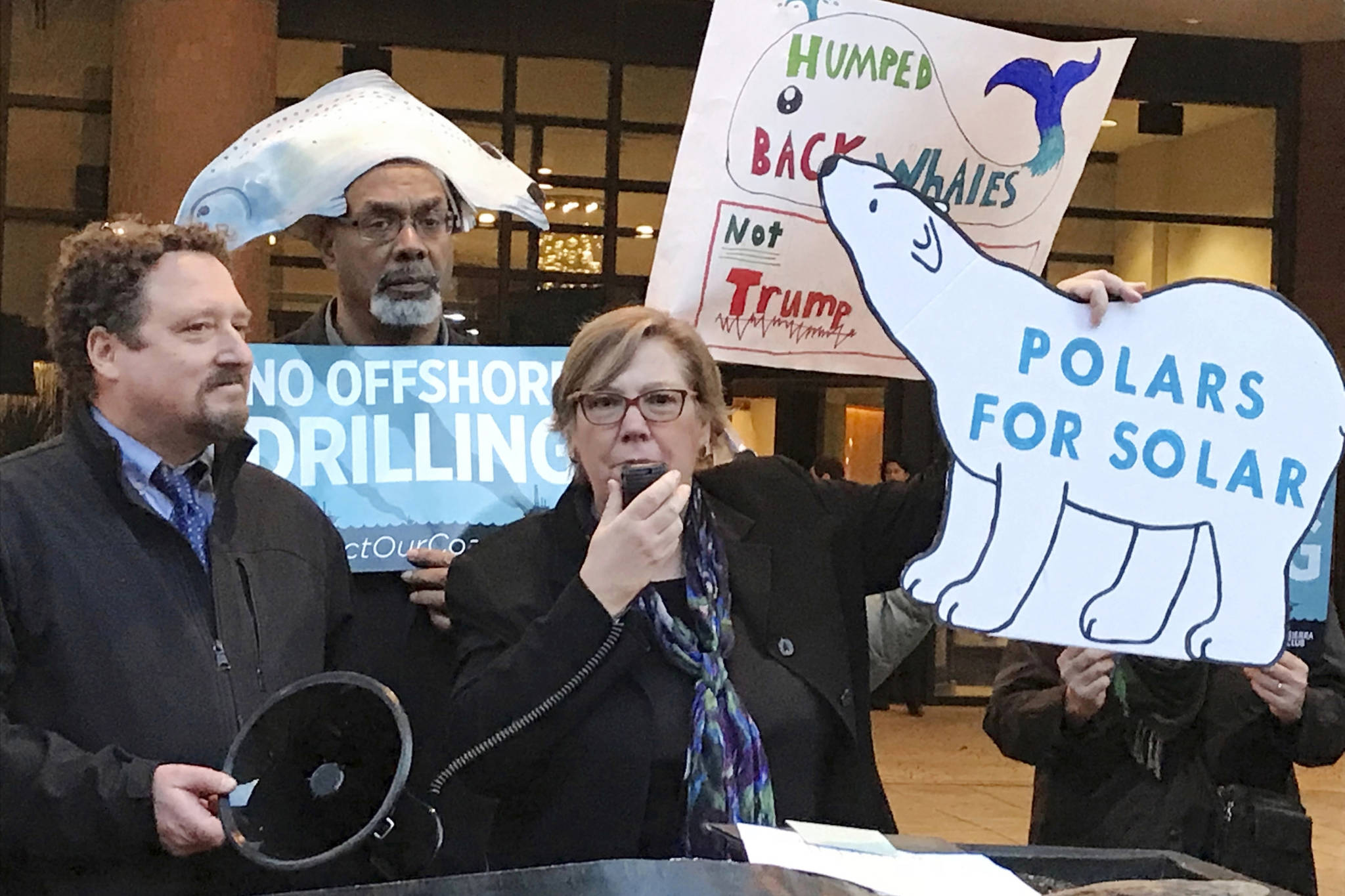
In this Feb. 15, 2018 file photo, Judith Enck, center, former regional administrator for the Environmental Protection Agency addresses those gathered at a protest against President Trump’s plan to expand offshore drilling for oil and gas in Albany, N.Y. A U.S. judge in Alaska says President Donald Trump exceeded his authority when he reversed a ban on offshore drilling in vast parts of the Arctic Ocean and dozens of canyons in the Atlantic Ocean. Judge Sharon Gleason in a ruling late Friday, March 29, 2019 threw out Trump‚Äôs executive order that overturned the ban implemented by President Barack Obama.(AP Photo/David Klepper, File)

In this Feb. 15, 2018 file photo, Judith Enck, center, former regional administrator for the Environmental Protection Agency addresses those gathered at a protest against President Trump’s plan to expand offshore drilling for oil and gas in Albany, N.Y. A U.S. judge in Alaska says President Donald Trump exceeded his authority when he reversed a ban on offshore drilling in vast parts of the Arctic Ocean and dozens of canyons in the Atlantic Ocean. Judge Sharon Gleason in a ruling late Friday, March 29, 2019 threw out Trump‚Äôs executive order that overturned the ban implemented by President Barack Obama.(AP Photo/David Klepper, File)

Judge restores Obama-era drilling ban in Arctic

The wording of President Obama’s withdrawals indicates that he intended them to extend indefinitely

  • By SUDHIN THANAWALA Associated Press
  • Saturday, March 30, 2019 10:31pm
  • News

President Donald Trump exceeded his authority when he reversed bans on offshore drilling in vast parts of the Arctic Ocean and dozens of canyons in the Atlantic Ocean, a U.S. judge said in a ruling that restored the Obama-era restrictions.

U.S. District Court Judge Sharon Gleason in a decision late Friday threw out Trump’s executive order that overturned the bans that comprised a key part of Obama’s environmental legacy.

Presidents have the power under a federal law to remove certain lands from development but cannot revoke those removals, Gleason said.

“The wording of President Obama’s 2015 and 2016 withdrawals indicates that he intended them to extend indefinitely, and therefore be revocable only by an act of Congress,” said Gleason, who was nominated to the bench by Obama.

A Department of Justice spokesman, Jeremy Edwards, declined comment Saturday.

The American Petroleum Institute, a defendant in the case, disagreed with the ruling.

“In addition to bringing supplies of affordable energy to consumers for decades to come, developing our abundant offshore resources can provide billions in government revenue, create thousands of jobs and will also strengthen our national security,” it said in a statement.

Erik Grafe, an attorney with Earthjustice, welcomed the ruling, saying it “shows that the president cannot just trample on the Constitution to do the bidding of his cronies in the fossil fuel industry at the expense of our oceans, wildlife and climate.”

Earthjustice represented numerous environmental groups that sued the Trump administration over the April 2017 executive order reversing the drilling bans. At issue in the case was the Outer Continental Shelf Lands Act.

Acting Assistant U.S. Attorney General Jeffrey Wood said during a hearing before Gleason in November that environmental groups were misinterpreting the intent of the law written in 1953. He said it is meant to be flexible and sensible and not intended to bind one president with decisions made by another when determining offshore stewardship as needs and realities change over time.

In 2015, Obama halted exploration in coastal areas of the Beaufort and Chukchi seas and the Hanna Shoal, an important area for walrus. In late 2016, he withdrew most other potential Arctic Ocean lease areas — about 98 percent of the Arctic outer continental shelf.

The bans were intended to protect polar bears, walruses, ice seals and Alaska Native villages that depend on the animals.

In the Atlantic, Obama banned exploration in 5,937 square miles of underwater canyon complexes, citing their importance for marine mammals, deep-water corals, valuable fish populations and migratory whales.


• By SUDHIN THANAWALA, Associated Press


More in News

A snowmachine rider takes advantage of 2 feet of fresh snow on a field down Murwood Avenue in Soldotna, Alaska, on Monday, Dec. 12, 2022. (Jake Dye/Peninsula Clarion)
Ice fishing opens on some Kenai National Wildlife Refuge lakes

Snowmachines are permitted for ice fishing access on Hidden, Kelly, Petersen, Engineer and Watson lakes.

The waters of Cook Inlet lap against Nikishka Beach in Nikiski, Alaska, where several local fish sites are located, on Friday, March 24, 2023. (Jake Dye/Peninsula Clarion)
Kenai asks for fishery economic disaster declaration

The Kenai City Council requested that Gov. Dunleavy declare a disaster and support a recovery plan for the Upper Cook Inlet East Side Set Net fishery.

The Kenai Peninsula Borough School District logo. (Photo courtesy of Kenai Peninsula Borough School District)
District superintendent dispels rumors about student construction

Superintendent Clayton Holland said student involvement in Seward High School construction is “based on rumor, not fact.”

Anchorage-based singer and songwriter Keeley Boyle is pictured in Anchorage<ins>, Alaska,</ins> on Sept. 26, 2023. Boyle, who was raised on the Kenai Peninsula, will use a $10,000 grant she received from the Rasmuson Foundation to create an album of songs about her grandparents’ home in Nikiski. Photo courtesy of Jovell Rennie
Musician hailing from Kenai receives Rasmuson grant

Keeley Boyle will record an album of songs about her grandparents’ Nikiski home.

Commercial fishing and recreational vessels are docked in the Homer harbor on Oct. 23, 2025. The commercial fishing industry endured a series of challenges over the year, some of them imposed by the new Trump administration. (Photo by Yereth Rosen/Alaska Beacon)
Alaska fisheries in 2025: turmoil, economic and environmental challenges and some bright spots

NOAA cuts, economic headwinds and invasive species pose problems, but there was some recovery in crab stocks and salmon harvests.

Cook Inlet near Clam Gulch is seen on Oct. 23, 2025. (Photo by Yereth Rosen/Alaska Beacon)
Disputed oil lease sale in Alaska’s Cook Inlet upheld in new Trump administration decision

After completing a court-ordered environmental study, the Bureau of Ocean Energy Management said no changes are needed for the 2022 sale that drew just one bid.

The Kenai Peninsula Borough School District logo.
School district projects $7.5 million budget deficit for fiscal year 2027

Decreased enrollment and increased property values mean less local and state funding.

The sign in front of the Homer Electric Association building in Kenai, Alaska as seen on April 1, 2020. (Photo by Brian Mazurek/Peninsula Clarion)
Homer Electric Association announces rate increase

The proposed increase, if approved by the Regulatory Commission of Alaska, will go into effect Jan. 1.

A photo of Anesha “Duffy” Murnane, missing since Oct. 17, 2019, in Homer, Alaska. (Photo provided, Homer Police Department)
Calderwood pretrial hearing rescheduled

The omnibus hearing for Kirby Calderwood was continued to Jan. 21. Trial week is currently scheduled for Feb. 17, barring finalization of a plea agreement.

Most Read