
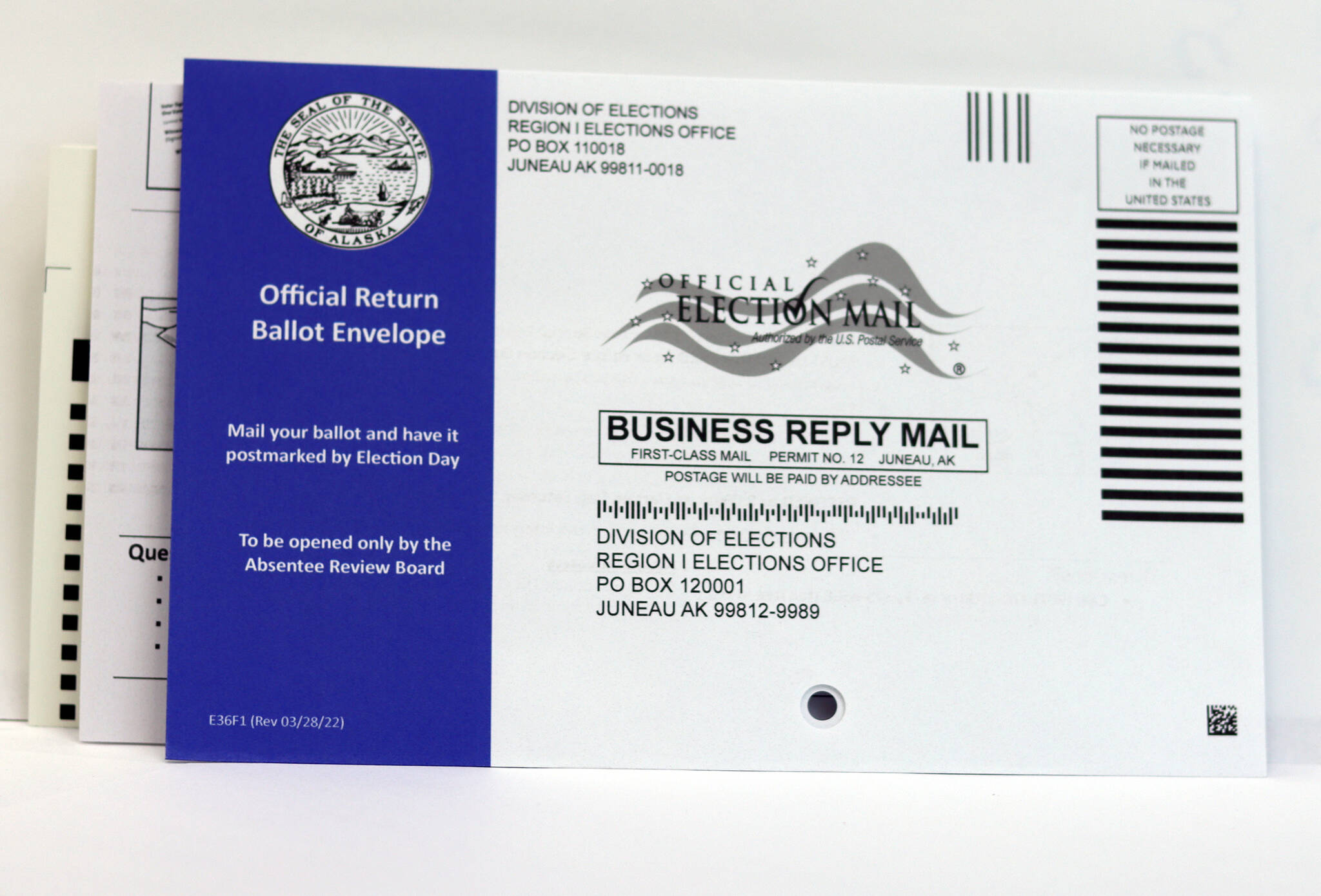
This photo shows elections materials for Alaska’s 2022 special primary election. (Ben Hohenstatt / Juneau Empire)

This photo shows elections materials for Alaska’s 2022 special primary election. (Ben Hohenstatt / Juneau Empire)

In-person voting begins for Alaska’s special primary election for US House

Forty-eight candidates are on the ballot for the special primary

By James Brooks

Alaska Beacon

Voting opened Friday at almost 170 locations statewide for the special primary election to temporarily replace Congressman Don Young, who died in March after 49 years in office.

Forty-eight candidates are on the ballot for the special primary. The four who receive the most votes will advance to a special general election on Aug. 16. At that election, voters will be asked to rank their preferred choices from one through four.

The winner of the special election will serve from September through January, when the winner of the November general election will be seated.

Because the special election is being conducted on a short timeline, the state made it Alaska’s first-ever statewide election by mail. The Alaska Division of Elections sent more than 560,000 ballots to registered voters in late April, and many have been returned.

According to statistics published Friday by the division, more than 51,000 ballots have been flagged as undeliverable, possibly because the registered voter no longer lives at the address on file.

That figure is an estimate; division officials said they won’t have a precise figure until after the election.

As of Friday evening, 89,237 of the mailed-out ballots had been voted and returned, and the first day of in-person voting resulted in 258 ballots cast.

Election Day is two weeks away, but turnout is already above the number of ballots cast in the August 2016 statewide primary, which saw 88,817 votes. In the 2020 primary, more than 133,000 registered voters cast ballots, and in 2018, the most recent non-presidential primary year, voters cast 115,727 ballots.

In 2020, Democratic voters overwhelmingly preferred voting by mail. Republicans preferred voting on Election Day in person.

In the current election, turnout to date has been highest in Republican-leaning parts of the state.

Republican-leaning areas in Anchorage and the Kenai Peninsula have the highest ballot return rates, while traditionally Democratic locations in Southeast Alaska and Anchorage are average or slightly below.

The lowest return rates have been in rural Alaska, particularly in the Yukon-Kuskokwim Delta and on the North Slope.

Ballots must be cast by June 11 and must arrive at the Division of Elections no later than June 21 in order to be counted.

A preliminary result will be announced on the evening of June 11, and updated periodically until June 21, when a final tally will be provided.

That figure will be checked and certified, opening the race to the special general election on Aug. 16. That election will be Alaska’s first ranked-choice vote.

James Brooks is a longtime Alaska reporter, having previously worked at the Anchorage Daily News, Juneau Empire, Kodiak Mirror and Fairbanks Daily News-Miner. This article originally appeared online at alaskabeacon.com. Alaska Beacon, an affiliate of States Newsroom, is an independent, nonpartisan news organization focused on connecting Alaskans to their state government.

More in News

Low clouds hang over Cook Inlet north of Anchor Point on Oct. 23, 2025. (Photo by Yereth Rosen/Alaska Beacon)
Inletkeeper condemns federal management of Cook Inlet oil lease sale

The agency alleges an environmental study by the Bureau of Ocean Energy Management was conducted with a “serious” lack of transparency.

The Kenai Chamber of Commerce announced the winners of the 13th annual gingerbread house competition on Dec. 20, 2025. This creation by Sierra won the 2-5 year old age category. Photo courtesy of the Kenai Chamber of Commerce
Wrapping up the holiday season

The Kenai Chamber of Commerce’s Angel Tree program and gingerbread house competition spread Christmas cheer to hundreds locally.

The Challenger Learning Center is seen here in Kenai<ins>, Alaska,</ins> on Sept. 10, 2020. (Photo by Brian Mazurek/Peninsula Clarion)
Kenai City Council considers possible uses for Challenger Center

One option would assess the facility’s potential as the new public safety building.

A snowmachine rider takes advantage of 2 feet of fresh snow on a field down Murwood Avenue in Soldotna, Alaska, on Monday, Dec. 12, 2022. (Jake Dye/Peninsula Clarion)
Ice fishing opens on some Kenai National Wildlife Refuge lakes

Snowmachines are permitted for ice fishing access on Hidden, Kelly, Petersen, Engineer and Watson lakes.

The waters of Cook Inlet lap against Nikishka Beach in Nikiski, Alaska, where several local fish sites are located, on Friday, March 24, 2023. (Jake Dye/Peninsula Clarion)
Kenai asks for fishery economic disaster declaration

The Kenai City Council requested that Gov. Dunleavy declare a disaster and support a recovery plan for the Upper Cook Inlet East Side Set Net fishery.

The Kenai Peninsula Borough School District logo. (Photo courtesy of Kenai Peninsula Borough School District)
District superintendent dispels rumors about student construction

Superintendent Clayton Holland said student involvement in Seward High School construction is “based on rumor, not fact.”

Anchorage-based singer and songwriter Keeley Boyle is pictured in Anchorage<ins>, Alaska,</ins> on Sept. 26, 2023. Boyle, who was raised on the Kenai Peninsula, will use a $10,000 grant she received from the Rasmuson Foundation to create an album of songs about her grandparents’ home in Nikiski. Photo courtesy of Jovell Rennie
Musician hailing from Kenai receives Rasmuson grant

Keeley Boyle will record an album of songs about her grandparents’ Nikiski home.

Commercial fishing and recreational vessels are docked in the Homer harbor on Oct. 23, 2025. The commercial fishing industry endured a series of challenges over the year, some of them imposed by the new Trump administration. (Photo by Yereth Rosen/Alaska Beacon)
Alaska fisheries in 2025: turmoil, economic and environmental challenges and some bright spots

NOAA cuts, economic headwinds and invasive species pose problems, but there was some recovery in crab stocks and salmon harvests.

Cook Inlet near Clam Gulch is seen on Oct. 23, 2025. (Photo by Yereth Rosen/Alaska Beacon)
Disputed oil lease sale in Alaska’s Cook Inlet upheld in new Trump administration decision

After completing a court-ordered environmental study, the Bureau of Ocean Energy Management said no changes are needed for the 2022 sale that drew just one bid.

Most Read