
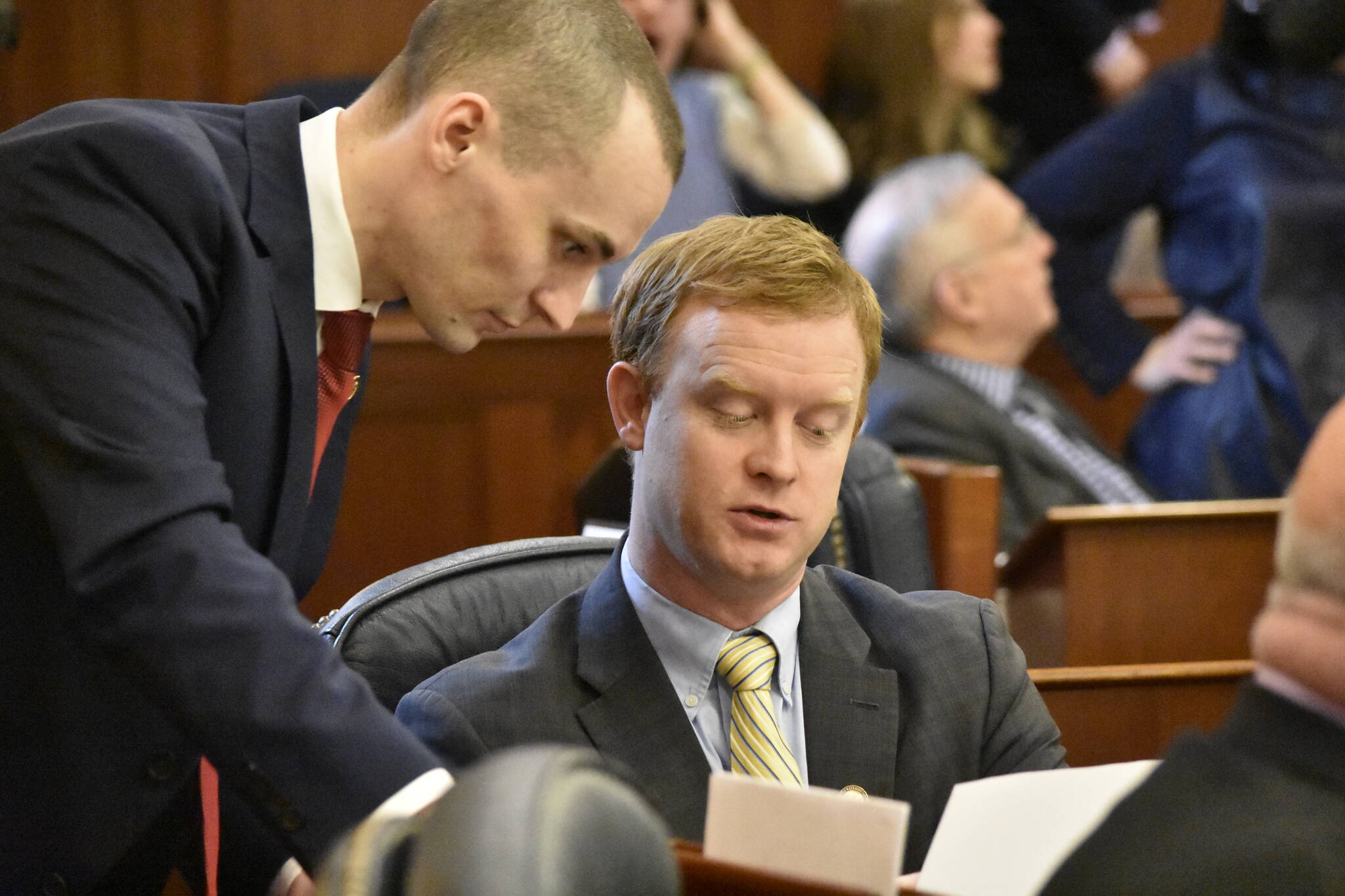
The Alaska House of Representatives spent several hours negotiating a bill that would enact campaign limits following a decision by the Alaska Public Offices Commission that allowed unlimited donations from people.
The House had to take a break in the middle of the debate Monday morning, as over a dozen amendments were submitted to the bill. Upon returning in the afternoon, House members were bogged down in debates about election security rather than campaign contributions, and continued working into the evening.
Lawmakers are moving to act following a March 3 announcement from APOC the state now had no contribution limits after the commission failed to achieve the votes necessary to set limits. APOC staff recommended setting the contribution limit at $1,500, up from the previous $500 limit a court previously found unconstitutional, but only three members of the commission voted for the advisory note, not enough for the measure to pass.
APOC’s advisory note asked the Legislature to provide guidance, but until lawmakers pass a limit there are no limits on donations individuals can make to candidates. Several bills seeking to change the campaign limit were already in the Legislature and House leadership coalesced around a bill from Rep. Calvin Schrage, I-Anchorage.
On Monday House members debated what the right limit — if any — would be.
Schrage’s bill would raise the limit to $2,000 per individual per candidate in a single election cycle, rather than the annual limits under the previous guidelines. The bill allows non-party political groups to donate up to $4,000 per campaign period to candidates and $5,000 a year to a political party. For governors’ races, the bill would cap individual donations at $4,000 and group donations at $8,000.
[Lawmakers move to pump the brakes on motor fuel tax]
Members supporting limits said doing so would help take money out of politics, something which they said Alaskans overwhelmingly approve. Rep. Andy Josephson, D-Anchorage, forwarded an amendment to lower individual contributions to $1,500 and said on the floor he’d like to see it even lower. Josephson cited the 2006 voter initiative that established the $500 limit, noting it had passed with 73% of the vote.
“How many things do Alaskans agree on by 73%?” Josephson asked.
But several members of the House Republican Minority argued against contribution limits of any kind, saying limiting donations limited an individual right to freedom of speech and expression.
Rep. David Eastman, R-Wasilla, cited the 2010 decision in Citizens United v. Federal Election Commission which allowed for unlimited corporate and union donations to campaigns.
“The (U.S.) Supreme Court has made it clear that any amount of money can be spent,” Eastman said. “That’s reflective of reality, the U.S. Supreme Court has said there is no limit.”
Rep. Sara Vance, R-Homer, said limiting the campaign contributions of individuals while large organizations are allowed unlimited donations violates the free speech rights of individuals.
But so many amendments were offered on the bill the House was forced to take a break to allow committee meetings to proceed. Before the break lawmakers did approve an amendment from Eastman repealing the requirement APOC have offices in each Senate district, something the commission has never had funding for.
But several amendments from Eastman and Rep. Chris Kurka, R-Wasilla, focused on changing the way elections are conducted in what those lawmakers said was an effort to strengthen election security.One amendment would have allowed voters to select a preference for a hand counting of their ballot and if more than 25% of voters in a precinct made that choice the entire precinct would be hand-counted.
Kurka —who’s running for governor — said several times the state needed to work to increase public confidence in the security of the state elections.
“It is a dangerous place when you have a massive (segment) of the populace that does not have confidence in the security or the integrity of an election,” Kurka said. “We have been blessed in this country with the peaceful transition of power since our foundation, and I think we all want that, one of the things that helps ensure that is confidence in the cleanliness, the security and the transparency and the integrity of an election.”
One of Kurka’s amendments would have allowed members of the public to request from the Division of Elections an “unencrypted electronic database containing the ballot tabulations and vote totals.”
House Majority Leader Chris Tuck, D-Anchorage, said at one point there were many bills in committees that dealt with the election process and suggested election security topics be taken up there. At one point Tuck raised a point of order to an amendment from Eastman to allow write-in candidates up to five days before an election in regional school board election, which Tuck said was not germane to a campaign contributions limit bill. House Speaker Louise Stutes, R-Kodiak, ruled the amendment out of order leading to objection from minority members who argued election security and spending were intertwined.
Late Monday the House recessed until 7 p.m. that evening.
• Contact reporter Peter Segall at psegall@juneauempire.com. Follow him on Twitter at @SegallJnuEmpire.
