
Community members were invited to a discussion on winter storm preparedness at the Anchor Point Senior Center last Thursday, Nov. 20.
Homer public health nurse Emily Sears covered a number of related topics, including why winter storms are considered dangerous; differences between various types of winter storms, winter weather terms and winter hazards; how to prepare your home and vehicle in case of a winter storm; what to do during winter storms if you’re caught outside or stuck at home; and what to do in the winter if your power or heat goes out.
When considering the dangers of winter storms, Sears said that most people think about the obvious things like car accidents, hypothermia and frostbite, but when winter storms occur, so do increases in carbon monoxide poisonings or heart attacks from overexertion while working or being active outside.
“Because you’re in your house, you’re wanting to keep things really warm (and) ventilation is not as good, and then sometimes people will bring in heating sources that put off carbon monoxide and can cause death from that,” she said.
Individuals at highest risk from winter storms include infants, older or elderly adults, unhoused individuals, and people with chronic illnesses.
“If you’ve got chronic illnesses, risk of cold can exacerbate things, especially if you have lung issues,” Sears said, adding that loss of power caused by storms can affect medical supplies or devices like oxygen, tube feeds or CPAP machines.
Sears also reviewed the differences between terms like “winter storm warning,” “winter storm watch” and “weather advisory.”
“The storm warning is that there’s going to be severe winter conditions within 24 hours, whereas the watch is in 36-48 hours,” she said. “Winter storm advisory, that one is not life threatening like the storm warning, but it is going to cause inconveniences, issues with travel, things like that. And then ‘storm outlook’ is that there’s a storm possible in the next two to five days.”
Sears explained that preparing for winter is a multi-step process.
“You want to prepare your home as well as your vehicle, so making sure you have a plan of where to go to stay warm and that you’re making sure that things are taken care of so your house is ready to go if there’s a storm coming,” she said. “Have an emergency kit for your vehicle, winterize your vehicle … and then know what to do if you’re stuck in a storm on the road.”
Some ways to prepare or winterize your home include cleaning out the gutters on your house to avoid pooling water in the event of snow melt or heavy rain; making sure your windows are well-sealed so that cold isn’t coming through; keeping an indoor thermometer to track the temperature inside your home; packing emergency supplies; and having a plan in the event of a storm and making sure that your family members or household members know and follow the plan as well.
“You want to have emergency supplies for up to seven days,” Sears said, adding that emergency supply lists are available on the State of Alaska website. “You (should) have one gallon of drinking water per person per day, as well as food set aside that won’t spoil, trash bags, good seasonal clothing and multiple layers, safe heating sources and light sources, and a first aid kit.
Sears also advised that people make sure they also have their medications and back-up batteries for any medical equipment they may be using; pet food and supplies; and a crank radio or battery radio in order to receive updates on storms or weather conditions.
To winterize vehicles, organizations like the National Weather Service advise changing over your tires if you don’t already have all-weather tires; testing your car battery; making sure your headlights and taillights are functioning properly; and keeping an emergency kit within reach inside your vehicle — i.e., not in the trunk or in a difficult-to-access area in the event of an accident.
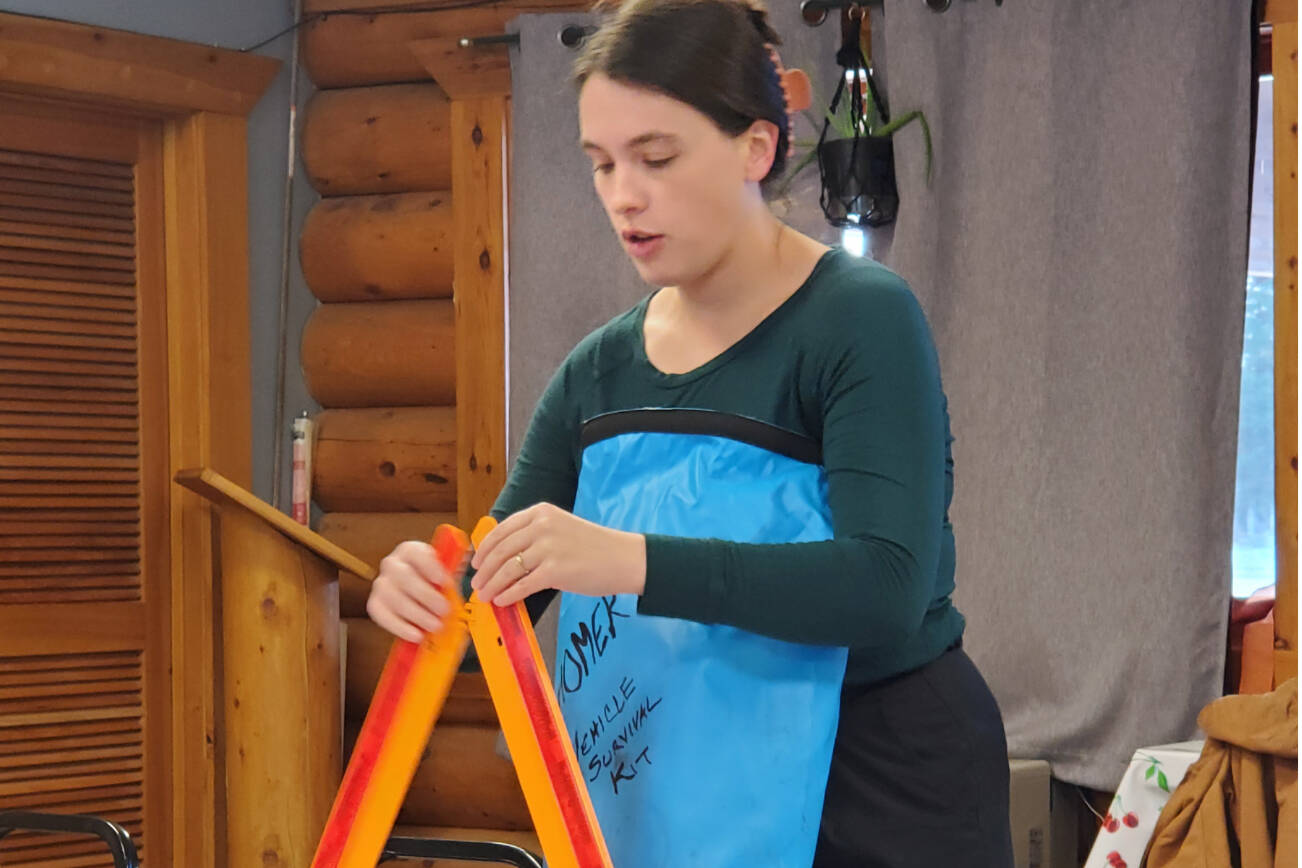
Sears demonstrated using her own vehicle winter survival kit that is required for all state vehicles, which contained a set of folding safety road reflectors, hand warmers, a shovel, a flashlight with a lithium battery to better survive the cold, a car window glass breaker, ponchos, ice cleats and jumper cables.
“You can even put snacks in there — any kind of dry food or things that will last and do well in the cold,” she said. She also suggested keeping winter clothing and extra layers, as well as bottled water and a “robust” first aid kit, in your vehicle.
“Those are all important things to have when you’re out driving and there’s risk of a storm,” she said.
Sears also advised that people practice their plan of where to go and what to do in the event of a winter storm.
“If you have the supplies, knowing how to use them is always a good thing as well,” she said. “Then when it comes to the point of needing to do that, it’s not something brand new that you’re thinking about, so then in an emergency you’re not panicking.”
In general, if a winter storm is coming, it’s most strongly advised to stay off the road and limit your time outside.
“Make sure you bring your pets in so that they can stay warm as well,” Sears said. “We talked about carbon monoxide poisoning — make sure that your heat source or generators are far enough away from your house and that you’re not using them indoors.
“If you have a woodburning stove, make sure that anything that could catch on fire is at least three feet away from that fireplace. And make sure to stay warm.”
Whether stuck inside your house or your car during a storm, good ventilation is also important, even while trying to keep out the cold and stay warm. If you begin to feel sick or dizzy, that may be a sign of carbon monoxide poisoning. In that event, Sears said, “get outside.”
“If you have to go outside, you want to know where you’re going to be going to stay warm — especially with winter storms, you can get confused and lost easily,” she said. “Make sure you have a plan of where you’re going to go to stay warm, something that’s nearby that would have good power.”
Sears also advised that people should wear multiple layers and cover as much exposed skin as possible; avoid overexertion so as to avoid sweating and chilling or running the risk of a heart attack; and know the signs of hypothermia and frostbite.
Additional emergency preparedness information is available through the National Weather Service, the CDC, American Red Cross and the State of Alaska.
