
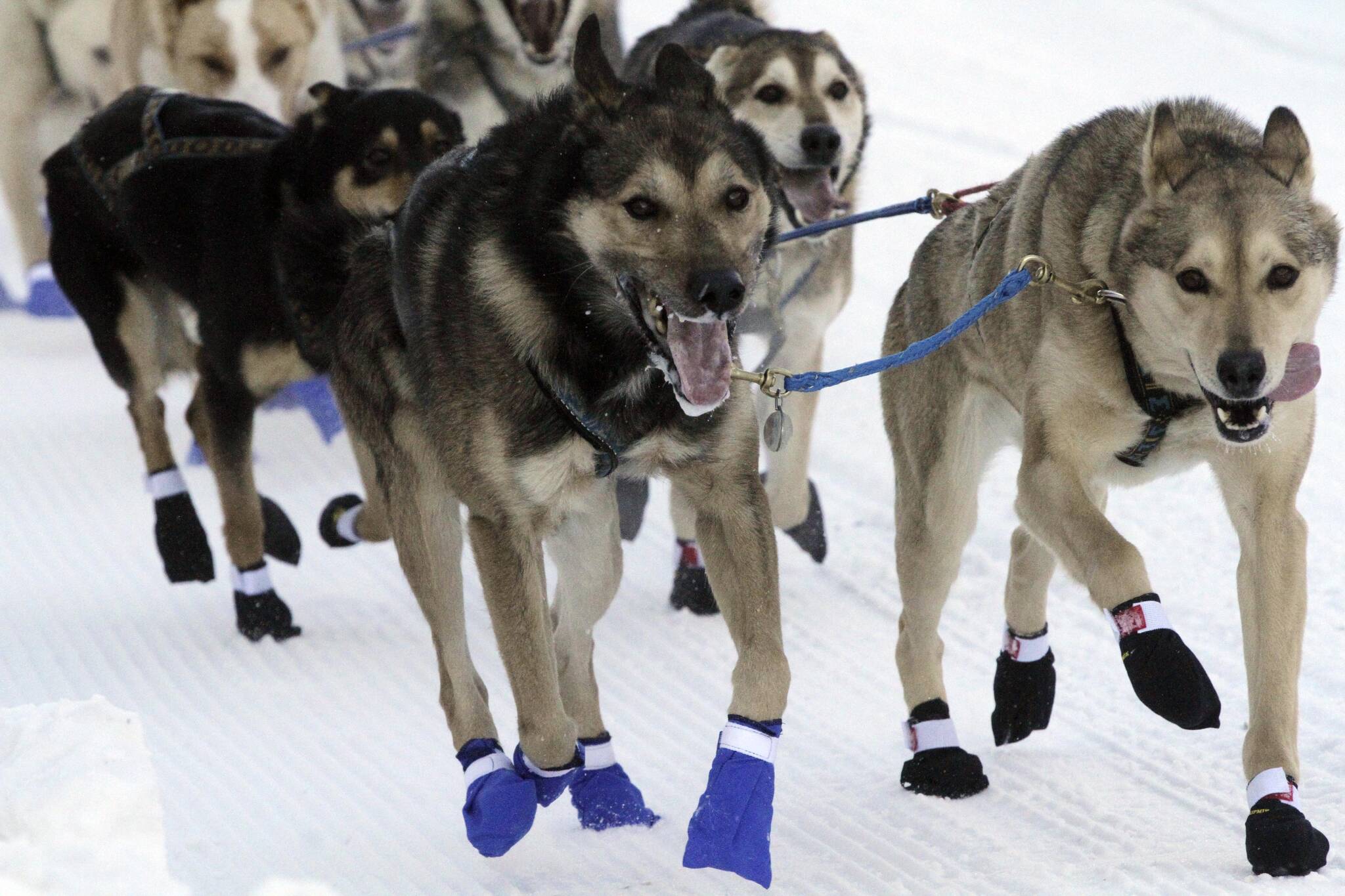
The lead dogs for musher Bailey Vitello of Milan, New Hampshire, run down Fourth Avenue during the Iditarod Trail Sled Dog Race’s ceremonial start in downtown Anchorage, Alaska, on Saturday, March 4, 2023. (AP Photo/Mark Thiessen)

The lead dogs for musher Bailey Vitello of Milan, New Hampshire, run down Fourth Avenue during the Iditarod Trail Sled Dog Race’s ceremonial start in downtown Anchorage, Alaska, on Saturday, March 4, 2023. (AP Photo/Mark Thiessen)

Heat takes toll as Iditarod mushers trek across Alaska

Many communities in the nation’s largest state hit record highs this week,

By Mark Thiessen

Associated Press

ANCHORAGE — Mushers and their dogs in the Iditarod Trail Sled Dog Race face plenty of variables in the Alaska wilderness. An unexpected one this year has been heat that is taking a toll in a sport better suited for temperatures well below zero.

Jason Mackey said a thermometer hanging from the back of his sled hit 80 degrees Fahrenheit at one point this week as he camped alongside the trail while mushers neared the halfway mark of the race. Other racers threw their game plans for the 1,000-mile race across Alaska out the window to deal with the heat and messy trail conditions.

Although it’s warm, it wasn’t 80 degrees in interior Alaska, which would probably be a record high in July, said Brian Brettschneider, a climate scientist with the National Weather Service’s Alaska Region. Instead, when you leave a thermometer in the sun, it absorbs the solar energy, which is the reason official measurement thermometers are kept in the shade.

But it’s still warm and sunny, and it’s having noticeable effects on people who are exposed to it, Brettschneider said.

Last weekend, the same area was much cooler than normal, with what appeared to be ideal mushing conditions. The warmer conditions are being driven by an area of high pressure, he said.

Many communities in the nation’s largest state hit record highs this week, from Kodiak off Alaska’s southern coast to Deadhorse, the supply town for oil companies operating on the state’s North Slope, about 1,250 miles away.

Along the Iditarod race route, the community of McGrath didn’t set records but had a high Wednesday of 36 degrees Fahrenheit, 14 degrees Fahrenheit above normal. More telling was a low temperature of 27 degrees Fahrenheit.

“Normally it should be below zero,” Brettschneider said.

That warmth was evident all along the Iditarod trail Wednesday. “There’s almost no places that were below freezing along the route,” he said.

That was not news to Mackey. “I wish the temperatures would cool down,” the musher told a television crew from the Iditarod Insider.

It’s just not the heat that was bothersome. He said he looked down at his sled at one point and saw two mosquitoes.

“Yeah, it’s spring,” Mackey said.

The heat is taking its toll on Mackey’s dogs, which he called “big boys” at 80 pounds. He said other teams were moving in the heat of the day, but he wasn’t willing to do that. “I mean, it zaps them,” he said of the dog team.

Kelly Maixner, a pediatric dentist, said his dogs don’t like the heat, and he’d rather it be minus -20 degrees Fahrenheit.

During the race, mushers must take one 24-hour layover at a checkpoint to rest. Part of where to take that layover plays into the strategy of most every musher.

Nic Petit took his mandatory rest early in the race, at the checkpoint in Nikolai, because the sun was out. “I like hot dogs, just not my dog as a hot dog,” said Petit, who was born in France and raised in New Mexico.

The melting was causing issues and concerns for some mushers, especially as they made for the race’s halfway point, the ghost village of Iditarod.

“It could be soft and punchy out there, and who knows how the hills are going into Iditarod,” Richie Diehl told the TV crew. “It could be big tussocks just like a couple of years ago, and it could be a brutal run, you know, with the rolling hills and possibly barren tundra.” Tussocks are clumps of grass.

Rookie musher Bailey Vitello of New Hampshire was near last place Thursday, running his dogs in the rain during the day and having to deal with ice at night.

He would rather not be behind and dealing with ripped-up trails. “The back-of-the-pack is the worst part of the trail,” he told the TV crew.

Riley Dyche of Fairbanks took his 24-hour break before reaching Iditarod because he didn’t want to run his dogs in the heat of the day. That likely cost him either $3,000 in gold nuggets or a new smart phone, the prize given to the first musher at the halfway point.

“I don’t think the little incentive prize — it would have been cool — but I don’t think it would have been a benefit to these guys for getting to the finish line,” he said, speaking of his dogs.

Instead, that prize went to race leader Wade Marrs, who is originally from Alaska but now living in Wisconsin. He arrived in Iditarod about 1 a.m. Thursday.

The good news for mushers is that as they continue west, temperatures will be more Alaska-like, highs around 10 degrees Fahrenheit and lows below zero, Brettschneider said.

The race started Sunday in Willow, just north of Anchorage. Mushers will take their dog teams over two mountain ranges, the frozen Yukon River and the Bering Sea ice to the finish line in Nome. The winner is expected sometime early next week.

More in News

David Ross is sworn in as Kenai Police Chief on Tuesday, May 31, 2016 at Kenai City Hall. The Alaska Association of Chiefs of Police named Ross the 2025 Police Chief of the Year, recognizing over two decades of service. Photo by Megan Pacer/Peninsula Clarion
Kenai police chief named 2025 Police Chief of the Year

The Alaska Association of Chiefs of Police recognized David Ross for his more than two decades of leadership.

The cast of Nikiski Middle School’s upcoming performance of “Alice in Wonderland” is pictured on Dec. 2, 2025. The upperclassmen-directed play opens on Friday, with additional showtimes Saturday and next weekend. Photo courtesy of Carla Jenness
Nikiski Middle School debuts student-led “Alice in Wonderland”

The show opens on Friday, with additional showtimes this weekend and next.

On Tuesday, the Kenaitze Indian Tribe unveiled Kahtnu Area Transit, a public transportation service open to the entire Peninsula Borough community. Photo courtesy of Kahtnu Area Transit
Kenaitze Indian Tribe unveils Kahtnu Area Transit

The fixed bus route offers 13 stops between Nikiski and Sterling.

The Kenai Chamber of Commerce and Visitor Center hosts the annual Christmas Comes to Kenai on Nov. 28<ins>, 2025</ins>. The beloved event began over 40 years ago, and this year over 1,000 attendees enjoyed hot chocolate, fireworks, pictures with Santa and shopping. Photo courtesy of the Kenai Chamber of Commerce
 Photo courtesy of the Kenai Chamber of Commerce
The Kenai Chamber of Commerce and Visitor Center hosted the annual Christmas Comes to Kenai on Nov. 28. The beloved event began over 40 years ago, and this year over 1,000 attendees enjoyed hot chocolate, fireworks, pictures with Santa and shopping.
Kicking off a month of holiday festivities

Last weekend’s holiday events, including the annual Christmas Comes to Kenai and the Soldotna Turkey Trot, drew folks from all over the Kenai Peninsula.

Starting Dec. 2, Aleutian Airways will offer roundtrip flights between Anchorage and Unalakleet every Tuesday, Friday and Sunday.
Aleutian Airways to offer roundtrip flights between Anchorage and Unalakleet

Starting Dec. 2, Aleutian Airways will offer three roundtrip flights per week.

The Trump administration’s “Big Beautiful Bill” act requires the Bureau of Ocean Energy management to hold at least six offshore oil and gas lease sales in Alaska between 2026-2028 and 2030-2032. The first of these sales — known as “Big Beautiful Cook Inlet 1,” or BBC1— is scheduled for March 2026. Photo courtesy of the Bureau of Ocean Energy Management
Cook Inletkeeper launches petition against federal government

The organization is calling for transparency in Cook Inlet offshore oil and gas sales.

Winter dining has always carried more weight than the menu might suggest. In the off-season, eating out isn’t just about comfort food or convenience; it’s a way of supporting local businesses as they hold steady through the slower months. Photo credit: Canva.
The ripple effect: How local spending builds stronger communities on the Kenai Peninsula

From cozy cafés to fine-dining bistros, purchases made close to home sustain local jobs and services

Courtesy Harvest
On the Kenai Peninsula, a dormant liquefied natural gas export plant could be repurposed to receive cargoes of imported LNG under a plan being studied by Harvest, an affiliate of oil and gas company Hilcorp. The fuel would be transferred from ships to the tanks on the left, still in liquid form, before being converted back into gas and sent into a pipeline.
Utilities say Alaska needs an LNG import terminal. Consumers could end up paying for two.

Planning for two separate projects is currently moving ahead.

A map shows the locations of the 21 Alaska federal offshore oil and gas lease sales proposed by the Trump administration. (Map provided by the U.S. Bureau of Ocean Energy Management)
Trump administration proposes offshore leasing in almost all Alaska waters

A new five-year offshore oil and gas leasing plan proposes 21 sales in Alaska, from the Gulf of Alaska to the High Arctic, and 13 more off the U.S. West Coast and in the Gulf of Mexico.

Most Read