
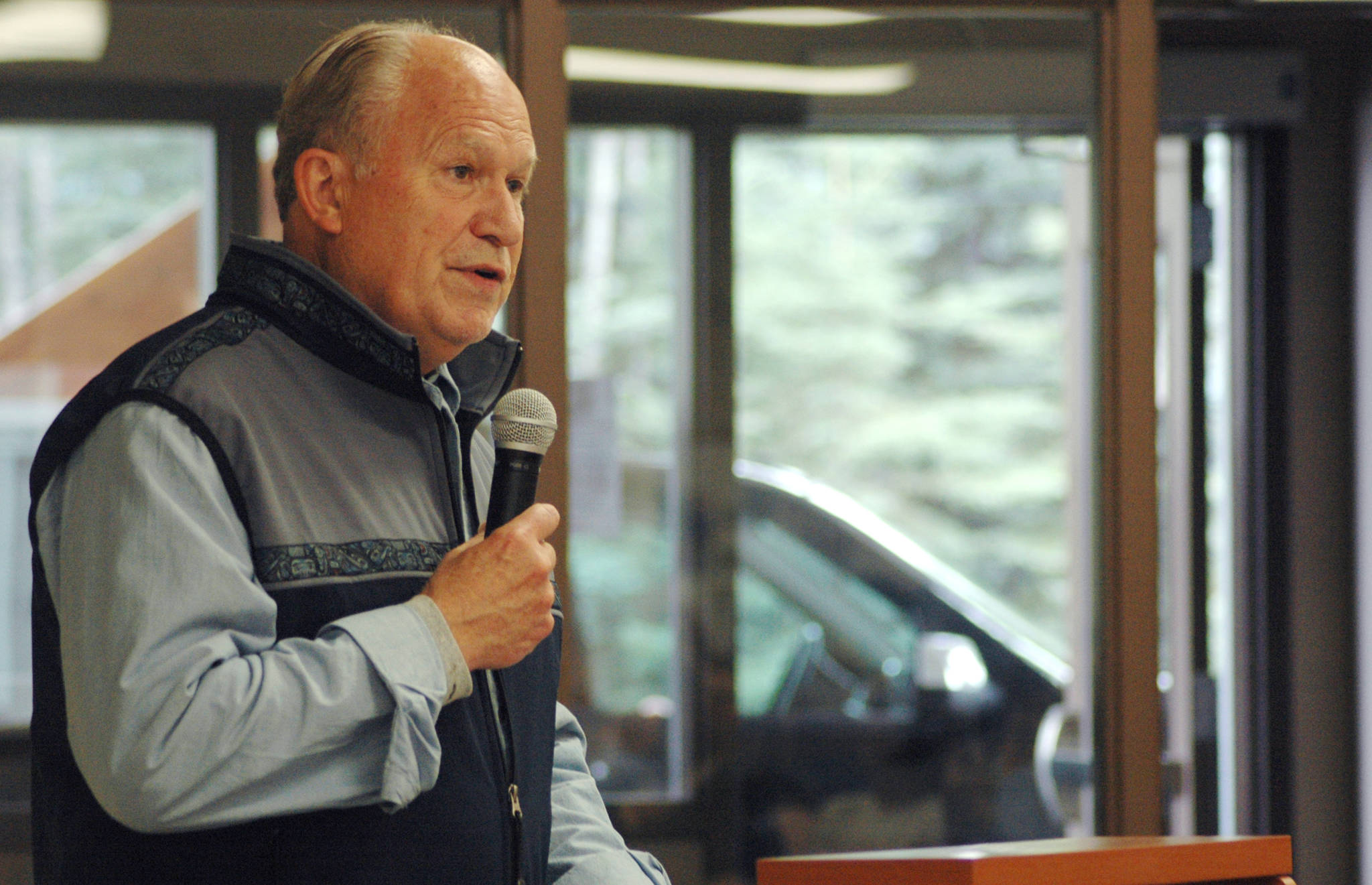
Gov. Bill Walker speaks to a crowd gathered at Hope Community Resources’ building on Kalifornsky Beach Road during a signing ceremony for Senate Bill 174 on Saturday, Aug. 25, 2018 in Soldotna, Alaska. (Photo by Elizabeth Earl/Peninsula Clarion)

Gov. Bill Walker speaks to a crowd gathered at Hope Community Resources’ building on Kalifornsky Beach Road during a signing ceremony for Senate Bill 174 on Saturday, Aug. 25, 2018 in Soldotna, Alaska. (Photo by Elizabeth Earl/Peninsula Clarion)

Governor signs disability service philosophy bill into law

Alaskans with disabilities will now have more flexibility in determining their care since Gov. Bill Walker signed Senate Bill 174 into law Saturday.

In a ceremony in Soldotna, Walker signed the bill with dozens of people from Hope Community Resources, the Independent Living Center, Access Alaska and other advocacy and care organizations in attendance. The bill adds language to the legislative findings related to the state’s disability services program, establishing the intent that disability services be person-directed and flexible to individual needs.

The law doesn’t directly change the way people with disabilities receive services right now. Rather, it’s a lens that future policies should be interpreted through, said Patrick Reinhart, the executive director of the Governor’s Council on Disabilities and Special Education.

“We call it aspirational language,” he said. “We had one a few years ago called employment-first, when we spend state money with people with disabilities, we should be asking them what they want to do for a living. It’s not an actual policy thing, it is a policy, it’s telling state workers (to ask) what (people with disabilities) want to do for a living. This is kind of similar in that respect in terms of it being aspirational language.”

Walker signed the bill before a room filled with disability service providers, service recipients, advocates and parents at Hope Community Resources’ building on Kalifornsky Beach Road in Soldotna on Saturday. Sen. Peter Micciche (R-Soldotna), who was the bill’s original sponsor in the Legislature, thanked Walker for the ceremony in Soldotna.

He sponsored the bill after working with advocates and professionals. Reinhart said the language was designed by a group of people with developmental disabilities, service providers and advocates who wanted to make sure that services in the future follow a person-directed model. The recent budget cuts at the state level, including to Medicaid services, did play a role in the discussions, but weren’t the sole impetus, he said. The Alaska Department of Health and Social Services is already fairly person-directed and focused on home- and community-based services, but the new language cements that intent, he said.

“We have a state that has placed a high priority on home and community-based services,” he said. “We’ve had several decades of that. It’s not like we were shifting something majorly, it’s just while we’re here, while we have a group of people who truly believe in this, let’s put it down right in our statutes.”

Micciche said at the ceremony the bill follows the state’s move away from institutionalizing people with disabilities, thus helping to reduce the cost of care and keep people in their communities.

“What we realized is you’re not a number,” he said. “You are Alaskans just like us with the same hopes and dreams. Alaskans with disabilities deserve the opportunity to have active lives.”

He also credited Kenai resident Maggie Winston, who also chairs the Council on Disabilities and Special Education, with much of the work behind the bill. Winston said at the ceremony that she was happy the state took the leadership on this type of care for people with disabilities.

“The language that’s in this bill is going to guide our state and encourage meaningful lives for individuals, for providers, and really strengthen our communities in doing so,” she said.

The final version of the bill states that the Legislature finds that “self-direction and autonomy enhance quality of life” to help people live their lives and that “The people of the state share a vision of a flexible system of support” for people with disabilities to participate actively in managing their support services.

Reinhart said the Council on Disabilities and Special Education would next be taking on the challenge of clearly defining what “person-directed” means, particularly for individuals with limited communication ability or cognitive disabilities, and ensuring a quality workforce to support people in working toward their goals. The state will be evaluating its policies to make sure they fit with the vision statement outlined in the bill, he said.

“(The Division of Senior and Disability Services) is pretty good about wanting person-centered plans, with people developing those plans from the get-go,” he said. “They did do that already, but now they have an overarching philosophy that they can always point to.”

Reach Elizabeth Earl at eearl@peninsulaclarion.com.
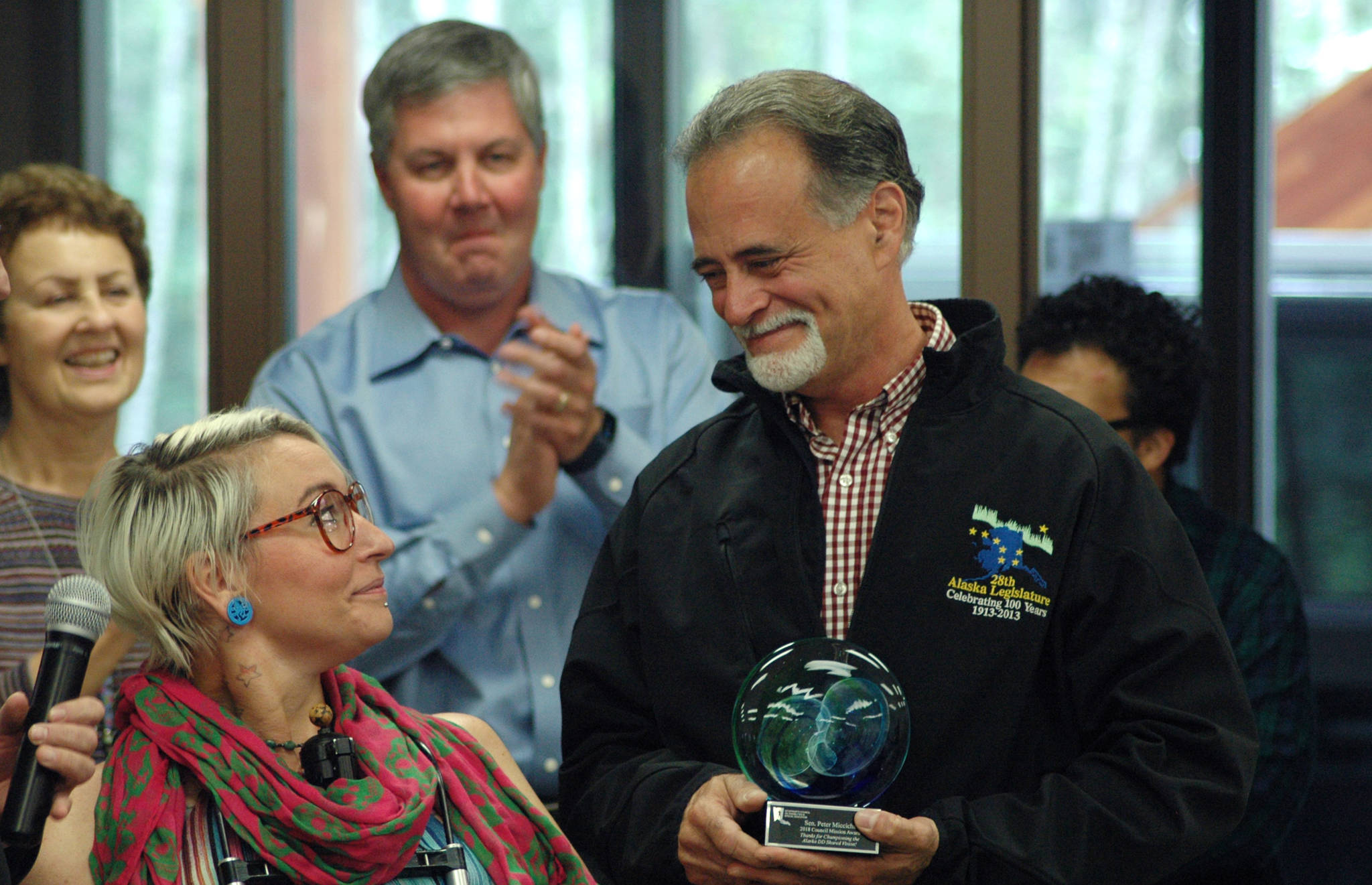
Sen. Peter Micciche, R-Soldotna (right) thanks Maggie Winston, the chair of the Governor’s Council on Disabilities and Special Education, for an award the board presented to him for his work on Senate Bill 174 during a signing ceremony for the bill at Hope Community Resources’ building on Saturday, Aug. 25, 2018 in Soldotna, Alaska. (Photo by Elizabeth Earl/Peninsula Clarion)

Sen. Peter Micciche, R-Soldotna (right) thanks Maggie Winston, the chair of the Governor’s Council on Disabilities and Special Education, for an award the board presented to him for his work on Senate Bill 174 during a signing ceremony for the bill at Hope Community Resources’ building on Saturday, Aug. 25, 2018 in Soldotna, Alaska. (Photo by Elizabeth Earl/Peninsula Clarion)

More in News

David Ross is sworn in as Kenai Police Chief on Tuesday, May 31, 2016 at Kenai City Hall. The Alaska Association of Chiefs of Police named Ross the 2025 Police Chief of the Year, recognizing over two decades of service. Photo by Megan Pacer/Peninsula Clarion
Kenai police chief named 2025 Police Chief of the Year

The Alaska Association of Chiefs of Police recognized David Ross for his more than two decades of leadership.

The cast of Nikiski Middle School’s upcoming performance of “Alice in Wonderland” is pictured on Dec. 2, 2025. The upperclassmen-directed play opens on Friday, with additional showtimes Saturday and next weekend. Photo courtesy of Carla Jenness
Nikiski Middle School debuts student-led “Alice in Wonderland”

The show opens on Friday, with additional showtimes this weekend and next.

On Tuesday, the Kenaitze Indian Tribe unveiled Kahtnu Area Transit, a public transportation service open to the entire Peninsula Borough community. Photo courtesy of Kahtnu Area Transit
Kenaitze Indian Tribe unveils Kahtnu Area Transit

The fixed bus route offers 13 stops between Nikiski and Sterling.

The Kenai Chamber of Commerce and Visitor Center hosts the annual Christmas Comes to Kenai on Nov. 28<ins>, 2025</ins>. The beloved event began over 40 years ago, and this year over 1,000 attendees enjoyed hot chocolate, fireworks, pictures with Santa and shopping. Photo courtesy of the Kenai Chamber of Commerce
 Photo courtesy of the Kenai Chamber of Commerce
The Kenai Chamber of Commerce and Visitor Center hosted the annual Christmas Comes to Kenai on Nov. 28. The beloved event began over 40 years ago, and this year over 1,000 attendees enjoyed hot chocolate, fireworks, pictures with Santa and shopping.
Kicking off a month of holiday festivities

Last weekend’s holiday events, including the annual Christmas Comes to Kenai and the Soldotna Turkey Trot, drew folks from all over the Kenai Peninsula.

Starting Dec. 2, Aleutian Airways will offer roundtrip flights between Anchorage and Unalakleet every Tuesday, Friday and Sunday.
Aleutian Airways to offer roundtrip flights between Anchorage and Unalakleet

Starting Dec. 2, Aleutian Airways will offer three roundtrip flights per week.

The Trump administration’s “Big Beautiful Bill” act requires the Bureau of Ocean Energy management to hold at least six offshore oil and gas lease sales in Alaska between 2026-2028 and 2030-2032. The first of these sales — known as “Big Beautiful Cook Inlet 1,” or BBC1— is scheduled for March 2026. Photo courtesy of the Bureau of Ocean Energy Management
Cook Inletkeeper launches petition against federal government

The organization is calling for transparency in Cook Inlet offshore oil and gas sales.

Winter dining has always carried more weight than the menu might suggest. In the off-season, eating out isn’t just about comfort food or convenience; it’s a way of supporting local businesses as they hold steady through the slower months. Photo credit: Canva.
The ripple effect: How local spending builds stronger communities on the Kenai Peninsula

From cozy cafés to fine-dining bistros, purchases made close to home sustain local jobs and services

Courtesy Harvest
On the Kenai Peninsula, a dormant liquefied natural gas export plant could be repurposed to receive cargoes of imported LNG under a plan being studied by Harvest, an affiliate of oil and gas company Hilcorp. The fuel would be transferred from ships to the tanks on the left, still in liquid form, before being converted back into gas and sent into a pipeline.
Utilities say Alaska needs an LNG import terminal. Consumers could end up paying for two.

Planning for two separate projects is currently moving ahead.

A map shows the locations of the 21 Alaska federal offshore oil and gas lease sales proposed by the Trump administration. (Map provided by the U.S. Bureau of Ocean Energy Management)
Trump administration proposes offshore leasing in almost all Alaska waters

A new five-year offshore oil and gas leasing plan proposes 21 sales in Alaska, from the Gulf of Alaska to the High Arctic, and 13 more off the U.S. West Coast and in the Gulf of Mexico.

Most Read