
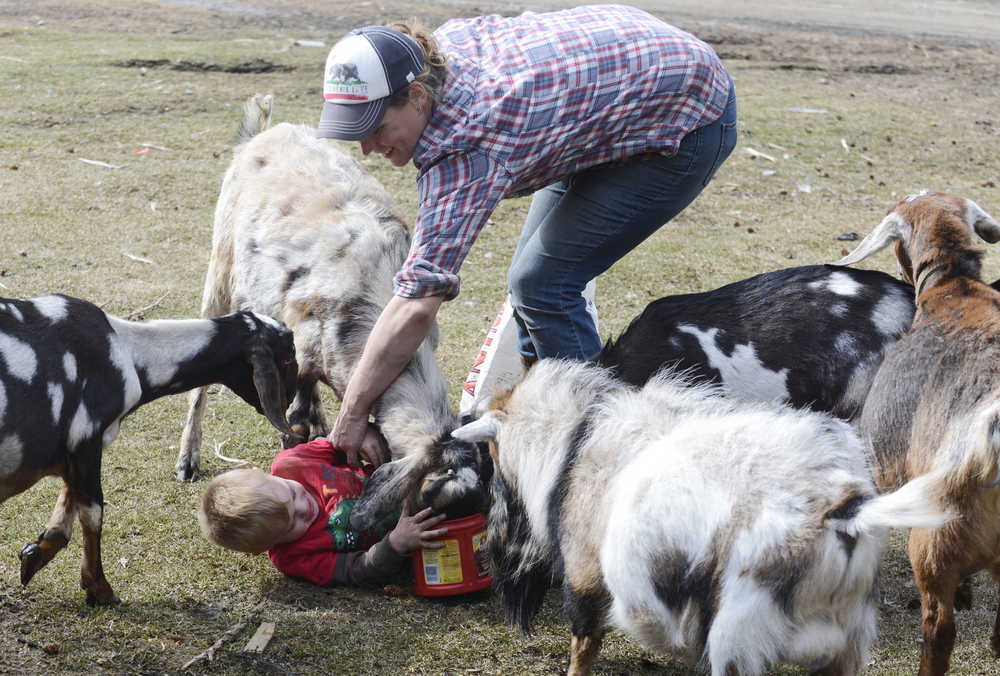
At feeding time Monday morning on Karluk Acres, a gang of Nigerian Dwarf and Nubian goats darted over gravel to claim scattered corn and grains.
The farm, which Julie Wendt co-owns with Paul Vass, has one of the few goat-shares on the Kenai Peninsula. Currently, the herd has seven milking females and is only large enough to supply the demand from friends and their families, Wendt said.
Herd-shares facilitate the purchase of local, raw dairy products, Wendt said. People buy half of a goat or a quarter of a goat depending on the size, and can take a portion of the milk the animal produces, she said. Selling unpasteurized milk is prohibited, but herd-share participants are paying for the goat, and as owners can have the milk for personal use.
It ends up costing roughly $5 per gallon because the buyer helps with work around the farm as well, Wendt said. If there is extra it usually goes to other animals on the farm, she said.
“It’s a shame to feed it to the pigs,” Wendt said.
Wendt says unpasteurized goat’s milk has numerous health benefits, especially for children, which is why she tries to sell shares to families with children. It is more homogenized than cow’s milk and is easier to digest, she said.
Suzy Crosby, a speaker at the 2015 Kenai Peninsula Ag Forum, owns Cottonwood Creek Farm, one of several larger herd-share operations in the Matanuska-Susitna Valley. She and her husband Mike Pendergrast began their herd-share in 2002, with only two milking goats.
“We had more milk even then, than we knew what to do with,” Crosby said.
Crosby is aware of aware of nearly one dozen active herd-shares raising various dairy animals throughout Alaska. Cottonwood Creek Farm has Chinook Wind Registered Alpine goats, whose supply is spoken for year-round during the peak in the summer and slow winter seasons, she said.
There is enough movement of shareholders that new applicants are usually accepted, Crosby said. Many shareholders stick with the program for years, while for others it may be a shorter duration, such as raising a baby until weaning age. This spring her very first shareholder finally left the program after 13 years, she said.
“It seems as if when one person leaves two more step in,” Crosby said. “It becomes very self-sustaining.”
The legality of selling a share in an animal versus selling their milk is a matter of using terminology approved by the state of Alaska, Crosby said. It becomes “a boarding arrangement,” and the buyer is paying a monthly fee to house their portion of the animal, she said.
Herd-share owners can come pick up their milk shares when the milk is available, on their assigned day of the week, Crosby said.
The Farm-to-Consumer Legal Defense Fund tracks regulations by state on raw milk sales. Alaska is one of seven states where herd-shares are legal. Ten states allow for the retail sale of raw milk, on-farm sales are legal in 15 states, four states do not have any regulations on raw milk, and only 11 states ban raw milk sales.
“Raw milk is considered by many to be one of nature’s most perfect foods, and yet it is one of the most banned substances by the government,” Crosby said.
There is a pervasive attitude that unpasteurized product is dangerous, Crosby said. However, raw milk itself rarely makes people ill; the conditions in which the product is stored and handled are more likely to blame for problems, she said. During her presentation at the Ag Forum, Crosby outlined the two essential components to properly handling raw milk.
“Clean and cold,” Crosby said, are the two priorities to follow. Chilling the milk quickly and storing it at a temperature below 40 degrees Fahrenheit, and maintaining a clean milking environment, equipment, and animals is essential, she said.
The interest in raw milk is picking up statewide, along with the rest of the nation coinciding with the grassroots movement toward consuming more local foods, Crosby said.
“People want to know where their food came from and what it took to get it there,” Crosby said.
Raw milk contains no hormones or pesticides if farmed using natural methods, and offers health benefits such as clearing up skin issues, and minimizing allergies and digestive problems, Crosby said, both of which she has witnessed first-hand through her shareholders.
“Everyone should have the choice of what food to eat,” Crosby said. “It should have never been restricted.”
Reach Kelly Sullivan at kelly.sullivan@peninsulaclarion.com.
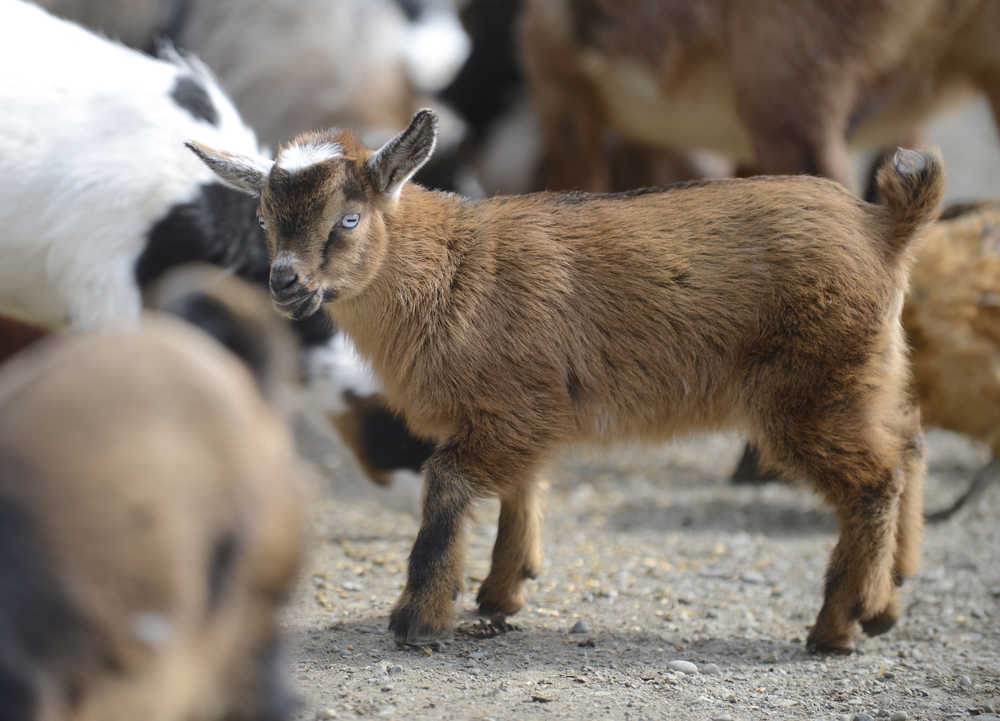
Photo by Kelly Sullivan/ Peninsula Clarion Julie Wendt reaches for her son Silas Wendt who was overrun by hungry goats during feeding time Monday, April 27, 2015, at Karluk Acres in Kenai, Alaska.
