
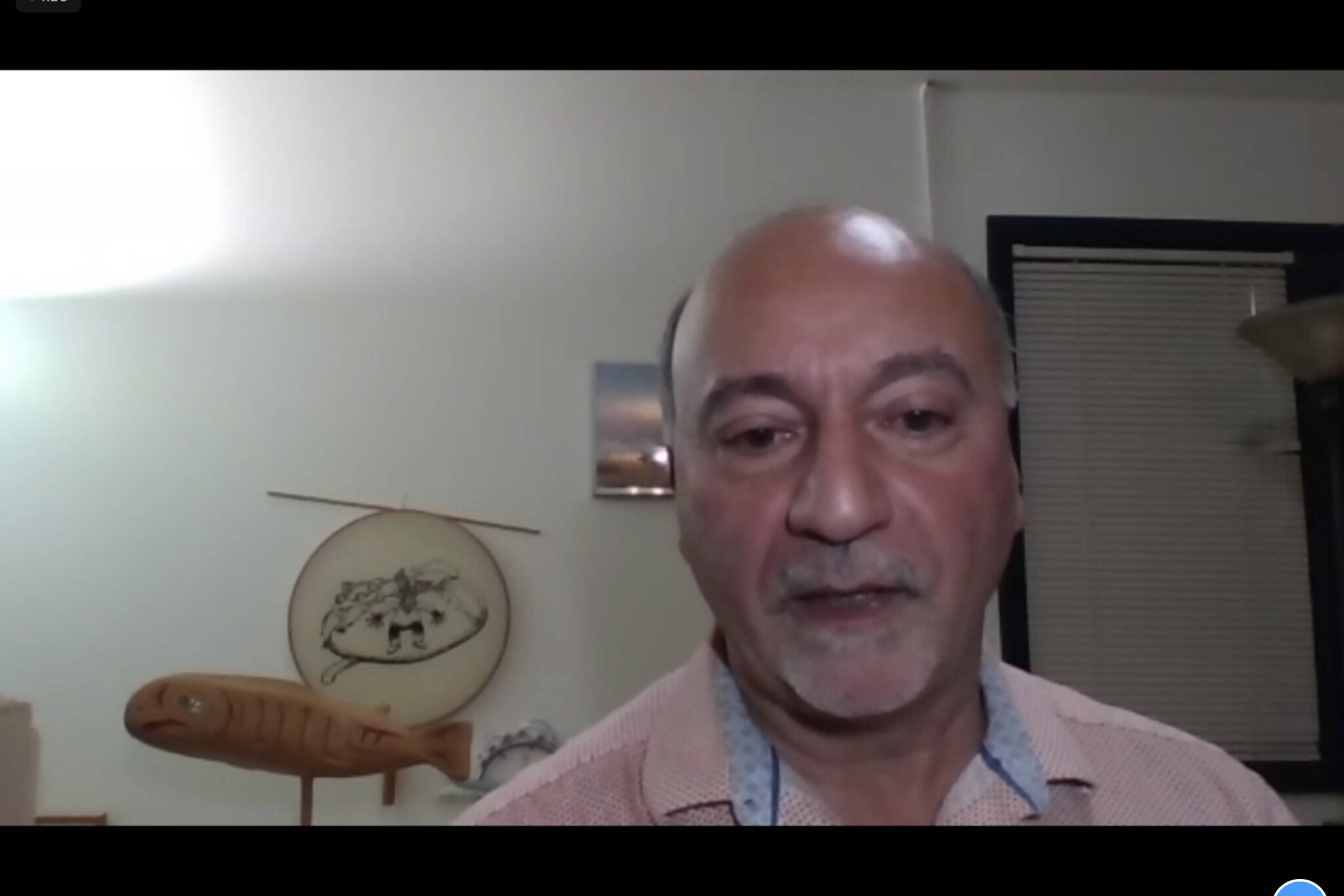
A virtual visit with Homer residents by Democratic Party candidate for governor Les Gara on Nov. 18 showed one of the challenges facing political candidates as they warm up their campaigns for the 2022 election year: How do you safely meet with voters in the midst of the COVID-19 pandemic? Gara, whose wife Kelly is a hospital physical therapist, chose to meet remotely, though he said he hoped to visit Homer when it felt safe.
Citizens AKtion Network, or CAN, organized the Zoom meeting, with about 25 people listening in. CAN describes itself as “a nonpartisan group supporting Alaskan and American constitutional values,” according to a press release. Its vision is of an “economic future that is sustainable, with our people aspiring to lives and public discussion that display integrity, while every adult sees engagement in the political process as a high ideal.”
Along with Gara, candidates who have announced their intent to run include incumbent Gov. Mike Dunleavy, a Republican; former Gov. Bill Walker, an independent; Rep. Christopher Kurka, R-Wasilla; and Libertarian candidate William Toien. Libertarian candidate Roman Shevchuk withdrew from the race for personal reasons Tuesday, the Alaska Libertarian Party announced in a press release.
Gara, 58, came to Alaska in 1988, living briefly in Fairbanks before moving to Anchorage to work as an assistant attorney general on the state’s civil prosecution of the Exxon Valdez oil spill. He represented House District 23 in Anchorage from 2003 to 2019.
Raised in foster homes after his father was murdered, Gara worked his way through school, graduating from Boston University and Harvard Law School.
“I learned early on I had a chance to succeed because I had good schools,” he said. “The right of every single person should be a good education and a good-paying job. A good-paying job means a living wage.”
Gara criticized Dunleavy for gutting Alaska’s education system.
“He’s been a disaster for education,” Gara said. “I could talk about differences with Gov. Walker. Whatever those differences are, and they’re a number, there’s never been a governor who wants to cut a quarter-billion (dollars) to education, and that’s Dunleavy.”
In response to a question about how the University of Alaska system could be rebuilt, Gara said you can’t do that with a governor who supported a one-third cut to the university budget.
“You can’t say, ‘Look, we’re out of money. We can’t fund anything,’” Gara said. “He (Dunleavy) doesn’t want to stand up for you on the street. He doesn’t want to look oil (the industry) in the eye.”
Alaska could fund education, capital projects and other programs if it did away with tax subsidies to the oil industry, Gara said.
“We have a tax system that gives away $1 billion in tax subsidies, tax credits,” he said.
Restoring Alaska’s construction budget could do things like expand Homer’s large-vessel harbor, Gara said. Capital projects pump money into the construction industry, but that also trickles down to other businesses.
At the Zoom talk, Gara gave a hint at how candidates might run in Alaska’s first ranked-choice voting process.
Under the new process, every registered voter can vote in the Aug. 16, 2022, primary, called the Nonpartisan Top Four Primary, regardless of party affiliation or non-affiliation. The top four candidates in each race advance to the general primary, where voters then rank those four in each race.
“I plan on being one of those,” Gara said.
In response to a question about if he would split votes with Walker and make it easier for Dunleavy to win, Gara said under ranked-choice voting, that wouldn’t happen. On his ranked-choice ballot, Gara said, “I’d be my first choice and Walker second. I’m not filling out Mike Dunleavy. He’s had his chance.”
To win an election in ranked-choice voting, a candidate has to get 50.1% of the vote. If that doesn’t happen right off, where a majority ranks a candidate first, the last-place candidate falls out of the race. Their second-place votes go to the other candidates. The process repeats until a candidate has the majority of the votes.
If Gara finished ahead of Walker, he said he anticipated Walker would get most of his second-place votes. If Walker finished ahead of Gara, Gara said he would probably get most of Walker’s second-place votes. Having two strong moderate or liberal candidates who go to the final four keeps conservatives from dominating the race, he said.
“You need to occupy at least two of those spots with acceptable candidates,” Gara said. “Even if I didn’t like campaigning and I or Bill Walker didn’t want to be in this race, we have to be in the race to make sure Dunleavy doesn’t benefit from too many second-place votes.”
A video on the Alaska Division of Elections page shows how ranked-choice voting works.
In response to a question about how he’s different from Walker, Gara said the biggest threat to the state is another four years of Dunleavy.
“That said, Gov. Walker — Paul knows,” Gara said, referring to former Rep. Paul Seaton, who attended the Zoom meeting, “Gov. Walker and I had some big disagreements. We all had the urge to work across party lines. He’s a very conservative person. He’s not pro-choice. He’s always said marriage should be between a man and a woman.”
Gara noted that Walker now says he’s pro-choice and equal marriage.
In response to a question on the Pebble Mine, Gara said he has opposed it since the moment he had a chance to study it.
“My moral compass told me putting a toxic mine at the headwaters of the world’s last remaining great salmon fishery doesn’t make sense to me,” he said.
When asked about supporting small businesses, Gara said the pandemic remained a problem. Dunleavy hasn’t provided leadership, he said.
“A good governor would travel the state with people who are trusted in the community,” he said. “… You travel and go to everyone of those places and in safe way explain right now there are only two ways to safely get out of this pandemic: vaccinations and wearing a mask if you’re close to others.”
Like any candidate seizing an opportunity to raise funds, Gara closed his talk with a pitch for donations and for his website, lesgara.com.
“My question to you is ‘What is it worth to you to not have Mike Dunleavy for the next four years?”
Reach Michael Armstrong at marmstrong@homernews.com.
