
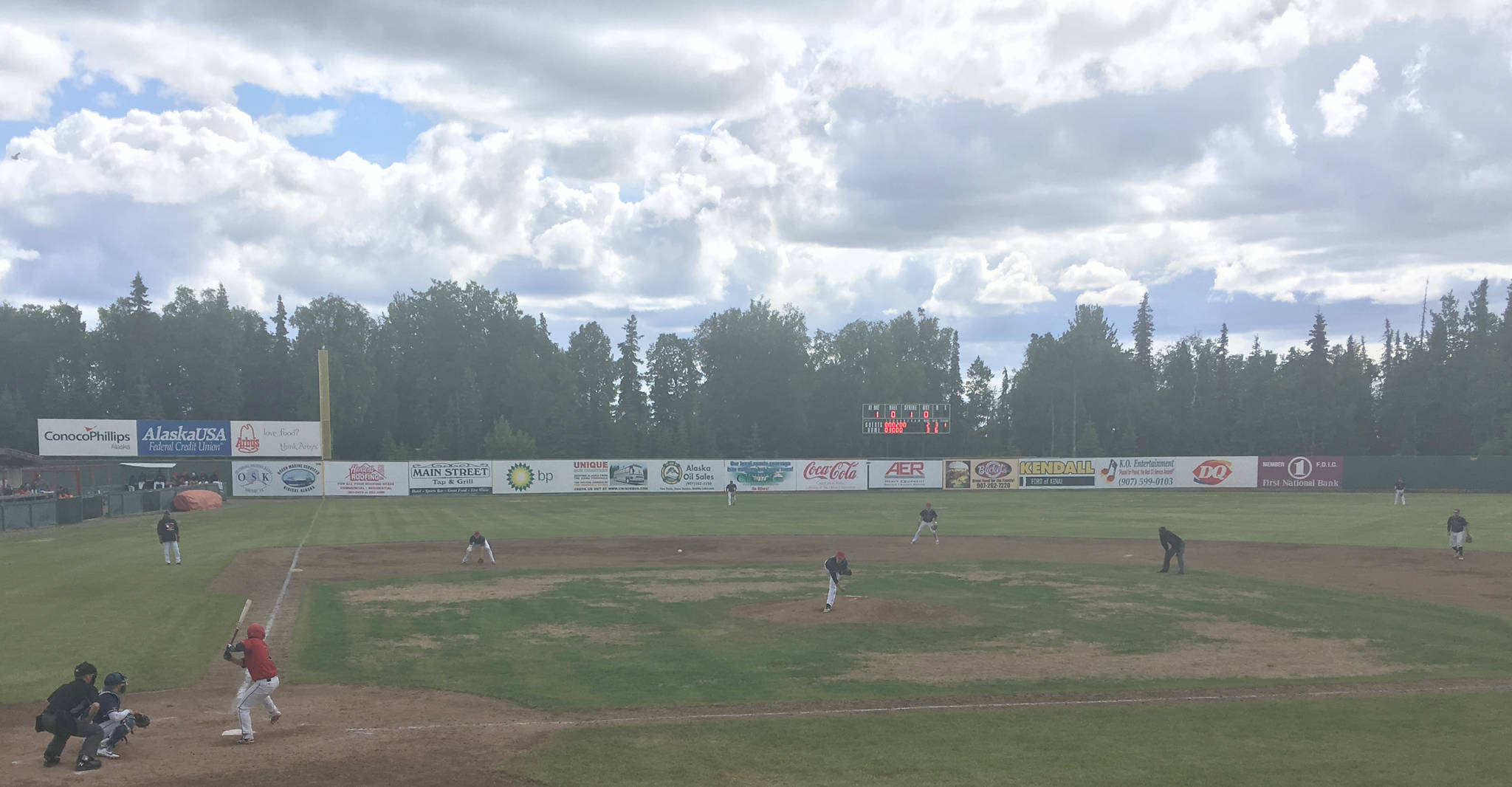
Years before he became commissioner of the Alaska Baseball League, Chris Beck pointed to the 6-foot-7 slugger in the Anchorage Glacier Pilots’ uniform and told his son to say hello.
Beck had a feeling about the freshman from Fresno State — a towering outfielder named Aaron Judge.
“I told my son to go get his autograph, because he just was different,” Beck said.
It was a quintessential college summer league experience, an up-close look at a major league star long before his big break. It’s one Beck hopes fans in the 49th State will have for years — but he’s not entirely confident they will.
Already burdened by the coronavirus pandemic and changes in player development that have limited their prospect pool, collegiate summer leagues like the ABL were hit by another potential obstacle recently when Major League Baseball announced the formation of at least two amateur leagues for college players with professional aspirations.
The Appalachian League, formerly a Rookie-level minor league, will convert into a 10-team wood bat summer league in 2021 for college players entering their freshman and sophomore seasons. Meanwhile, the six-team MLB Draft League is launching for college and high school players during their draft-eligible year.
Both leagues have spawned as MLB shrinks its affiliated minors from 160 teams to 120, repurposing franchises to serve amateur talent. The new leagues will offer those players access to top-level coaching, guaranteed looks from pro scouts, and ballparks outfitted with the latest cameras and tracking systems that provide prized data to major league front offices.
It’s mostly good news for players hoping to get noticed. Less ideal for the leagues that used to give them that chance.
“Any time MLB puts their name on something, they do it well,” Beck said. “They have the money to back it. The problem is it’s going to put some of the smaller leagues out of business, I think.”
Wood-bat college summer leagues have played a crucial role in the development of many major leaguers. Most leagues start in May or June, after the completion of the spring college season, and they offer players high-end competition at parks filled with pro scouts and equipped with some of the same technology they’ll find in MLB’s leagues.
For decades, the leagues have run largely independent of MLB, and they figure to be affected differently.
The Cape Cod League has long been the top destination for rising college juniors and has produced over 1,400 big leaguers. With the Appalachian League targeting incoming freshman and sophomores and the MLB Draft League likely to draw players heading into their senior seasons or later, Cape Cod Commissioner Eric Zmuda expects his league to hold its ground as the premier stop for players with two years of college experience.
“When you look at our history, nothing has changed in that respect,” Zmuda said.
The squeeze is more likely to be felt further down the ladder in leagues that were already dealing with complications stemming from changes in player development. In-game reps — although still important — are less of a priority for modern players. Pitchers are limiting their workloads to try to stay healthy, and players on both sides of the ball are placing a premium on other training, like weightlifting or lab work at facilities like Driveline.
Sean McGrath, commissioner of the New England Collegiate Baseball League, said recruiting has undoubtedly become a greater challenge in recent years, and he acknowledged that is likely to be complicated further by the new Appalachian and MLB Draft Leagues.
Even so, he remains optimistic leagues like the NECBL will still find future big leaguers.
“I truly don’t believe that every kid who will play professional baseball will appear in one of (MLB’s new) leagues,” he said.
Northwoods League Commissioner Ryan Voz holds a similar view and doesn’t believe MLB’s incursion is an existential threat on its own.
For starters, the league’s sustainability isn’t tied strictly to the talent. It helps that the NWL’s alumni list includes MLB stars like Max Scherzer, Chris Sale and Pete Alonso, but the business model for its franchises is tied more closely to their community value as an affordable, family-friendly gathering spot.
“Fans are looking for good baseball, but they’re looking for great entertainment,” Voz said. “And that’s where the Northwoods League we feel is really kind of a combination of all of them.”
Of course, competition for players isn’t the only concern for some leagues.
The Cape and NECBL are members of the National Alliance of College Summer Baseball, a 12-league organization that receives funding from MLB. Leagues can apply for grants worth thousands of dollars for crucial expenses like baseballs, umpire fees and team travel.
There’s no indication at this point that MLB plans to pull that funding, but if it did in the future, it could put NACSB members in a difficult position.
“Certainly it would have an impact,” McGrath said. “It’s a lot of ticket sales or several sponsorships to offset that loss.”
Summer league executives say they are full-steam ahead on planning for the 2021 season after most lost 2020 to the pandemic — the Northwoods League was among the exceptions and even hosted several hundred fans at many games.
Even those that didn’t play remain in decent financial shape. The timing of March’s coronavirus surge meant leagues avoided most of their biggest expenses, like baseballs, bats, umpire fees and travel.
Uncertainty remains for next season, though, pending the status of a virus vaccine. Franchises rely on host families for players, a potentially dangerous arrangement amid a pandemic. They also depend on sponsorships and donations from community businesses that have been hit harder.
“If those two things go away, we’re all in trouble,” Beck said.
The alumni list for Beck’s ABL includes some of the best in baseball history — Tom Seaver, Barry Bonds and Randy Johnson. It’s already become less common for players of that caliber to pass through Alaska. Beck is hoping the obstacles presented by 2020 don’t make things worse.
“When they can see the Aaron Judges,” he said, “the guys that go on to play in the big leagues, and they can remember that time they saw him in Alaska, the average fan, that helps our attendance and helps everything.”
