
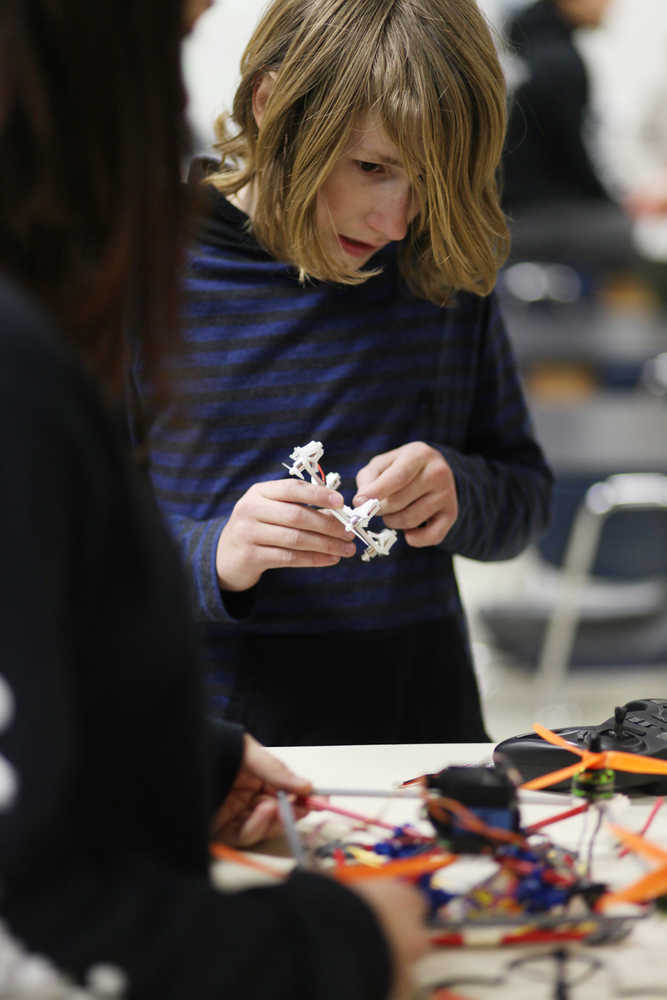
One day in early December, an up-and-coming engineering firm in Nikiski was bustling.
Employees, all of whom are 18 and younger, aside from Vice President Jake Doth, were preparing for a field test involving a change in altitude of the company’s only quad-rotor Unmanned Aerial Vehicle. 12th grader Corin Cooper and 11th grader Lochlan Quiner were readying to copilot the late afternoon flight.
The two students stood with their co-workers besides the fields behind Nikiski Middle-High School that afternoon to watch the venture.
“Elvis has left the building,” the two boys confirmed once the machine lifted off, and a few of their peers echoed.
The two aren’t the only young staffers at the startup. Nearly a dozen students in the school’s Upward Bound Program officially began logging hours at the start of the school year as researchers, outreach coordinators, videographers, operators and mechanics.
The after school program, sponsored and organized through The Modern Blanket Toss program, is coordinated through the Alaska Experimental Program to Stimulate Competitive Research based out of the University of Alaska Fairbanks. Funding comes through a three-year $750,000 National Science Foundation award. It aims is to prepare and inspire prospective first-generation college students to enter STEM fields through the learning process of operating UAVs or drones.
Four other Upward Bound programs in Shishmaref, Bethel, Chefornak and Seward, involving roughly 75 students, are also taking part.
VP of the “firm,” and at Nikiski Middle-High School, Science Teacher Jake Doth promises he manages his workers on the Central Kenai Peninsula “with an iron fist.”
When he was offered the chance to involve his students in the program, it took some creativity to develop a way to deliver lessons appealing to an atypical group of employees — employees who have after-school sports, extracurricular activities, jobs and homework. He said he designed the firm to coordinate, and offer a little pay — $10 per hour — to the diverse groups of individuals.
To earn their wages, staffers are required to attend meetings, complete training to successfully operate the UAVs, and deliver quality products including analysis of collected data.
Safety has always been a top priority, Doth said.
“I know when the work didn’t live up to expectations, and during the first two weeks people wouldn’t get paid sometimes,” Doth said. “I don’t have that problem anymore. It’s not a lot of money, but enough that it made it real.”
For internal operations to run this smoothly, it took significant outside coordination.
Adam Low, who designed the curriculum, has an extensive career of working with UAVs, and now orchestrates communication between the schools and the researchers at UAF while based in Hawaii. In Nikiski, the group is working with John Monahan, Director of Upward Bound at UAF, and his team of UAV professionals to collect bluff erosion data and Kathy Walter Anthony, Research Assistant Professor at the Water and Environmental Research Center, to map methane deposits in the area’s lakes.
The full list of equipment for the school sites includes hexcopter UAVs, or a UAV with five sets of wings, GoPro cameras, GPS tracking devices, and small UAVs for training. Low said the large UAVs cost between $5-6,000 per unit, and the students build and run the technology themselves. Some Upward Bound students received training on the UAF campus over the summer, he said.
The Nikiski firm has access to an onsite 3D printer, which Doth said, makes repairs and receiving replacement parts easier, although he tries to purchase materials on his own so the staff at UAF don’t have to send things down, such as engines
Low said part of the goal of the program is to make sure operations can continue once the grant is over.
“What are the bread crumbs we leave from this grant?” Low said.
The curriculum Low developed has been licensed, so organizations and school districts throughout the U.S. can purchase the program. And of course, he hopes there is a lasting impression on the students involved currently.
In the long run, having a future work force trained in the uses of drones may mean a greater chance in increasing their usage for positive purposes and improve public perception, Low said.
Another component of the grant is to expose more secondary level students to options in STEM fields. Nicole Gaunt, a guidance counselor at the school, plays a critical role in organizing modern blanket toss through the Upward Bound program.
Upward Bound is a federally funded program that provides extra assistance to prospective first generation college students from low socioeconomic backgrounds. The chance to operate UAVs has taken the school’s college preparations for the program’s students to a greater level, especially for the girls. There is still an obvious absence of women in the STEM fields, Gaunt said.
Senior Destiny Owens juggles applying for scholarships, an after school job, being Senior Class President on top of being an integral part of the drone program. She hopes to go into business management, and that hasn’t changed from her new experiences, but it has opened up other possibilities down the road.
Owens’ fellow senior Cooper joined Upward Bound three years ago, and flying UAVs has been a game changer for him. Last year, Doth asked him to take the new equipment for a spin.
Doth said Owens and Cooper are two of the highest achieving students in the program. He doubled their hourly wage because of the amount of work they have put into their roles.
Cooper spent a lot of time logging hours in the simulators before flying a real drone. He had to watch videos that lacked gusto, and were “almost like watching a cooking show,” but finally got the hang of it and it has been smooth sailing since. He hopes to go into electrical engineering, which was even further solidified after tinkering and toying with the wires inside the program’s equipment.
Doth recognize the importance of making sure students continue to have access to the various experiences that come along with drones in the future. He is working with Low and Monahan to make sure the program in Nikiski is self-sustaining for once the grant cycle ends.
“I will hide (our) credit card and receipts from wife if I have to,” Doth said with a laugh.
Reach Kelly Sullivan at kelly.sullivan@peninsulaclarion.com.

Photo by Kelly Sullivan/ Peninsula Clarion Eleventh grader Lochlan Quiner pilots a drone Wednesday, Dec. 9, 2015, at Nikiski Middle-High School in Nikiski, Alaska. It was the first day the group’s UAV changed altitude during flight.
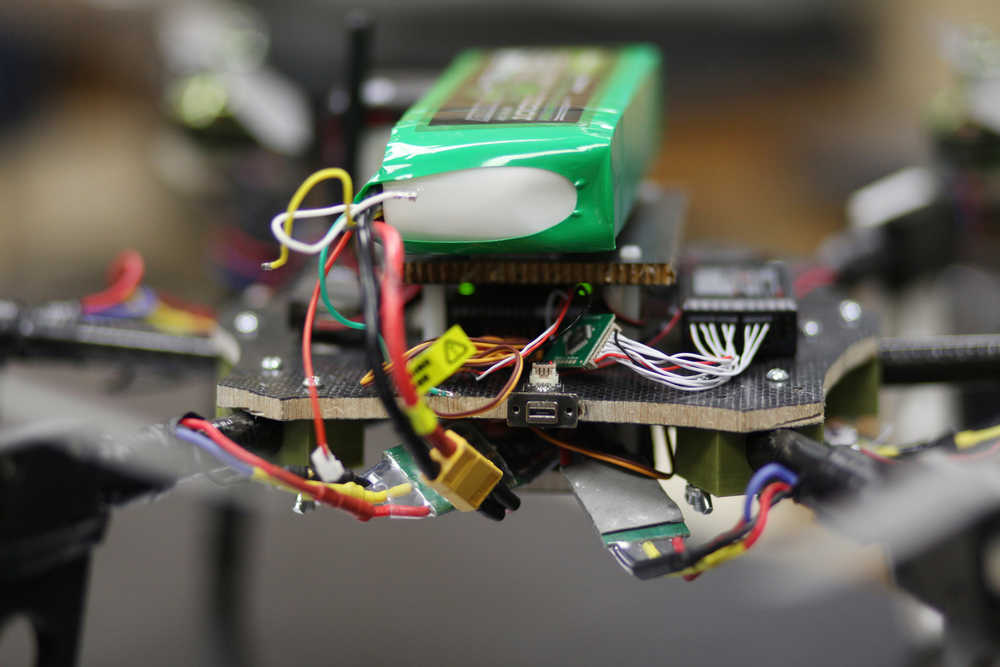
Photo by Kelly Sullivan/ Peninsula Clarion Students in Nikiski’s Upward Bound program build the drones they fly Wednesday, Dec. 9, 2015, at Nikiski Middle-High School in Nikiski, Alaska.
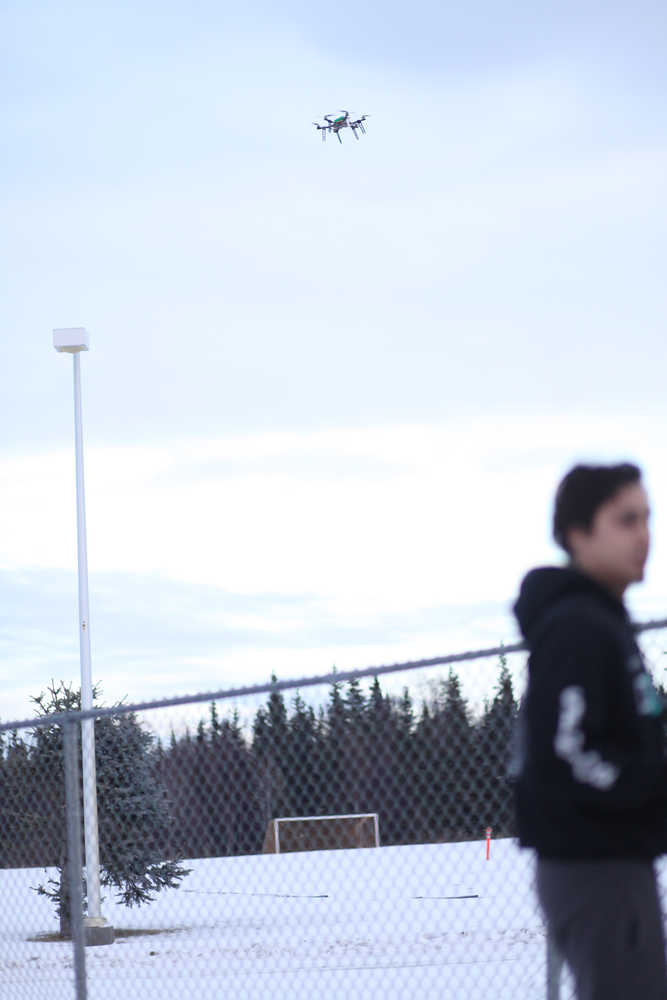
Photo by Kelly Sullivan/ Peninsula Clarion Senior Corin Cooper was in charge of manually flying the drone when autopilot was turned off, Wednesday, Dec. 9, 2015, at Nikiski Middle-High School in Nikiski, Alaska.
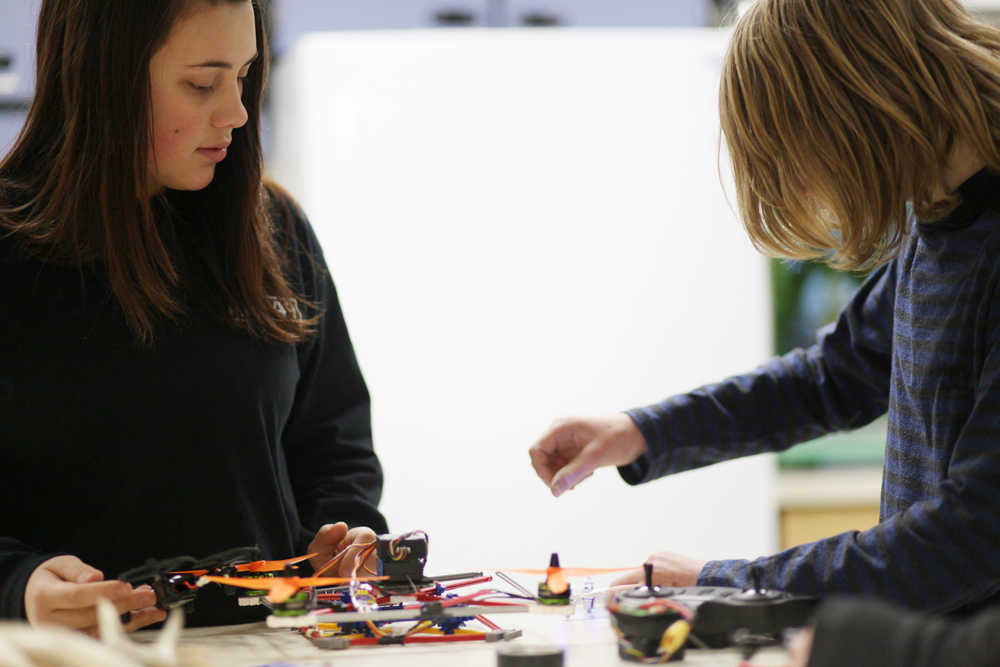
Photo by Kelly Sullivan/ Peninsula Clarion Seventh grader Brady Evoy shows eleventh grader Ceyara Showalter a few things about small drones, Wednesday, Dec. 9, 2015, at Nikiski Middle-High School in Nikiski, Alaska. Showalter recently joined the program and is still getting caught up, she said.
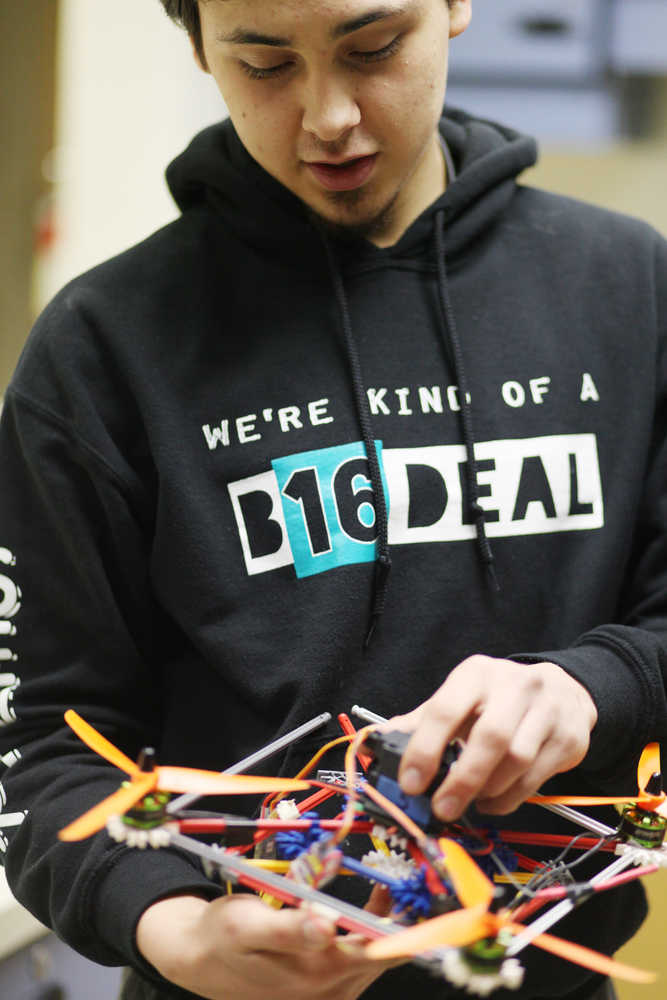
Photo by Kelly Sullivan/ Peninsula Clarion Senior Corin Cooper explains some of his first experiences flying drones Wednesday, Dec. 9, 2015, at Nikiski Middle-High School in Nikiski, Alaska.
