
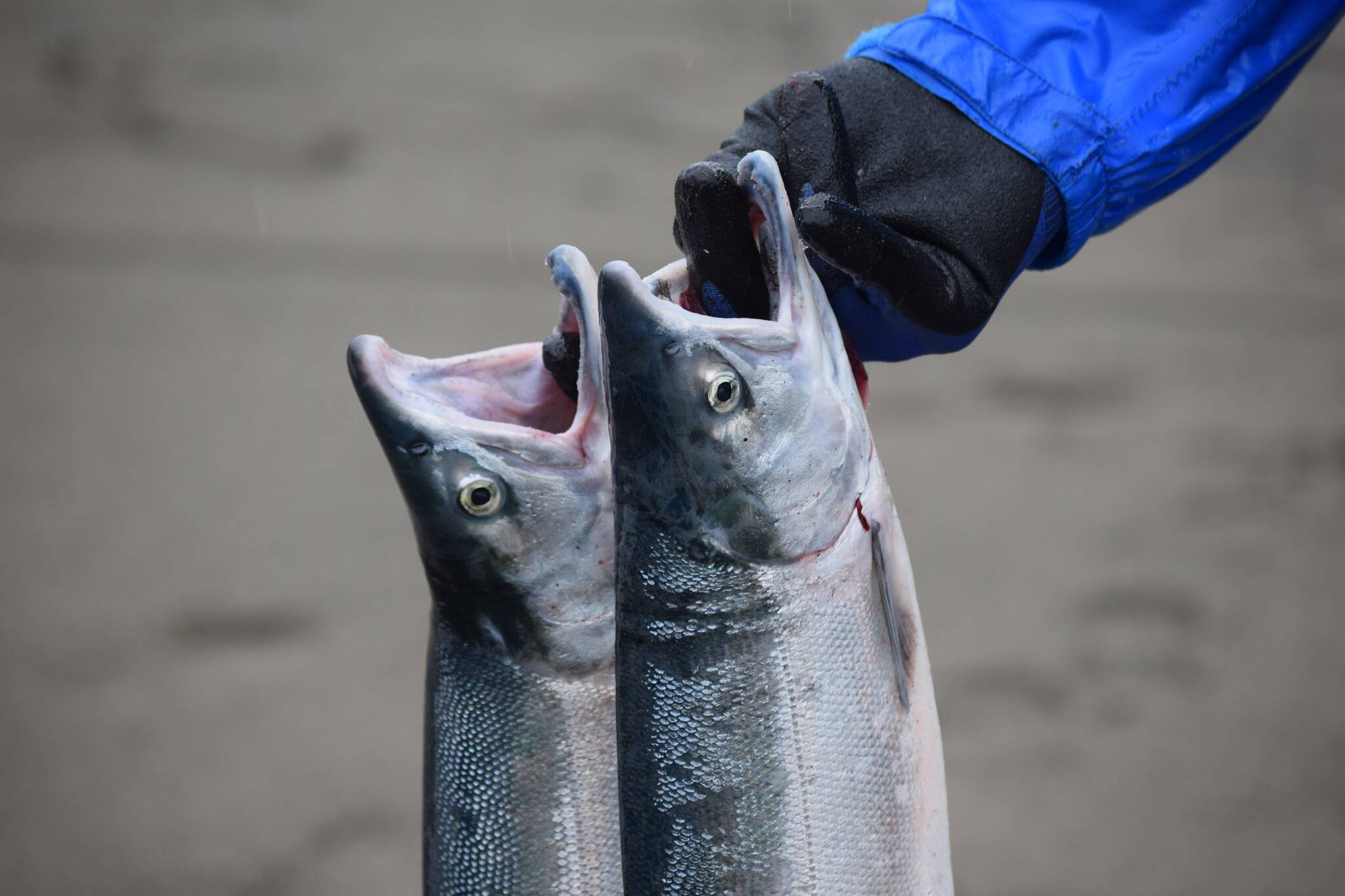
Raymond Bradbury preserves his salmon while dipnetting in the mouth of the Kenai River on Saturday, July 10, 2021. (Camille Botello / Peninsula Clarion)

Raymond Bradbury preserves his salmon while dipnetting in the mouth of the Kenai River on Saturday, July 10, 2021. (Camille Botello / Peninsula Clarion)

Fish and Game projects ‘average’ sockeye run for 2023 season

Annual projection and review of last season published last week

The State Department of Fish and Game last week published its annual statewide salmon run forecast and commercial harvest projections, as well as a review of last year’s season.

Cook Inlet is divided into the Upper and Lower Cook Inlet by the department, around the longitude line of Anchor Point on the Southern Kenai Peninsula.

In the Upper Cook Inlet, which includes the Kenai and Kasilof Rivers, the department is projecting an “average” season for sockeye salmon, with a total run forecast of 5.12 million fish. That forecast is the largest for the species since 2019.

Of that run, the department says it estimates that 3.12 million fish will be available for harvest across the commercial, sport, personal use and subsistence fisheries.

For Kenai River, the forecast is 2.82 million sockeye, around 765,000 fewer than the historical average of 3.59 million. The prediction is also fewer than last year’s forecast.

In the Kasilof River, the forecast is 1,126,000 sockeye. That count is greater than any projection for the river in the last 10 years and exceeds the historical average by around 180,000.

In the Upper Cook Inlet, the commercial harvest forecast for pink salmon is 83,000, chum at 89,000 and coho at 157,000.

The report also includes detailed reports about last year’s salmon season.

In the Upper Cook Inlet, sockeye salmon runs in 2022 exceeded preseason forecasts by 300,000 fish, with a total estimated run of 5.2 million.

The commercial salmon fishery harvest was 1.4 million, falling 44% below the 10-year average harvest, which is 2.5 million. That harvest was composed of around 2,000 chinook, 1.1 million sockeye, 103,000 coho, 101,000 pink and 99,000 chum.

As sockeye salmon runs were exceeding forecasts, the report said, chinook runs fell below forecasts in the 2022 season, resulting in the closures of fisheries to reduce chinook harvest. In the Kasilof and Kenai River, this was in pursuit of meeting optimal escapement goals set by the Board of Fisheries. That OEG is 15,000-30,000 large chinook salmon — greater than around 34 inches. The run was estimated to be 13,425, falling below the OEG.

The OEG has not been met in the fishery since it was implemented in 2020.

Chinook runs in the Anchor River and the Ninilchik River also failed to meet sustainable escapement goals.

Commercial harvest of chinook in the region was 2,278 fish. The East Side Setnet fishery harvested 341 of those, 32 of which were of large Kenai River late-run origin. The drift gillnet fishery harvested 167 chinook.

Sockeye abundance fell below forecasts in the Kenai River by 220,000 fish, but exceeded forecasts by 554,000 in the Kasilof River. Sockeye met SEG in the Kenai River, and exceeded the OEG in the Kasilof River by around 600,000 fish.

Sockeye harvest fell below the 10-year average in every part of the Central District, including the Kenai River and the Kasilof River.

The report said there are four coho salmon systems in the Upper Cook Inlet with escapement goals. Floods left counts incomplete at three of them. The fourth is an on-foot survey in Jim Creek, which was found to exceed its SEG.

All coho salmon commercial harvests in the Upper Cook Inlet fell below their 10-year averages.

Pink salmon harvests are even-year dominant in the Upper Cook Inlet, the report said. Last year’s harvest of 100,998 fish fell far below the 10-year average for those even-year seasons, which is 363,813 fish.

Chum salmon harvest also fell below averages.

To view the full report, search for “Run forecasts and harvest projections for 2023 Alaska salmon fisheries and review of the 2022 season” at adfg.alaska.gov.

Reach reporter Jake Dye at jacob.dye@peninsulaclarion.com.

More in News

David Ross is sworn in as Kenai Police Chief on Tuesday, May 31, 2016 at Kenai City Hall. The Alaska Association of Chiefs of Police named Ross the 2025 Police Chief of the Year, recognizing over two decades of service. Photo by Megan Pacer/Peninsula Clarion
Kenai police chief named 2025 Police Chief of the Year

The Alaska Association of Chiefs of Police recognized David Ross for his more than two decades of leadership.

The cast of Nikiski Middle School’s upcoming performance of “Alice in Wonderland” is pictured on Dec. 2, 2025. The upperclassmen-directed play opens on Friday, with additional showtimes Saturday and next weekend. Photo courtesy of Carla Jenness
Nikiski Middle School debuts student-led “Alice in Wonderland”

The show opens on Friday, with additional showtimes this weekend and next.

On Tuesday, the Kenaitze Indian Tribe unveiled Kahtnu Area Transit, a public transportation service open to the entire Peninsula Borough community. Photo courtesy of Kahtnu Area Transit
Kenaitze Indian Tribe unveils Kahtnu Area Transit

The fixed bus route offers 13 stops between Nikiski and Sterling.

The Kenai Chamber of Commerce and Visitor Center hosts the annual Christmas Comes to Kenai on Nov. 28<ins>, 2025</ins>. The beloved event began over 40 years ago, and this year over 1,000 attendees enjoyed hot chocolate, fireworks, pictures with Santa and shopping. Photo courtesy of the Kenai Chamber of Commerce
 Photo courtesy of the Kenai Chamber of Commerce
The Kenai Chamber of Commerce and Visitor Center hosted the annual Christmas Comes to Kenai on Nov. 28. The beloved event began over 40 years ago, and this year over 1,000 attendees enjoyed hot chocolate, fireworks, pictures with Santa and shopping.
Kicking off a month of holiday festivities

Last weekend’s holiday events, including the annual Christmas Comes to Kenai and the Soldotna Turkey Trot, drew folks from all over the Kenai Peninsula.

Starting Dec. 2, Aleutian Airways will offer roundtrip flights between Anchorage and Unalakleet every Tuesday, Friday and Sunday.
Aleutian Airways to offer roundtrip flights between Anchorage and Unalakleet

Starting Dec. 2, Aleutian Airways will offer three roundtrip flights per week.

The Trump administration’s “Big Beautiful Bill” act requires the Bureau of Ocean Energy management to hold at least six offshore oil and gas lease sales in Alaska between 2026-2028 and 2030-2032. The first of these sales — known as “Big Beautiful Cook Inlet 1,” or BBC1— is scheduled for March 2026. Photo courtesy of the Bureau of Ocean Energy Management
Cook Inletkeeper launches petition against federal government

The organization is calling for transparency in Cook Inlet offshore oil and gas sales.

Winter dining has always carried more weight than the menu might suggest. In the off-season, eating out isn’t just about comfort food or convenience; it’s a way of supporting local businesses as they hold steady through the slower months. Photo credit: Canva.
The ripple effect: How local spending builds stronger communities on the Kenai Peninsula

From cozy cafés to fine-dining bistros, purchases made close to home sustain local jobs and services

Courtesy Harvest
On the Kenai Peninsula, a dormant liquefied natural gas export plant could be repurposed to receive cargoes of imported LNG under a plan being studied by Harvest, an affiliate of oil and gas company Hilcorp. The fuel would be transferred from ships to the tanks on the left, still in liquid form, before being converted back into gas and sent into a pipeline.
Utilities say Alaska needs an LNG import terminal. Consumers could end up paying for two.

Planning for two separate projects is currently moving ahead.

A map shows the locations of the 21 Alaska federal offshore oil and gas lease sales proposed by the Trump administration. (Map provided by the U.S. Bureau of Ocean Energy Management)
Trump administration proposes offshore leasing in almost all Alaska waters

A new five-year offshore oil and gas leasing plan proposes 21 sales in Alaska, from the Gulf of Alaska to the High Arctic, and 13 more off the U.S. West Coast and in the Gulf of Mexico.

Most Read